
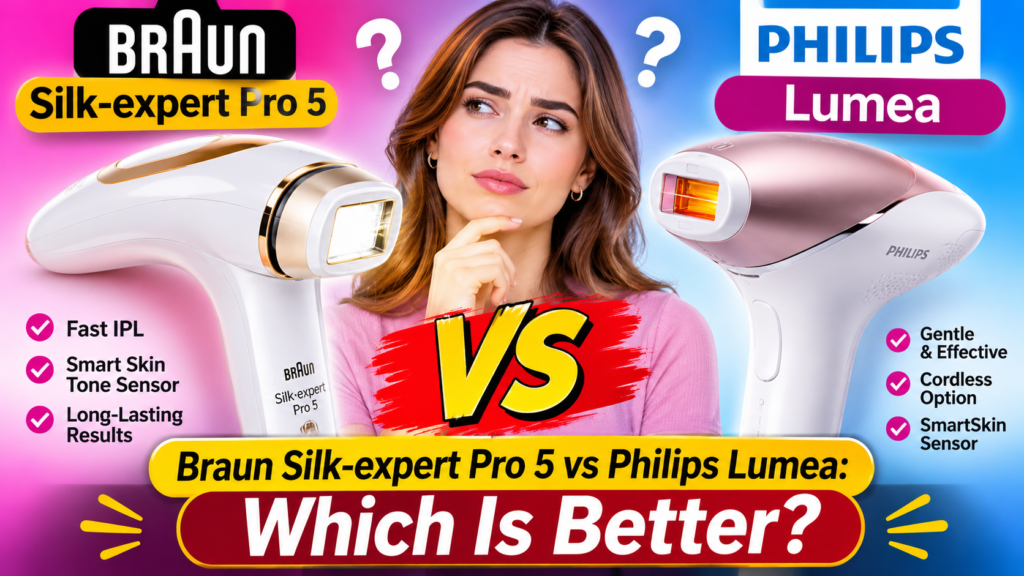
Choosing between the Braun Silk-expert Pro 5 and the Philips Lumea is one of the most common dilemmas for anyone investing in at-home IPL hair removal. Both devices dominate the market, both carry premium price tags, and both promise significant hair reduction without salon visits. But they take meaningfully different approaches to getting you there.
This comparison breaks down the Braun Silk-expert Pro 5 vs Philips Lumea 9900 Series across every factor that actually matters — from skin-tone sensing and treatment speed to comfort, attachments, and long-term value — so you can choose the right device for your skin, hair, and lifestyle.
Braun Silk-expert Pro 5 vs Philips Lumea: Quick Comparison
| Feature | Braun Silk-expert Pro 5 | Philips Lumea 9900 Series |
|---|---|---|
| IPL Technology | IPL with SensoAdapt™ | IPL with SenseIQ |
| Skin-Tone Sensor | Continuous (80×/sec) | SmartSkin (pre-treatment) |
| Intensity Settings | 10 levels | 5 levels |
| Flash Lifespan | 400,000 flashes | 450,000 flashes |
| Treatment Speed | Up to 125 flashes/min | Up to ~75 flashes/min |
| Attachments | 3 (standard, wide, precision) | 4 (body, face, bikini, underarm) |
| Corded / Cordless | Corded only | Corded and cordless |
| App Support | Braun Skin i-Expert | Philips Lumea IPL App |
| Treatment Areas | Legs, arms, underarms, bikini, face | Legs, arms, underarms, bikini, face |
| Approximate Price | $300–$400 | $450–$550 |
| Best For | Speed and simplicity | Versatility and cordless freedom |
Prices vary by retailer and kit configuration. Always check current availability.
Braun Silk-expert Pro 5 Overview
The Braun Silk-expert Pro 5 is Braun’s flagship IPL device, built around its SensoAdapt™ skin sensor that reads your skin tone 80 times per second and automatically adjusts flash intensity in real time. It offers 10 intensity levels, 400,000 flashes, and three comfort modes (Normal, Gentle, Extra Gentle). The device operates corded only, which keeps power consistent throughout every session.
Philips Lumea Overview
The Philips Lumea 9900 Series is Philips’ most advanced IPL system. It features SenseIQ technology, which uses a SmartSkin sensor to analyze your skin tone before treatment and recommend the optimal intensity setting. With 450,000 flashes, four curved attachments, and the ability to operate both corded and cordless, the Lumea 9900 prioritizes versatility and personalized treatment. Note that Philips Lumea spans multiple generations and model lines — this comparison focuses specifically on the 9900 Series to keep specifications accurate.
Design and Ease of Use
The Braun Pro 5 has a compact, gun-shaped design that feels lightweight and easy to maneuver across large areas like legs. Its corded design means you never worry about battery life mid-session, though you do need to stay near an outlet.
The Philips Lumea 9900 is slightly larger and heavier, partly because of its built-in battery. The cordless option is a genuine advantage for hard-to-reach areas or travel, though cordless mode delivers fewer flashes per charge. Both devices are straightforward to operate, but the Braun’s automatic intensity adjustment means fewer manual decisions during treatment.
Skin Tone Sensor: Which Device Is Better?
This is where the two devices diverge most significantly.
Braun’s SensoAdapt™ sensor reads your skin tone continuously — 80 times per second — and adjusts the flash intensity with every single pulse. If you move from a lighter area to a slightly darker patch, the device responds instantly. This real-time adaptation provides an extra layer of safety and consistency across uneven skin tones.
Philips’ SmartSkin sensor works differently. You press the sensor against your skin before starting, and it recommends one of five intensity levels. Once set, the device maintains that level until you manually change it. The SenseIQ technology then tracks your treatments over time and adapts recommendations through the companion app.
Bottom line: Braun’s continuous sensing is more responsive during a single session. Philips’ approach is simpler but requires you to re-check if you move to a body area with a noticeably different skin tone.
Hair Reduction Results: Which Works Better?
Both manufacturers claim significant hair reduction after a series of treatments. Braun states that users can see visible results after four weeks of weekly sessions. Philips reports up to 92% hair reduction after three treatments with the Lumea 9900, based on internal clinical studies.
However, it is important to understand what these claims mean in practice. The American Academy of Dermatology notes that light-based hair removal works best on dark hair against lighter skin, and that results vary significantly between individuals. Neither device permanently eliminates all hair for every user. Most people experience substantial thinning and slower regrowth, with periodic maintenance sessions needed to sustain results.
Realistic expectations: anticipate noticeable reduction after 4–8 weekly sessions, with maintenance every 4–8 weeks afterward. Individual outcomes depend on hair color, skin tone, hormonal factors, and treatment consistency.
Treatment Speed and Convenience
The Braun Pro 5 is the faster device. At up to 125 flashes per minute on its fastest setting, you can treat both lower legs in roughly five minutes. This speed advantage matters if you plan to treat large areas regularly.
The Philips Lumea 9900 is slower, delivering roughly 75 flashes per minute depending on the attachment and intensity level. Full-leg treatments take noticeably longer. However, the cordless option adds convenience the Braun cannot match — you can treat your legs on the couch without worrying about cord reach.
Attachments and Treatment Areas
The Philips Lumea 9900 wins on attachment variety. It includes four curved attachments specifically shaped for the body, face, bikini area, and underarms. Each attachment is designed to optimize skin contact and light delivery for that zone.
The Braun Pro 5 typically ships with three attachments: a standard head, a wide head for large areas, and a precision head for smaller zones like the upper lip or chin. The attachments are flat rather than curved, which works well on flat surfaces but can be slightly less ergonomic on contoured areas like knees or ankles.
Both devices are suitable for legs, arms, underarms, bikini line, and face (below the cheekbones for women).
Comfort and Pain: Which Is More Comfortable?
IPL discomfort varies by individual, but most users describe the sensation as a warm snap or rubber-band flick.
The Braun Pro 5 offers three comfort modes. Normal mode delivers full intensity, Gentle mode reduces it, and Extra Gentle mode is designed for sensitive areas or first-time users. Because the SensoAdapt sensor automatically lowers intensity on darker skin patches, the Braun tends to feel more consistent across different body areas.
The Philips Lumea 9900 operates at five intensity levels. Lower settings are comfortable but less effective; higher settings deliver stronger results with more noticeable sensation. The curved attachments help maintain better skin contact, which can reduce the uneven flashes that sometimes cause stinging.
Neither device is painless, but both are generally well-tolerated. If you have a low pain threshold, start on the lowest setting with either device and increase gradually.
Safety for Different Skin Tones and Hair Colours
IPL technology targets melanin in the hair follicle, which means it works best when there is strong contrast between skin and hair color. Both devices are suitable for skin tones I–V on the Fitzpatrick scale and naturally dark blonde, brown, or black hair.
Neither device is safe for very dark skin (Fitzpatrick VI) or effective on red, light blonde, white, or grey hair. The Philips skin tone and hair colour compatibility guide provides a detailed chart to help you determine whether IPL is appropriate for your specific combination.
If you have recently tanned, take photosensitizing medications, or have a skin condition such as eczema or psoriasis in the treatment area, consult a dermatologist before using either device. The US FDA notes that clearance of radiation-emitting consumer products does not guarantee specific cosmetic outcomes, and users should follow all manufacturer safety instructions carefully.
Long-Term Value and Flash Lifespan
The Philips Lumea 9900 offers 450,000 flashes compared to the Braun Pro 5’s 400,000. In practical terms, both lifespans are more than sufficient for years of full-body treatments — most users will never exhaust either device’s flash count.
The bigger value question is price versus features. The Braun Pro 5 typically costs $100–$150 less than the Lumea 9900 while delivering faster treatments and more granular intensity control. The Lumea’s higher price reflects its cordless capability, additional attachment, and app-driven personalization.
Braun vs Philips: Which Is Better for Beginners?
The Braun Silk-expert Pro 5 is the more beginner-friendly option. Its automatic skin-tone sensing removes guesswork — you simply glide and flash. The three comfort modes make it easy to start gently and increase intensity as you build confidence.
The Philips Lumea requires slightly more initial setup (checking skin tone, selecting intensity, choosing the right attachment), but the companion app provides helpful treatment schedules and reminders that some beginners find reassuring.
Pros and Cons of Both Devices
Braun Silk-expert Pro 5
- ✅ Fastest treatment speed in its class
- ✅ Continuous skin-tone sensing for real-time safety
- ✅ 10 intensity levels for precise control
- ✅ Lower price point
- ❌ Corded only
- ❌ Fewer attachments than Lumea
- ❌ Flat attachments less ergonomic on curves
Philips Lumea 9900 Series
- ✅ Corded and cordless operation
- ✅ Four curved, area-specific attachments
- ✅ SenseIQ app personalization
- ✅ Slightly higher flash lifespan
- ❌ Slower treatment speed
- ❌ Higher price
- ❌ Skin-tone check is not continuous during treatment
Who Should Buy Braun Silk-expert Pro 5?
Choose the Braun if you prioritize treatment speed, want the most responsive skin-tone safety, and prefer a simpler, more affordable device. It is ideal for people treating large areas like legs and arms who want to finish sessions quickly. For those exploring at-home grooming as part of a broader self-care routine — such as the approach outlined in this men’s skincare guide — the Braun’s straightforward operation makes it an easy addition.
Who Should Buy Philips Lumea?
Choose the Philips Lumea 9900 if you value cordless flexibility, want area-specific curved attachments, and appreciate app-guided treatment tracking. It is a strong choice for people who travel frequently, want the most versatile attachment set, or prefer a more personalized treatment experience and don’t mind spending extra time per session.
Final Verdict: Which IPL Device Should You Buy?
There is no single winner in the Braun Silk-expert Pro 5 vs Philips Lumea comparison — the best choice depends on your priorities.
Buy the Braun Silk-expert Pro 5 if speed, simplicity, and value matter most. Its continuous skin-tone sensing and rapid flash rate make it the most efficient at-home IPL device available.
Buy the Philips Lumea 9900 if versatility and cordless convenience are your top priorities. Its four curved attachments and app integration provide a more tailored experience for users willing to invest extra time and money.
Both devices are capable of delivering significant, long-lasting hair reduction when used consistently and correctly.
Frequently Asked Questions
1. Is Braun Silk-expert Pro 5 better than Philips Lumea?
Neither is universally better. The Braun excels in speed and automatic skin-tone adjustment, while the Philips Lumea offers cordless use and more attachments. Your best choice depends on your specific needs and budget.
2. Which IPL device gives faster results?
Both devices deliver comparable results over a similar timeline. Most users see noticeable hair reduction after 4–8 weekly sessions with either device. The Braun treats areas faster per session, but overall hair reduction timelines are similar.
3. Is Philips Lumea less painful than Braun?
Pain perception is highly individual. Both devices offer lower-intensity settings for sensitive areas. The Braun’s Extra Gentle mode and the Lumea’s lower intensity levels provide comparable comfort for most users.
4. Which device is better for sensitive skin?
The Braun Pro 5’s Extra Gentle mode and continuous skin-tone sensing make it slightly more forgiving for sensitive skin, as it automatically reduces intensity on darker or more reactive patches during treatment.
5. Can both devices be used on the face?
Yes. Both devices include facial attachments suitable for use below the cheekbones on women. Neither should be used near the eyes or on the male beard area, where dense hair can cause excessive heat buildup.
6. Which IPL device is better for dark skin?
Both devices are suitable for skin tones up to Fitzpatrick V. The Braun’s continuous SensoAdapt sensor provides real-time adjustments that may offer a slight safety advantage for darker skin tones within the compatible range. Neither device is safe for Fitzpatrick VI skin.
7. How long do Braun and Philips IPL results last?
After completing an initial treatment phase, results typically last several weeks to months. Maintenance sessions every 4–8 weeks are recommended to sustain hair reduction. Individual results vary based on hair type, hormones, and consistency.
8. Can you use IPL devices every week?
Both manufacturers recommend weekly treatments during the initial phase (typically 4–12 weeks). After that, you transition to maintenance sessions every 2–8 weeks. Do not treat the same area more than once per week.
9. Is Braun Silk-expert Pro 5 worth the money?
For most users, yes. The Braun Pro 5 delivers fast, effective treatments with excellent safety features at a lower price point than the Lumea 9900. Its 400,000-flash lifespan provides years of use.
10. Is Philips Lumea worth buying in 2026?
Yes, if its features align with your needs. The cordless capability, four curved attachments, and SenseIQ app integration justify the higher price for users who value versatility and personalization over raw treatment speed.
Final SEO Deliverables
1. SEO Title:
Braun Silk-expert Pro 5 vs Philips Lumea: Which IPL Device Is Better?
2. Meta Description:
Compare the Braun Silk-expert Pro 5 and Philips Lumea 9900 across speed, comfort, skin safety, and value. Find out which at-home IPL device is right for you.
3. URL Slug:braun-silk-expert-pro-5-vs-philips-lumea
4. Primary Focus Keyword:
Braun Silk-expert Pro 5 vs Philips Lumea
5. Secondary Keywords:
Braun vs Philips IPL, Braun Silk-expert Pro 5 review, Philips Lumea review, best at-home IPL hair removal device, Braun IPL vs Philips IPL, Philips Lumea 9900 vs Braun Pro 5, Braun or Philips hair removal device, at-home IPL comparison
6. Suggested Featured Image Alt Text:
Braun Silk-expert Pro 5 and Philips Lumea 9900 IPL hair removal devices side by side comparison on white background
7. Internal Link Audit:
| URL | Anchor Text | Section | Status |
|---|---|---|---|
| https://sylomaskincare.com/simple-skincare-routine-men/ | “men’s skincare guide” | Who Should Buy Braun | Verified (provided by client) |
Note: Only one internal URL was confirmed as live and relevant. No additional internal links were fabricated. Recommend creating dedicated IPL or hair removal articles on Syloma Skincare to enable richer internal linking in future updates.
8. External Link Audit:
| # | Source | URL | Anchor Text | Section |
|---|---|---|---|---|
| 1 | Braun Official | https://us.braun.com/en-us/female-hair-removal/ipls/silk-expert-pro-ipl | “Braun Silk-expert Pro 5” | Braun Overview |
| 2 | Philips Lumea Official | https://www.philips.co.uk/c-p/BRP958_00/lumea-ipl-9900-series-ipl-hair-removal-device-with-senseiq | “Philips Lumea 9900 Series” | Philips Overview |
| 3 | Philips Skin Tone Guide | https://www.philips.co.in/c-f/XC000003324/is-philips-lumea-suitable-for-all-skin-tones-and-body-hair-colors | “Philips skin tone and hair colour compatibility guide” | Safety |
| 4 | American Academy of Dermatology | https://www.aad.org/public/cosmetic/hair-removal/laser-hair-removal-faqs | “American Academy of Dermatology” | Hair Reduction Results |
| 5 | US FDA | https://www.fda.gov/radiation-emitting-products/electronic-product-radiation-control-program/getting-radiation-emitting-product-market-frequently-asked-questions | “US FDA notes” | Safety |
All five external links are incorporated naturally where they support the surrounding claims. No research findings are fabricated or misattributed.