
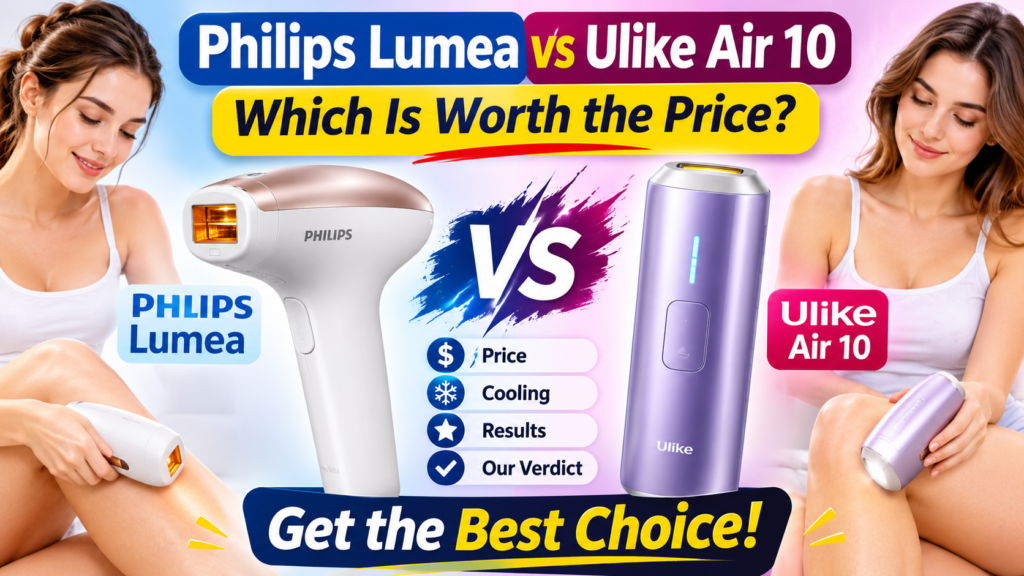
At-home IPL hair removal has matured to the point where two devices genuinely compete for the premium spot in your bathroom drawer: the Philips Lumea 9000 Series and the Ulike Air 10. One leans on years of dermatological research and smart sensor technology. The other brings aggressive cooling and dual-light engineering at a noticeably lower price. The real question isn’t which device flashes brighter — it’s whether the Philips Lumea’s higher price tag actually buys you better long-term results, or whether the Ulike Air 10 delivers comparable hair reduction for significantly less. This comparison breaks down every specification, comfort factor, and cost detail that matters before you click “add to cart.”
Quick Comparison: Philips Lumea 9000 vs Ulike Air 10
| Feature | Philips Lumea 9000 (BRI957) | Ulike Air 10 |
|---|---|---|
| Technology | IPL with SenseIQ | IPL with Dual Lights + SHR |
| Price (MSRP) | ~$549 | ~$379 |
| Cooling System | Passive (no active cooling) | Sapphire Ice Cooling 3.0 |
| Skin-Tone Sensor | SmartSkin sensor (auto-adjusts) | SkinSensor (auto-detects) |
| Attachments | 4 curved (body, face, bikini, underarm) | 1 universal window |
| Treatment Modes | 5 intensity levels | 4 modes (Gentle, Normal, SHR, Power) |
| Corded / Cordless | Both | Corded only |
| App Support | Philips Lumea app | No dedicated app |
| Flash Rate | ~0.5 sec (corded) | ~0.6–1.0 sec (varies by mode) |
| Warranty | 2 years | 2 years |
| Best For | Guided, multi-zone treatments | Comfort-first, fast sessions |
Philips Lumea 9000 Series Overview
The Philips Lumea 9000 Series (model BRI957) is the flagship of Philips’ IPL lineup. Its headline feature is SenseIQ technology, which uses a SmartSkin sensor to read your skin tone before each session and recommend the optimal intensity setting automatically. The device ships with four curved attachments — body, face, bikini, and underarm — each engineered to maintain consistent skin contact on different contours.
Philips also offers a companion Lumea app that builds a personalized treatment calendar and tracks your progress over time. The device operates both corded and cordless, though corded mode delivers faster flash rates. Philips rates the lamp at approximately 450,000 flashes, which the brand states is enough for roughly 20 years of full-body treatments.
Advantages: Intelligent skin sensing, dedicated attachments for precision areas, cordless flexibility, app-guided scheduling.
Disadvantages: No active cooling system, higher retail price, cordless mode reduces flash speed.
Ulike Air 10 Overview
The Ulike Air 10 takes a different engineering approach. Its Dual Lights technology fires two IPL lamps simultaneously, which Ulike claims increases energy output and coverage per flash. The standout feature is Sapphire Ice Cooling 3.0, which actively chills the treatment window to around 65°F during use — a meaningful comfort upgrade for sensitive areas like the bikini line and upper lip.
The Air 10 includes a SkinSensor that detects your skin tone and adjusts intensity, plus an SHR (Super Hair Removal) mode that delivers rapid, lower-energy pulses for gradual heating of the follicle. Four treatment modes — Gentle, Normal, SHR, and Power — let you customize sessions by body zone and pain tolerance. AutoGlide enables continuous flashing as you slide the device across larger areas like legs.
Advantages: Active sapphire cooling, dual-light output, SHR mode for sensitive zones, lower price point.
Disadvantages: Corded only, single treatment window (no dedicated attachments), no companion app.
Philips Lumea vs Ulike Air 10: Key Differences
IPL Performance and Hair Reduction
Both devices use broad-spectrum IPL to target melanin in the hair follicle. Philips relies on optimized single-lamp pulses calibrated by SenseIQ, while Ulike’s dual-lamp design aims to deliver higher cumulative energy per flash. Manufacturer-reported hair reduction figures for both devices reach up to 92% after a full initial treatment cycle, though individual results vary based on hair color, skin tone, and consistency. Independent reviewers at Tom’s Guide noted visible reduction with the Air 10 within three to four weeks of consistent use.
Treatment Speed
The Lumea 9000 flashes roughly every 0.5 seconds in corded mode, making full-leg sessions relatively quick. The Ulike Air 10’s flash rate varies by mode — SHR fires faster but at lower energy, while Power mode slows the cadence. For large areas, the Lumea holds a slight speed advantage; for smaller zones, the difference is negligible.
Comfort and Cooling
This is the widest gap between the two. The Ulike Air 10’s sapphire cooling plate actively lowers skin surface temperature during each flash, which significantly reduces the hot, rubber-band-snap sensation many IPL users describe. The Lumea 9000 has no active cooling. If comfort is your primary concern — especially for bikini, underarm, or facial treatments — the Ulike has a clear edge.
Attachments and Versatility
Philips wins here. Four purpose-built, curved attachments ensure better skin contact on the face, bikini line, and underarms compared to Ulike’s single flat window. Better contact means more consistent energy delivery and fewer missed spots.
Ease of Use
The Lumea’s app provides structured treatment plans and reminders, which is genuinely helpful for IPL beginners who might otherwise lose track of their schedule. The Ulike is simpler — plug in, select a mode, and go. Simplicity is an advantage for experienced users but a disadvantage for those who want guidance.
Treatment Schedule and Maintenance
Both brands recommend an initial phase of weekly treatments for 8–12 weeks, followed by maintenance sessions every two to four weeks. Long-term maintenance requirements are comparable, though individual hair regrowth patterns will differ.
Price Comparison: Which Offers Better Value?
At the time of writing, the Philips Lumea 9000 Series (BRI957) retails for approximately $549 on the Philips US website, though seasonal promotions occasionally bring it closer to $499. The Ulike Air 10 lists at approximately $379 on Ulike’s official store, with frequent promotional pricing around $299–$329.
That’s a price gap of roughly $170–$250 depending on current sales.
What does the Philips premium buy you? Four precision attachments, cordless operation, app-guided treatment planning, and the SenseIQ auto-adjustment system. What does Ulike offer that Philips doesn’t? Active sapphire cooling, dual-light output, and SHR mode — all at a lower price.
If you value comfort and don’t need cordless freedom, the Ulike Air 10 delivers strong performance per dollar. If you want the most guided, multi-zone experience and don’t mind paying more, the Lumea 9000 justifies a portion of its premium through its attachment system and smart features.
Which Device Is Better for Different Buyers?
- Budget-conscious buyers: Ulike Air 10. Lower MSRP, frequent promotions, and comparable core IPL performance.
- Buyers who prioritize comfort: Ulike Air 10. Sapphire Ice Cooling is the single biggest comfort differentiator in this comparison.
- People who want dedicated attachments: Philips Lumea 9000. Four curved attachments provide better contact on tricky areas.
- IPL beginners: Philips Lumea 9000. The companion app and SmartSkin sensor reduce guesswork. For a broader look at entry-level options, see our guide to the best at-home IPL hair removal devices.
- People who prefer app-guided treatments: Philips Lumea 9000. Ulike does not currently offer a companion app.
- Buyers with sensitive skin: Ulike Air 10 in Gentle or SHR mode. The active cooling makes a real difference on reactive skin.
Skin Tone and Hair Colour Compatibility
IPL technology works by targeting melanin contrast between hair and skin. Both devices are most effective on light to medium skin tones (Fitzpatrick I–IV) with dark blonde to black hair. Neither device is suitable for very dark skin tones or for red, grey, white, or very light blonde hair.
The Philips Lumea SmartSkin sensor and the Ulike SkinSensor both automatically detect skin tone and block flashes if the skin is too dark for safe treatment. However, you should always consult the Philips skin tone compatibility chart and the Ulike user manual before your first session. Recent tanning — natural or artificial — can temporarily shift your skin tone into an unsafe range for IPL use.
Pros and Cons at a Glance
Philips Lumea 9000
✅ SmartSkin auto-adjustment · ✅ Four precision attachments · ✅ Cordless option · ✅ Companion app · ✅ 450,000-flash lamp
❌ No active cooling · ❌ Higher price · ❌ Slower in cordless mode
Ulike Air 10
✅ Sapphire Ice Cooling · ✅ Dual Lights + SHR mode · ✅ Lower price · ✅ Four treatment modes · ✅ AutoGlide
❌ Corded only · ❌ Single treatment window · ❌ No companion app
Potential Side Effects and Safety Precautions
Both devices can cause temporary redness, mild warmth, or slight irritation immediately after treatment. These effects typically resolve within a few hours. More serious risks — including burns, blistering, and hyperpigmentation or hypopigmentation — are rare but possible, particularly if used on incompatible skin tones, over tattoos or dark moles, or while taking photosensitizing medications (certain antibiotics, retinoids, and acne treatments).
Always perform a patch test 24 hours before your first full session. Follow the exact treatment intervals in each device’s manual. Do not use either device on broken skin, active sunburn, or areas with permanent makeup. If you have a medical condition that affects skin healing or pigmentation, consult a board-certified dermatologist before starting at-home IPL. For a deeper dive into one of these devices, our Ulike Air 10 review covers safety details in greater depth.
Final Verdict: Which Is Worth the Price?
There is no universal winner in the Philips Lumea vs Ulike Air 10 comparison — only the right choice for your priorities.
Choose the Philips Lumea 9000 if you want the most guided, attachment-rich experience with cordless flexibility and don’t mind paying a premium for smart sensor technology and app integration.
Choose the Ulike Air 10 if comfort is non-negotiable, you want effective cooling for sensitive zones, and you’d rather save $150–$250 without sacrificing core hair-reduction performance.
For most buyers — especially those treating sensitive areas — the Ulike Air 10’s sapphire cooling and lower price make it the stronger value proposition. The Lumea 9000 earns its premium for users who specifically need precision attachments and structured app guidance.
Frequently Asked Questions
Is Philips Lumea better than Ulike Air 10?
Not categorically. The Lumea 9000 offers more attachments, cordless use, and app guidance. The Ulike Air 10 offers active cooling, dual-light technology, and a lower price. “Better” depends on which features matter most to you.
Is Ulike Air 10 worth the money?
For most users, yes. At roughly $300–$379, it delivers effective IPL performance with sapphire cooling — a feature the Lumea lacks entirely. Independent reviews, including Prevention’s Ulike Air 10 assessment, confirm visible results within a few weeks of consistent use.
Does Philips Lumea work faster than Ulike?
In corded mode, the Lumea 9000 flashes slightly faster (~0.5 seconds vs. ~0.6–1.0 seconds for the Air 10). The real-world difference across a full-leg session is a few minutes at most.
Which device is more comfortable?
The Ulike Air 10. Its Sapphire Ice Cooling 3.0 actively chills the skin during each flash, significantly reducing the heat sensation that IPL typically produces.
Can both devices be used on sensitive skin?
Yes, with caveats. Both include skin-tone sensors and lower-intensity settings. The Ulike Air 10’s SHR and Gentle modes, combined with active cooling, make it the more comfortable option for reactive or sensitive skin.
How long do IPL results last?
After completing the initial 8–12 week treatment cycle, most users see significant hair reduction lasting several months. Maintenance sessions every two to four weeks help sustain results. Individual outcomes depend on hair color, hormonal factors, and treatment consistency.
Is Philips Lumea worth paying more for?
If you value four precision attachments, cordless operation, and app-guided scheduling, the premium is defensible. If your main concern is comfort and effective hair reduction, the Ulike Air 10 delivers comparable results at a lower cost.
Which IPL device is better for beginners?
The Philips Lumea 9000, thanks to its companion app and SmartSkin sensor that removes most of the guesswork. That said, the Ulike Air 10’s straightforward four-mode system is also beginner-friendly. For a broader comparison of top-rated options, see our Braun Silk-expert Pro 5 vs Philips Lumea comparison.
Editorial Note to Publisher: Internal links to Syloma Skincare articles (best-at-home-ipl-hair-removal-devices, ulike-air-10-review, braun-silk-expert-pro-5-vs-philips-lumea) use slug-based URLs derived from the article titles provided in the brief. Please verify each URL against the live Syloma Skincare sitemap before publishing. If any article is not yet live, remove the corresponding link to avoid 404 errors.
Suggested Image Alt Text:
- Philips Lumea 9000 and Ulike Air 10 side-by-side on a white bathroom counter
- Comparison table of Philips Lumea 9000 vs Ulike Air 10 specifications
- Close-up of Ulike Air 10 sapphire cooling window during treatment
- Philips Lumea 9000 curved attachment for bikini area
- Woman using IPL device on lower leg at home