
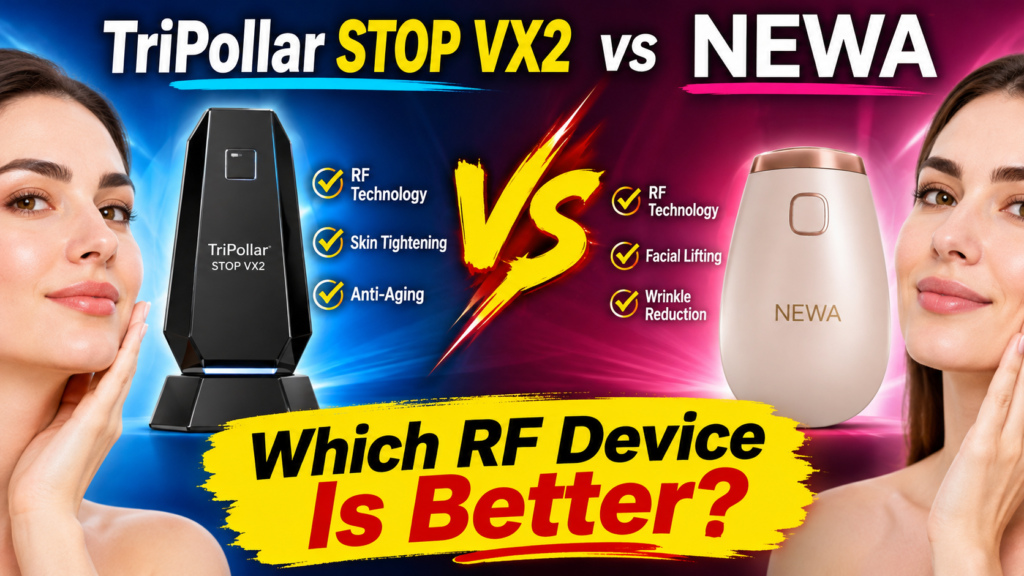
If you have narrowed your search for an at-home radiofrequency skin tightening device down to two names — TriPollar STOP VX2 and NEWA — you are looking at the two most established competitors in the consumer RF market. Both devices deliver controlled radiofrequency energy to the dermis to stimulate collagen production, and both come from companies with deep roots in professional aesthetic technology. But they differ significantly in how they deliver that energy, how long treatments take, what the ongoing costs look like, and what level of regulatory evidence backs their claims.
The short version: the TriPollar STOP VX2 offers a more feature-rich experience with multi-frequency RF and dynamic muscle activation, making it appealing to users who want advanced technology and shorter session times. The NEWA device leans on its clinically studied 3DEEP RF platform and FDA De Novo authorization, making it a strong choice for buyers who prioritize regulatory documentation and a structured, zone-based treatment protocol. Neither device is universally “better.” The right choice depends on your budget, your patience for treatment routines, and how much weight you place on specific types of clinical evidence.
This article breaks down every meaningful difference between the two devices so you can make an informed purchase.

- AIDS IN COLLAGEN PRODUCTION: new Triple-Wave Multi-RF Technology delivers interchanging RF waves that comb the dermis la…
- PERSONALIZED TREATMENT: 2nd Generation Thermal Mapping provides the skin with the most accurate temperature for effectiv…
- PLEASANT TREATMENT & SUPERIOR RESULTS: the 3rd Generation features automatically adjusts in real-time to ensure a pleasa…
TriPollar STOP VX2 vs NEWA: Quick Comparison
| Feature | TriPollar STOP VX2 | NEWA |
|---|---|---|
| RF Technology | Multi-RF (multiple frequencies) + DMA (Dynamic Muscle Activation) | 3DEEP RF (phase-controlled, multi-electrode) |
| Total Treatment Time | ~12–15 minutes per session | ~24–28 minutes (4 min per zone × 6–7 zones) |
| Initial Treatment Schedule | 2–3 sessions per week for 6–8 weeks | 3 sessions per week for 4 weeks |
| Maintenance Schedule | 1–2 sessions per month | 1–2 sessions per week |
| Conductive Gel | TriPollar Preparation Gel (required) | NEWA Activator Gel (required) |
| Power Source | Corded (wall outlet) | Corded (wall outlet) |
| Treatment Areas | Full face, jawline, neck, décolletage | Full face divided into 6–7 treatment zones |
| Temperature Monitoring | Built-in thermal mapping with real-time feedback | Built-in skin temperature sensor with LED indicator |
| Regulatory Evidence | TriPollar brand holds FDA clearances for prior STOP models; verify VX2-specific status | FDA De Novo authorization (DEN150005) for the NEWA Skin Care System |
| Approximate Price (USD) | $449–$549 | $299–$349 |
| Warranty | 1–2 years (varies by retailer) | 1 year |
| Manufacturer | Pollogen (a Lumenis company) | EndyMed / Home Skinovations |
Prices and warranty terms vary by retailer and region. Always verify current pricing before purchasing.
TriPollar STOP VX2 Review
RF Technology and Features
- AIDS IN COLLAGEN PRODUCTION: new Triple-Wave Multi-RF Technology delivers interchanging RF waves that comb the dermis la…
- PERSONALIZED TREATMENT: 2nd Generation Thermal Mapping provides the skin with the most accurate temperature for effectiv…
- PLEASANT TREATMENT & SUPERIOR RESULTS: the 3rd Generation features automatically adjusts in real-time to ensure a pleasa…
The TriPollar STOP VX2 is the latest iteration in Pollogen’s consumer RF lineup. It uses Multi-RF technology, which delivers radiofrequency energy at multiple frequencies simultaneously. The premise behind multi-frequency delivery is that different frequencies penetrate to different depths within the dermis, potentially allowing the device to heat a broader volume of tissue compared to single-frequency systems.
In addition to RF, the STOP VX2 incorporates DMA (Dynamic Muscle Activation). This technology delivers low-level electrical stimulation to the facial muscles during treatment. Pollogen positions DMA as a complement to RF heating, intended to promote muscle toning alongside collagen stimulation. Whether this combination produces meaningfully different results than RF alone in a home-use context is difficult to determine from publicly available data, but it does distinguish the STOP VX2 from most competing devices.
The device features a compact treatment head with multiple electrodes and is designed for use across the full face, jawline, neck, and upper chest area. You can review the full TriPollar STOP VX2 product specifications on the official Pollogen website for detailed technical parameters.
Thermal Mapping and Muscle Activation
One of the STOP VX2’s notable features is its thermal mapping system. The device monitors skin surface temperature in real time and adjusts energy output to maintain the skin within a target temperature range. This serves two purposes: it helps ensure the dermis reaches a temperature sufficient to trigger the wound-healing response associated with collagen remodeling, and it reduces the risk of overheating the epidermis.
The thermal feedback is indicated through LED lights on the device, giving users a visual cue about whether they are maintaining adequate contact and movement speed. This is particularly useful for beginners who may not yet have an intuitive sense of how quickly to glide the device.
The DMA muscle activation component operates concurrently with RF delivery. Users may feel a mild pulsing or tapping sensation during treatment, which is distinct from the warming sensation of the RF energy.
Treatment Routine
A typical TriPollar STOP VX2 session takes approximately 12 to 15 minutes for the full face. The initial treatment protocol recommends 2 to 3 sessions per week for 6 to 8 weeks. After completing the initial phase, Pollogen suggests transitioning to a maintenance schedule of 1 to 2 sessions per month.
The relatively short session time is one of the STOP VX2’s practical advantages. The trade-off is a longer initial treatment period (up to 8 weeks) before transitioning to maintenance, compared to NEWA’s 4-week intensive phase.
Pros and Cons
Pros:
- Short per-session treatment time (~12–15 minutes)
- Multi-frequency RF may target multiple dermal depths
- DMA muscle activation adds a feature not found in most competitors
- Real-time thermal mapping for temperature feedback
- Suitable for face, neck, and décolletage
- Lower maintenance frequency after initial phase
Cons:
- Higher upfront price point ($449–$549)
- Longer initial treatment phase (6–8 weeks)
- FDA clearance status for the specific VX2 model should be independently verified
- Ongoing gel costs add to long-term ownership expense
- DMA sensation may be uncomfortable for sensitive users
NEWA RF Device Review
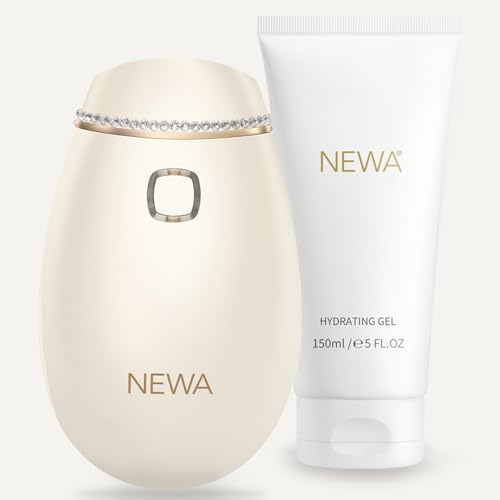
- SKIN TIGHTENING DEVICE: NEWA uses the power of radio frequency to: ✔️Boost the skin’s collagen production ✔️Visibly redu…
- FDA CLEARED – BACKED BY CLINICAL STUDIES: The NEWA device and gel were clinically tested on various skin types aged 37 t…
- TRUSTED TECHNOLOGY: One of the most clinically validated skin tightening technologies around today, radio frequency mach…
3DEEP RF Technology
NEWA is built on 3DEEP RF technology, developed by EndyMed, a company well known for its professional-grade RF platforms used in dermatology clinics worldwide. The 3DEEP system uses multiple electrodes that deliver phase-controlled RF energy in a focused, directional pattern. Unlike older bipolar RF designs that can lose energy laterally, 3DEEP is engineered to concentrate heat vertically into the mid-to-deep dermis while keeping the epidermis relatively cool.
This technology is the same platform used in EndyMed’s professional devices, scaled down for safe home use. You can read a detailed explanation of NEWA’s 3DEEP RF technology on the official NEWA website.
The NEWA device features a single treatment head with six electrodes arranged in a linear array. Treatment involves dividing the face into 6 to 7 zones (forehead, each cheek, each side of the jaw, chin, and sometimes the neck) and treating each zone individually for approximately 4 minutes.
Treatment Protocol
NEWA’s treatment protocol is more structured and zone-specific than the TriPollar approach. Each zone receives 4 minutes of continuous RF delivery, and the device uses an LED indicator to signal when the target skin temperature has been reached and when the 4-minute interval is complete.
The initial protocol calls for 3 sessions per week for 4 weeks (12 total sessions). After the initial phase, the recommended maintenance schedule is 1 to 2 sessions per week on an ongoing basis. This means NEWA’s maintenance commitment is higher than TriPollar’s — you will be using the device more frequently over the long term.
A full-face treatment session takes approximately 24 to 28 minutes, which is notably longer than the STOP VX2’s 12–15 minute sessions.
Safety and Clinical Evidence
NEWA holds a significant regulatory distinction: it received FDA De Novo authorization (DEN150005) in 2016 for the NEWA Skin Care System as an over-the-counter device intended for the treatment of facial wrinkles. You can view the FDA De Novo authorization record for NEWA and read the full FDA De Novo review document, which includes a summary of the clinical data submitted in support of the authorization.
It is important to understand what this means — and what it does not. FDA De Novo authorization indicates that the FDA reviewed the device’s safety and effectiveness data and determined it met the standard for marketing in the United States for its intended use. It does not mean the FDA has declared NEWA superior to other RF devices, nor does it guarantee specific results for any individual user. The clinical studies submitted were relatively small and short-term, which is typical for this device category.
The NEWA device also includes a built-in temperature sensor that monitors skin temperature and modulates energy delivery to prevent overheating. The NEWA official FAQs page provides additional guidance on safe use, contraindications, and expected treatment experiences.
Pros and Cons
Pros:
- 3DEEP technology backed by extensive professional clinical use
- FDA De Novo authorization with publicly available review documentation
- Structured, zone-based protocol is easy to follow
- Lower upfront price ($299–$349)
- Shorter initial treatment phase (4 weeks)
- Well-documented safety profile
Cons:
- Longer per-session treatment time (~24–28 minutes)
- Higher ongoing maintenance frequency (1–2x per week indefinitely)
- No muscle activation feature
- Limited to facial treatment zones (less versatile for neck/décolletage)
- Ongoing gel costs accumulate over time due to frequent use
TriPollar STOP VX2 vs NEWA: Key Differences
RF Technology
- AIDS IN COLLAGEN PRODUCTION: new Triple-Wave Multi-RF Technology delivers interchanging RF waves that comb the dermis la…
- PERSONALIZED TREATMENT: 2nd Generation Thermal Mapping provides the skin with the most accurate temperature for effectiv…
- PLEASANT TREATMENT & SUPERIOR RESULTS: the 3rd Generation features automatically adjusts in real-time to ensure a pleasa…
The fundamental technology difference is multi-frequency RF with muscle activation (TriPollar) versus phase-controlled 3DEEP RF (NEWA). TriPollar’s approach aims to treat multiple tissue depths simultaneously and add a muscle-toning dimension. NEWA’s approach focuses on delivering highly controlled, directional heat to the dermis using a proven professional platform adapted for home use.
Neither approach is inherently superior based on currently available independent research. Both are designed to raise dermal temperature to the range associated with collagen stimulation (approximately 40–43°C at the dermal level). The clinical significance of multi-frequency versus single-platform delivery in a home-use context has not been conclusively established in head-to-head peer-reviewed studies.
Treatment Time and Convenience
This is where the two devices diverge most noticeably in daily use. The TriPollar STOP VX2 requires roughly half the time per session compared to NEWA. If you are someone who struggles to maintain a consistent skincare routine, a 12-minute session is significantly easier to commit to than a 28-minute session.
However, NEWA’s initial phase is shorter (4 weeks versus 6–8 weeks), and its zone-based protocol provides clear start-and-stop cues that some users find more reassuring than TriPollar’s continuous gliding approach.
Skin Tightening and Wrinkle Reduction
Both devices target the same biological mechanism: controlled thermal injury to the dermis that triggers fibroblast activity and new collagen synthesis. Realistic expectations are important here. At-home RF devices operate at lower energy levels than professional in-office RF treatments, and results are typically subtle and gradual. Most users who respond well to at-home RF report modest improvements in skin firmness, fine line appearance, and overall skin texture over a period of 4 to 12 weeks.
Neither device is likely to produce dramatic lifting or tightening comparable to professional treatments such as Thermage or Morpheus8. Individual results vary significantly based on age, skin condition, consistency of use, and genetic factors.
Gel and Maintenance Costs
Both devices require proprietary conductive gels, and these represent an ongoing cost that many buyers overlook. TriPollar Preparation Gel and NEWA Activator Gel are similarly priced at approximately $25–$35 per tube. However, because NEWA’s maintenance protocol requires more frequent use (1–2 times per week versus 1–2 times per month for TriPollar), NEWA’s long-term gel costs will be substantially higher.
Over a 12-month period of maintenance use, a NEWA user may go through 6–10 tubes of gel, while a TriPollar user may need only 2–4 tubes. This difference can add $100–$200 or more to NEWA’s annual operating cost.
Safety and FDA Evidence
NEWA has a clear advantage in terms of publicly verifiable regulatory documentation. The FDA De Novo authorization and its associated review document are publicly accessible, and the clinical data submitted as part of that application is summarized in the review. This level of transparency is uncommon in the at-home beauty device market.
TriPollar, as a brand under Pollogen/Lumenis, has a long history of FDA-cleared professional and consumer devices. However, the specific regulatory status of the STOP VX2 model should be independently verified by consumers. Prior models in the STOP line (such as the STOP V) received FDA 510(k) clearance, but newer iterations may follow different regulatory pathways. The absence of easily accessible FDA documentation for the VX2 specifically does not mean the device is unsafe — it simply means the regulatory picture is less transparent than NEWA’s.
Ease of Use
For beginners, NEWA’s zone-based protocol with timed intervals and clear LED indicators provides a more guided experience. You treat one zone, the device tells you when to stop, and you move to the next. There is less guesswork about coverage and timing.
The TriPollar STOP VX2 requires more user judgment. You glide the device continuously across treatment areas while monitoring the thermal indicator to ensure you are maintaining the right temperature and speed. This is not difficult to learn, but it does have a slightly steeper learning curve.
Which RF Device Is Better for Different Skin Concerns?
Fine lines around the eyes and mouth: Both devices can be used in these areas with appropriate caution. NEWA’s smaller, more controlled treatment zones may offer slightly more precision around delicate areas. However, neither device should be used directly on the eyelids.
Moderate wrinkles and loss of firmness: This is the primary use case for both devices, and both are designed to address it. Users with mild to moderate skin laxity are the most likely to see noticeable improvements. Consistency of use matters more than the specific device choice.
Jawline definition and mild sagging: The TriPollar STOP VX2’s DMA muscle activation feature is specifically marketed for this concern. Whether the muscle stimulation component produces meaningful additional benefit over RF alone is not conclusively proven, but the feature does give TriPollar a theoretical edge for users focused on facial contouring.
Neck and décolletage: The TriPollar STOP VX2 is designed for use on the neck and upper chest in addition to the face. NEWA’s treatment protocol is primarily focused on facial zones. If neck and chest treatment is a priority, TriPollar offers greater versatility.
Pricing and Long-Term Value
Upfront cost:
- TriPollar STOP VX2: approximately $449–$549 USD
- NEWA: approximately $299–$349 USD
Included accessories: Both devices typically ship with a starter tube of conductive gel, a charging/power cable, and a user manual. Exact inclusions vary by retailer.
Ongoing gel costs (estimated annual maintenance):
- TriPollar STOP VX2: ~$50–$100 per year (lower maintenance frequency)
- NEWA: ~$150–$250 per year (higher maintenance frequency)
Total first-year cost estimate:
- TriPollar STOP VX2: ~$500–$650
- NEWA: ~$450–$600
When you factor in the higher maintenance gel costs for NEWA, the long-term cost gap between the two devices narrows considerably. Over two to three years of ownership, the total cost of ownership may be quite similar despite the difference in upfront price.
Which Device Should You Buy?
Best for advanced features: TriPollar STOP VX2. The combination of multi-frequency RF, DMA muscle activation, and thermal mapping makes it the more technologically ambitious device.
Best for budget-conscious buyers: NEWA. The lower upfront price makes it more accessible, though higher ongoing gel costs partially offset this advantage over time.
Best for beginners: NEWA. The zone-based protocol with timed intervals and clear LED guidance removes most of the guesswork from treatment.
Best for a structured treatment routine: NEWA. If you thrive on clear, step-by-step protocols, NEWA’s 4-minute-per-zone approach provides a more regimented experience.
Best for buyers prioritizing regulatory evidence: NEWA. The publicly available FDA De Novo authorization and review documentation provide a level of transparency that is difficult to match in this product category.
Final Verdict: TriPollar STOP VX2 vs NEWA
There is no single winner across every category, and any review that declares one device universally superior is oversimplifying a nuanced comparison.
Choose the TriPollar STOP VX2 if you value shorter session times, want the most feature-rich device available, plan to treat areas beyond the face, and are comfortable with a higher upfront investment. The multi-frequency RF and DMA muscle activation give it a broader feature set, and the lower maintenance frequency makes it more practical for long-term use once the initial phase is complete.
Choose the NEWA if you prioritize regulatory transparency, prefer a guided treatment protocol, want a lower entry price, and are willing to commit to more frequent maintenance sessions. The 3DEEP technology is well-established in professional settings, and the FDA De Novo authorization provides a documented safety and effectiveness review that is rare in the at-home device market.
Both devices are legitimate options from reputable manufacturers. The most important factor in achieving results with either device is consistent, long-term use according to the recommended protocol. The best RF device is the one you will actually use regularly.
Frequently Asked Questions
1. Is TriPollar better than NEWA?
- AIDS IN COLLAGEN PRODUCTION: new Triple-Wave Multi-RF Technology delivers interchanging RF waves that comb the dermis la…
- PERSONALIZED TREATMENT: 2nd Generation Thermal Mapping provides the skin with the most accurate temperature for effectiv…
- PLEASANT TREATMENT & SUPERIOR RESULTS: the 3rd Generation features automatically adjusts in real-time to ensure a pleasa…
Neither device is categorically better. TriPollar STOP VX2 offers more advanced features including multi-frequency RF and muscle activation, along with shorter session times. NEWA offers stronger publicly available regulatory documentation and a more structured treatment protocol. The better choice depends on your priorities regarding technology, convenience, budget, and regulatory evidence.
2. Does NEWA really work for wrinkles?
NEWA’s 3DEEP RF technology is designed to stimulate collagen production through controlled dermal heating, which is a well-established mechanism for improving the appearance of fine lines and wrinkles. The FDA De Novo review for NEWA included clinical data supporting its intended use for facial wrinkle treatment. However, results vary by individual, and improvements are typically modest and gradual. At-home RF devices should not be expected to replicate the results of professional treatments.
3. Is TriPollar STOP VX2 FDA cleared?
TriPollar as a brand has a history of FDA-cleared devices, including earlier models in the STOP line. The specific regulatory status of the STOP VX2 model should be independently verified. FDA clearance of a prior model does not automatically extend to newer iterations. Check the FDA’s device database or contact Pollogen directly for the most current information.
4. How often should you use NEWA?
During the initial treatment phase, NEWA should be used 3 times per week for 4 weeks. After completing the initial phase, the recommended maintenance schedule is 1 to 2 sessions per week on an ongoing basis.
5. How often should you use TriPollar STOP VX2?
During the initial phase, the TriPollar STOP VX2 should be used 2 to 3 times per week for 6 to 8 weeks. After the initial phase, the recommended maintenance schedule is 1 to 2 sessions per month.
6. Can you use RF devices every day?
No. Both TriPollar and NEWA specifically advise against daily use. RF treatment works by creating controlled thermal stress that triggers a healing response, and the skin needs recovery time between sessions. Using an RF device too frequently can increase the risk of irritation, redness, and potential skin damage. Always follow the manufacturer’s recommended treatment schedule.
7. Do both devices require special gel?
Yes. Both the TriPollar STOP VX2 and NEWA require proprietary conductive gels to function properly. The gel serves as a coupling medium that allows RF energy to pass safely through the skin’s surface and into the dermis. Using the devices without gel, or with an incompatible substitute, can result in uneven energy delivery, reduced effectiveness, and increased risk of skin irritation.
8. How long does it take to see results?
Most users who respond to at-home RF treatment begin to notice subtle improvements in skin texture and firmness within 4 to 8 weeks of consistent use. More noticeable changes in fine lines and skin laxity may take 8 to 12 weeks or longer. Results vary significantly based on age, skin condition, treatment consistency, and individual biological response. Neither device produces immediate or dramatic results.
Disclaimer: This article is for informational purposes only and does not constitute medical advice. Individual results with at-home RF devices vary. Consult a dermatologist or qualified skincare professional if you have specific skin concerns or medical conditions that may affect your suitability for RF treatment. Always verify current product specifications, pricing, and regulatory status directly with the manufacturer before purchasing.