
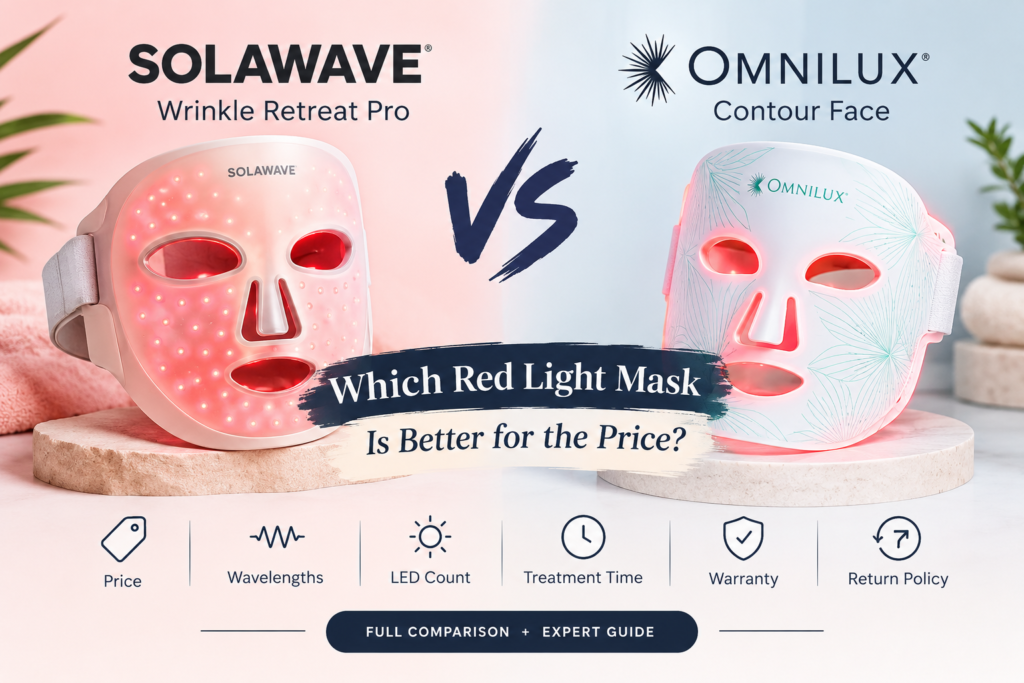
You’re about to spend nearly $400 on a glowing piece of silicone that promises to soften fine lines from your couch. That’s a real investment, and you deserve a clear answer before you click “add to cart.” The two masks dominating the conversation right now are the Solawave Wrinkle Retreat Pro and the Omnilux Contour Face — and on paper, they look almost identical in price. So what are you actually getting for your money?
This comparison breaks down wavelengths, LED count, treatment time, clinical evidence, warranty protection, and everyday usability to help you choose the best LED face mask for wrinkles and firm skin without overspending on specs that don’t translate to visible results.
The Short Verdict
If your priority is the shortest possible daily routine and you like the idea of multiple wavelength options, the Solawave Wrinkle Retreat Pro is the more convenient pick. If you value a brand with deep clinical roots, a longer warranty, and wavelengths that align closely with the most-cited peer-reviewed LED research, the Omnilux Contour Face edges ahead on long-term confidence. The $4 price gap between them is not the deciding factor — your lifestyle and trust in the evidence are.
Solawave vs Omnilux: Quick Comparison
| Feature | Solawave Wrinkle Retreat Pro | Omnilux Contour Face |
|---|---|---|
| Listed price | ~$399 | ~$395 |
| Wavelengths | 605 nm, 630 nm, 660 nm, 830 nm | 633 nm, 830 nm |
| LED count | 320 | 132 |
| Treatment time | 3 minutes | 10 minutes |
| Design | Rigid full-face mask | Flexible silicone full-face mask |
| Warranty | 1 year | 2 years (verify current terms) |
| Return policy | 60 days | 30 days (verify current terms) |
| FDA status | 510(k) cleared | 510(k) cleared |
| Key limitation | Newer brand; less independent clinical data on this specific device | Longer daily session; fewer advertised wavelengths |
Prices and policies checked against official brand pages as of early 2025. Always confirm current terms before purchasing.
Solawave Wrinkle Retreat Pro: Features, Strengths, and Limitations
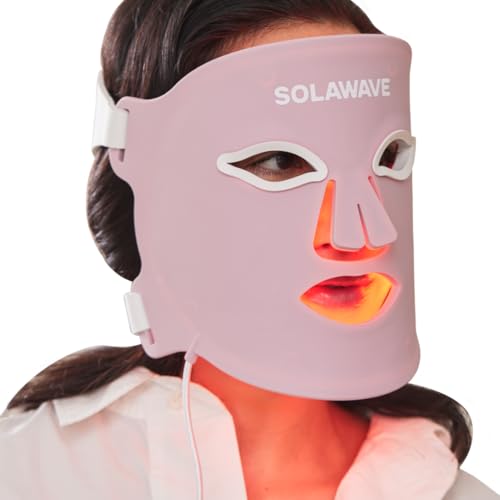
- 4 WAVELENGTHS. ZERO BLIND SPOTS: Red (630nm) softens fine lines. Deep Red (660nm) targets elasticity. Amber (605nm) revi…
- FASTER THAN BREWING YOUR MORNING COFFEE: 3 minutes. Hands-free. Automatic shut-off. While most LED masks demand 10-20 mi…
- 320 LEDS. BUILT FOR EFFICIENCY: One charge powers up to 20 full sessions – most competitor masks max out at six. Digital…
The Solawave Wrinkle Retreat Pro is the brand’s flagship full-face mask, positioned as a quick, high-output alternative to longer LED sessions. Solawave advertises 320 LEDs emitting across four wavelengths — 605 nm (amber), 630 nm (red), 660 nm (deep red), and 830 nm (near-infrared) — in a single three-minute cycle.
Strengths. The three-minute treatment is genuinely appealing for anyone who struggles to sit still for ten minutes every day. The four-wavelength approach covers a broader portion of the visible red and near-infrared spectrum, which the brand argues provides more comprehensive skin support. The 60-day return window also gives you more time to test the mask risk-free than many competitors offer.
Limitations. Solawave is a relatively young consumer brand, and independent, peer-reviewed studies specifically testing the Wrinkle Retreat Pro are not widely available as of this writing. The higher LED count sounds impressive, but LED count alone does not determine how much therapeutic light energy actually reaches your skin — a point we’ll unpack below. The rigid mask design may also fit some face shapes better than others.
Note: Solawave also sells a popular handheld device called the Radiant Renewal Wand at a lower price point. That is a different product with a different use case and should not be confused with the Wrinkle Retreat Pro mask.
Omnilux Contour Face: Features, Strengths, and Limitations
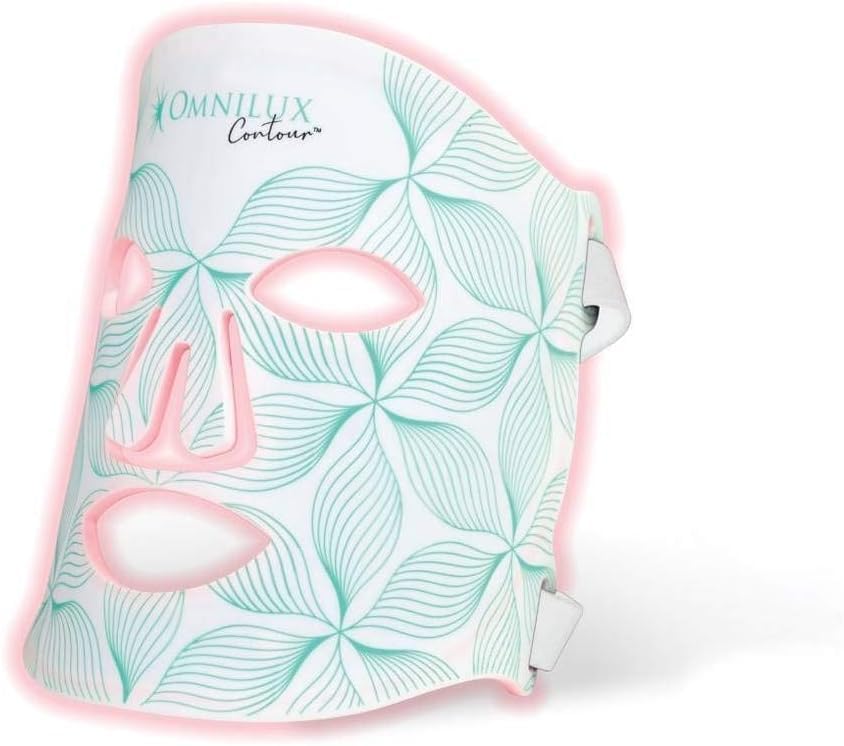
The Omnilux Contour Face comes from a company with a long history in professional and clinical LED light therapy. Omnilux originally manufactured devices for dermatology offices before expanding into at-home products, which gives the brand a credibility advantage among evidence-minded buyers.
The Contour Face uses 132 LEDs delivering two wavelengths — 633 nm (red) and 830 nm (near-infrared) — over a ten-minute session. The mask is made of flexible medical-grade silicone that conforms more closely to facial contours than a rigid shell.
Strengths. Omnilux’s clinical heritage is a genuine differentiator. The 633/830 nm wavelength pairing is the most extensively studied combination in published LED phototherapy research, which we’ll discuss in the evidence section. The flexible design tends to sit more comfortably on a wider range of face shapes, and the reported two-year warranty provides longer protection than Solawave’s one-year coverage. For a deeper dive, see our full Omnilux Contour Face review.
Limitations. Ten minutes is a meaningful daily commitment compared to three. If consistency is your biggest hurdle, a longer session could become a friction point. The two-wavelength setup is narrower than Solawave’s four, and the lower LED count may raise questions — though, again, count is only one variable.
The Price Question: Does $4 Actually Matter?
Here’s the straightforward truth: the listed prices of these two masks are functionally identical. A $4 difference will not affect your purchasing power, your skincare results, or your bank account in any meaningful way.
What does matter is what each brand includes at that price point. Check whether the current bundle includes a controller, carrying case, eye protection, or replacement straps. Look for seasonal promotions — both brands run periodic sales that can drop the effective price by $50–$100 or more. And factor in the warranty length: a two-year warranty on a $395 device is objectively more protective than a one-year warranty on a $399 device, even if the upfront cost is slightly lower.
If you’re weighing LED masks across a wider price range, our ultimate LED face mask buying guide covers options at every budget.
Wavelengths Explained in Plain English
LED wavelengths determine how deeply light penetrates your skin and which cellular processes it may influence. Here’s a simplified breakdown of the wavelengths in play:
- 605 nm (amber): Targets the most superficial skin layers. Some research suggests amber light may support skin calmness and surface tone, though the evidence base is smaller than for red and near-infrared.
- 630–633 nm (red): The most widely studied visible red wavelength for skin rejuvenation. Red light in this range is believed to support fibroblast activity and collagen synthesis in the upper dermis.
- 660 nm (deep red): Penetrates slightly deeper than 630 nm. Often included in multi-wavelength devices to broaden coverage within the red spectrum.
- 830 nm (near-infrared): Penetrates deepest, reaching the lower dermis and subcutaneous tissue. Near-infrared is associated with anti-inflammatory effects and deeper tissue repair.
A landmark clinical study by Lee et al. published in Photomedicine and Laser Surgery found that combining 633 nm and 830 nm LED treatments produced measurable improvements in skin texture, collagen density, and patient satisfaction in photoaged skin — the specific pairing Omnilux uses. Solawave’s additional 605 nm and 660 nm wavelengths are not a disadvantage, but the published evidence supporting their incremental benefit in an at-home mask context is more limited.
Why LED Count Alone Does Not Prove Superiority
It’s tempting to see “320 LEDs” next to “132 LEDs” and declare a winner. Resist that impulse. What matters for biological effect is irradiance — the amount of light energy delivered per square centimeter of skin — and the accuracy of the stated wavelengths. A mask with fewer, higher-quality LEDs positioned closer to the skin can deliver equal or greater irradiance than a mask with more LEDs spread across a larger surface area.
Neither Solawave nor Omnilux publishes detailed, independently verified irradiance maps for their consumer masks, so the LED count comparison is less informative than it appears. Until third-party irradiance testing becomes standard, treat LED counts as a rough design indicator rather than a performance guarantee.
Scientific Evidence: What the Research Actually Says
If you want to understand whether LED face masks really work, it’s important to separate general LED research from device-specific proof.
The broader scientific literature on LED phototherapy is encouraging. A review by Weiss et al. on LED photomodulation documented improvements in skin texture, pigmentation, and fine lines after repeated LED treatments in clinical settings. The Lee et al. study mentioned above demonstrated that the 633/830 nm combination improved collagen production markers in a controlled, split-face trial.
However, these studies used professional-grade devices in controlled clinical environments, not at-home consumer masks. Neither the Solawave Wrinkle Retreat Pro nor the Omnilux Contour Face has been the subject of a large, independent, peer-reviewed randomized controlled trial as of this writing. Both brands reference clinical data, but some of that data is company-sponsored or extrapolated from professional device studies.
This doesn’t mean the masks are ineffective — it means the level of evidence is not yet as robust as marketing language sometimes implies. Manage your expectations accordingly.
Treatment Time, Comfort, and Routine Consistency
This is where the comparison gets personal. Three minutes is easy to justify on a busy morning. Ten minutes requires more intentionality. If you already meditate, listen to a podcast, or scroll your phone for ten minutes each day, the Omnilux session slots in naturally. If you know yourself well enough to admit that a ten-minute daily task will get abandoned by week three, the Solawave’s shorter cycle could be the difference between a device you actually use and one that gathers dust.
Comfort-wise, the Omnilux’s flexible silicone tends to mold more comfortably around the nose and cheekbones, while the Solawave’s rigid shell may feel more stable but less forgiving on certain face shapes. Both masks are lightweight enough for seated use, and neither is designed for walking around the house.
Warranty, Returns, and Long-Term Ownership
A red light mask is a multi-year purchase. The Omnilux Contour Face’s reported two-year warranty provides an extra year of protection compared to Solawave’s one-year coverage, which matters if an LED array or controller develops a fault after month thirteen.
On the return side, Solawave’s 60-day window is more generous than the typical 30-day policy, giving you a longer trial period to assess whether you see or feel any changes. Always verify current warranty and return terms on the official product pages before purchasing, as policies can change without notice.
Which Mask Fits Your Goals?
- Fine lines and early signs of aging: Both masks target the same fundamental mechanisms. The Omnilux’s 633/830 nm pairing has stronger direct clinical support, but the Solawave’s broader wavelength range is not a drawback.
- Mature skin with deeper concerns: Near-infrared penetration matters most here. Both masks include 830 nm, so the difference is marginal. Consistency of use will outweigh wavelength nuances.
- Convenience and busy schedules: Solawave’s three-minute session wins clearly.
- Budget-conscious buyers: The prices are nearly identical. Look for sales, bundles, and warranty value rather than list price. If you’re exploring alternatives to Solawave at various price points, there are options that cost significantly less — though they may differ in build quality and evidence.
For a broader comparison that includes other popular masks, see our Omnilux vs CurrentBody analysis.
Who Should Not Buy Either Mask
Skip both devices if you expect facelift-level results, dramatic wrinkle erasure, or overnight transformation. LED therapy, at best, offers gradual and subtle improvements that require consistent use over eight to twelve weeks. If you have active rosacea flares, photosensitivity disorders, or take photosensitizing medications (certain antibiotics, retinoids, or acne treatments), consult a dermatologist before using any LED device. Neither mask is a substitute for sunscreen, a consistent skincare routine, or professional treatments for advanced skin concerns.
Pros and Cons
Solawave Wrinkle Retreat Pro
Pros:
- Ultra-short 3-minute treatment
- Four wavelengths for broader spectral coverage
- 60-day return policy
- High LED count (with the caveats discussed above)
Cons:
- Newer brand with less independent clinical data on this specific device
- Rigid design may not fit all face shapes comfortably
- One-year warranty is shorter than Omnilux’s
- No published independent irradiance testing
Omnilux Contour Face
Pros:
- Strong clinical heritage and professional background
- 633/830 nm pairing aligns with the most-cited LED research
- Flexible silicone design for better facial conformity
- Reported two-year warranty
Cons:
- 10-minute daily session requires more commitment
- Only two wavelengths
- Lower LED count (though this is less meaningful than it appears)
- Shorter return window than Solawave
Final Verdict
There is no single “better” mask at this price point — there is a better mask for you. Choose the Solawave Wrinkle Retreat Pro if a three-minute routine is the key to long-term consistency and you value a generous return window. Choose the Omnilux Contour Face if clinical credibility, a longer warranty, and alignment with the strongest published wavelength research give you the confidence to stick with a ten-minute daily habit.
Either way, check current prices and promotions on the official Solawave and Omnilux websites before purchasing, and give whichever mask you choose at least eight to twelve weeks of consistent use before evaluating results.
Frequently Asked Questions
Is Solawave better than Omnilux?
Neither mask is categorically better. Solawave offers a faster treatment and more wavelengths; Omnilux offers stronger clinical heritage and a longer warranty. The best choice depends on your routine, skin goals, and what gives you confidence to use the device consistently.
Is the Solawave Wrinkle Retreat Pro worth $399?
If you will use it daily for at least three months, the cost per session becomes negligible. The three-minute treatment time makes consistent use more realistic for many people, which is the biggest factor in whether any LED mask delivers value.
Is Omnilux worth the price?
Omnilux’s professional background and the strong evidence base for its 633/830 nm wavelength combination provide a reasonable foundation for the investment. The two-year warranty adds long-term value that partially offsets the higher daily time commitment.
Can I use a red light mask every day?
Both brands design their masks for daily or near-daily use. Follow the specific instructions included with your device, and start gradually if you have sensitive skin.
How long before I see results from LED light therapy?
Most manufacturers and clinical studies suggest a minimum of eight to twelve weeks of consistent use before evaluating visible changes. Results vary significantly by individual, and some users may notice only subtle improvements.
Do I need eye protection with these masks?
Both brands provide guidance on eye safety in their user manuals. Follow the included instructions carefully. If you have any eye conditions or concerns, consult an eye care professional before use.
What does FDA 510(k) clearance actually mean for LED masks?
FDA 510(k) clearance indicates that a device is substantially equivalent to a previously cleared device in terms of safety and intended use. It is not the same as FDA approval, which involves a more rigorous review process. You can learn more about the distinction through the FDA’s explanation of the 510(k) clearance process https://sylomaskincare.com/
Disclosure: Syloma Skincare may earn a commission from qualifying purchases made through links in this article, at no additional cost to you. This does not influence our editorial recommendations.
*Disclaimer: This article is for informational purposes only and does not constitute medical advice. LED light therapy devices are not intended to diagnose, treat, cure, or prevent