
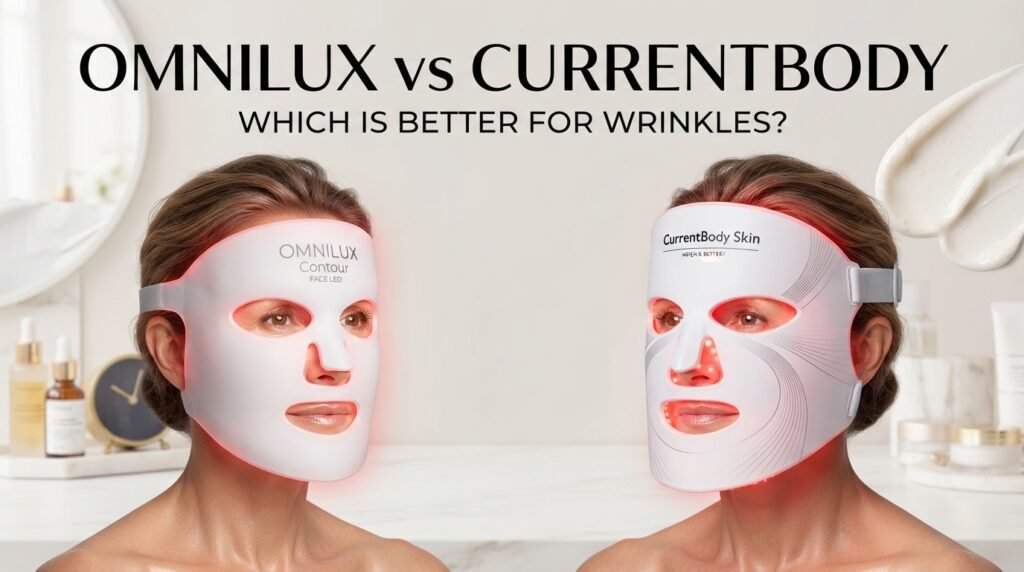
If you’re down to two finalists in your LED mask search, they’re probably these: the Omnilux Contour Face and the CurrentBody Skin LED Light Therapy Mask Series 2. Both are premium, dermatologist-referenced devices with loyal followings, and both are marketed heavily around fine lines and wrinkles. So which one actually makes more sense if wrinkles are your main concern?
The honest answer is more nuanced than a single “winner.” Omnilux vs CurrentBody LED mask comparisons often get reduced to LED counts and wavelength lists, but the real decision comes down to documented specs, fit, treatment routine, and what the evidence can and can’t tell you. This guide breaks down exactly that, using only verifiable manufacturer specifications and published research, so you can decide which mask fits your face, routine, and expectations.
One note before we start: CurrentBody also sells a Series 1 and a newer Series 3 mask. This article is specifically comparing the Omnilux Contour Face against the CurrentBody Series 2 — not Series 1 or Series 3, which have different LED counts and, in the case of Series 3, different features. If you see a listing that doesn’t specify the series, double-check before you buy.
Quick Answer: Omnilux vs CurrentBody for Wrinkles
Both masks use red and near-infrared light, the two wavelength types most studied for skin rejuvenation. Omnilux Contour Face uses 633nm (red) and 830nm (near-infrared). CurrentBody Series 2 uses those same two wavelengths plus a third, 1072nm (deep near-infrared). Both are flexible, silicone, full-face devices designed for 10-minute at-home sessions several times a week.
Here’s the important part: there is no published, direct head-to-head clinical trial comparing these two specific masks against each other for wrinkle reduction. Each brand can point to research supporting red and near-infrared light therapy in general, and Omnilux in particular has a long history of clinical publications tied to its technology. But neither company has data proving its device outperforms the other’s for wrinkles specifically. That means the smarter way to choose is by comparing documented specifications, coverage, comfort, treatment routine, warranty, and price — then matching those to your own priorities and skin goals.
Omnilux vs CurrentBody: Side-by-Side Comparison
| Omnilux Contour Face | CurrentBody Series 2 | |
|---|---|---|
| Wavelengths | 633nm (red), 830nm (near-infrared) | 633nm (red), 830nm (near-infrared), 1072nm (deep near-infrared) |
| LED count | 132 LEDs (66 bulbs) | 236 LEDs |
| Irradiance | Not publicly listed by Omnilux | Approximately 30 mW/cm² (manufacturer-stated) |
| Treatment time | 10 minutes | 10 minutes |
| Recommended frequency | 3–5 sessions/week for 4–6 weeks, then maintenance | 3–5 sessions/week for approximately 8 weeks, then maintenance |
| Coverage | Full face | Full face plus chin, jaw, and nose coverage |
| Design | Flexible silicone, head straps | Flexible silicone, adjustable strap plus chin strap |
| Eye protection | Not included as a standard accessory; users typically keep eyes closed during treatment | Optional eye inserts included |
| FDA clearance | FDA-cleared | FDA-cleared |
| Warranty | 2 years on the device (shorter coverage on the controller) | 2 years, plus a 30-day return window |
| Approximate price | Around $395–$490 depending on retailer and promotions | Around $380–$470 depending on retailer and promotions |
| Best suited for | Straightforward red + NIR routine, established brand history | Broader wavelength coverage, more chin/jaw coverage, reading-friendly eye inserts |
Prices fluctuate with sales and bundles on both brands’ sites and at authorized retailers, so treat the figures above as a general range rather than a fixed number.
Omnilux Contour Face: What You Get
Omnilux is one of the older names in LED light therapy, with roots in medical and clinic-grade devices before the brand released a home version. The Contour Face carries that lineage into a flexible, at-home mask.
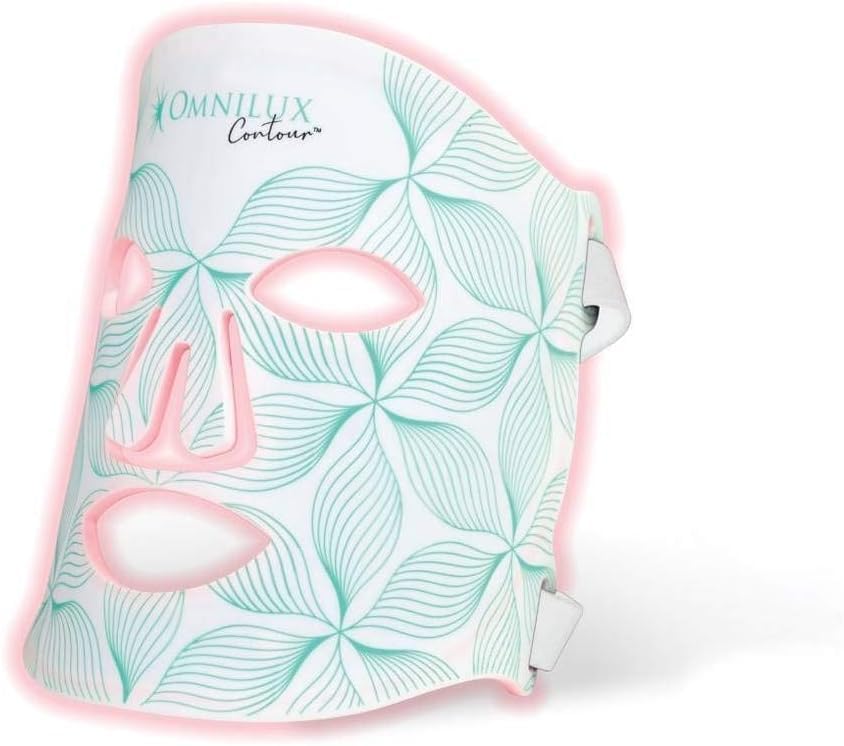
The specs:
- 633nm red light — associated in published research with collagen stimulation and general skin rejuvenation
- 830nm near-infrared light — associated with deeper tissue effects and reduced inflammation
- 132 LEDs (66 bulbs, 2 diodes per bulb) across a flexible silicone shell that molds to the face
- 10-minute sessions, recommended 3 to 5 times per week
- An initial 4- to 6-week course, followed by maintenance sessions as needed
- FDA-cleared status for its intended use
- A 2-year warranty on the device, with separate (typically shorter) coverage on the rechargeable controller
Strengths for wrinkle-focused shoppers: The Contour Face keeps things simple with two well-documented wavelengths rather than adding extra features. For people who want a straightforward anti-aging routine and value a brand with a long clinical track record, that simplicity is a selling point, not a shortcoming. It’s also worth noting in our <a href=”https://sylomaskincare.com/omnilux-contour-faomnilux-contour-face-review-2026ce-review-2026-is-this-red-light-mask-worth-it-for-wrink/”>Omnilux Contour Face review</a> that fit and comfort are generally rated highly.
Limitations: Omnilux does not publicly publish an irradiance (power density) figure for the Contour Face, which makes it harder to compare precisely against masks that do disclose this number. It also doesn’t include dedicated eye inserts, so most users close their eyes for the session rather than reading or watching a screen. Coverage is focused on the face itself rather than extending down to the chin and jawline.
CurrentBody Series 2: What You Get
CurrentBody’s Series 2 is the brand’s most recent full-face mask sold in the US (Series 3 exists as well, but has different specs and is not the focus of this comparison). It expands on the original Series 1 with an added wavelength and more LEDs.

- Enhanced collagen production capability significantly reduces fine lines, wrinkles and redness, for younger-looking skin…
- Upgraded light coverage provides our famous instant glow, for a healthier, brighter and smoother complexion.
- An all-new, exclusive layout of 236 LED bulbs emits three clinically recognised wavelengths: red (633nm), near-infrared …
The specs:
- 633nm red light and 830nm near-infrared light — the same two core wavelengths used in Omnilux Contour
- 1072nm deep near-infrared light — an additional wavelength not found in the Omnilux Contour Face
- 236 LEDs total (manufacturer breakdown: 110 red, 110 near-infrared, 16 deep near-infrared)
- Manufacturer-stated irradiance of approximately 30 mW/cm²
- 10-minute sessions, recommended 3 to 5 times per week for about 8 weeks, per CurrentBody’s official product specifications
- Flexible silicone construction with an extended nose flap and a chin strap for added lower-face coverage
- Optional eye inserts included, which some users find make it easier to read or watch TV during a session
- FDA-cleared status
- A 2-year warranty, along with a 30-day return window from CurrentBody’s US site
Strengths for wrinkle-focused shoppers: The Series 2 covers more of the lower face and jawline than the Omnilux Contour, and the included eye inserts add convenience during longer routines. More LEDs generally means more even light distribution across the treatment area, which matters for consistent exposure.
Limitations, and an important caveat: More LEDs and an additional wavelength sound like an automatic upgrade, but that isn’t the same as proven superior wrinkle results. A higher LED count mainly affects coverage and light distribution, not necessarily how deeply or effectively the light works on skin cells. The same goes for the third wavelength — more on that below.
Which Has Better Evidence for Wrinkles?
This is where it’s worth slowing down, because marketing language and scientific evidence are not the same thing.
1. Evidence for red/NIR LED phototherapy generally. There’s a real, published body of research on red and near-infrared light for skin rejuvenation and photoaging. Peer-reviewed studies have looked at how combined red and near-infrared light exposure affects fine lines, skin texture, and collagen-related markers over multi-week treatment courses. For example, research on combined <a href=”https://pubmed.ncbi.nlm.nih.gov/17566756/”>633nm and 830nm LED treatment</a> and separate work on <a href=”https://pubmed.ncbi.nlm.nih.gov/16989189/”>photoaged skin treated with the same two wavelengths</a> both reported measurable improvements in wrinkle appearance and patient-reported satisfaction after a series of treatments.
2. Evidence tied to the Omnilux wavelength combination. Omnilux’s 633nm + 830nm pairing is the same combination used in several of the published studies above, which is part of why the brand frequently references this research in its marketing. That’s a reasonable connection to draw, but it’s still evidence for the wavelength combination and underlying technology category — not a clinical trial run specifically on the consumer Contour Face mask.
3. Evidence tied to CurrentBody’s specific device. CurrentBody’s red and near-infrared wavelengths sit within the same general range studied in the literature above. The 1072nm wavelength is less represented in long-term, peer-reviewed wrinkle studies than 633nm and 830nm are; it’s a newer addition to at-home masks, and its role in wrinkle reduction specifically is less established than the redder and near-infrared wavelengths CurrentBody shares with Omnilux.
4. Direct head-to-head evidence. As of this writing, there is no independently published clinical trial that directly compares the Omnilux Contour Face against the CurrentBody Series 2 for wrinkle outcomes. Neither brand claims one over the other in a controlled trial. Any “better for wrinkles” claim you see comparing these two specific products is editorial opinion or marketing, not clinical data — including in this article, which is why we’re not declaring a winner here.
If you want more background on how these devices work in general, our guide to whether LED face masks really work goes deeper into the mechanism and the limits of current research.
Omnilux vs CurrentBody for Fine Lines
Zooming in on fine lines and early wrinkles rather than deeper folds, the practical differences come down to coverage and routine rather than dramatically different light science.
- Fine lines and crow’s feet: Both masks’ red and near-infrared wavelengths fall in ranges studied for fine-line improvement. Fit matters here — a mask that sits closer to the skin around the eye area and temples will deliver more consistent light exposure to those zones. Our roundup of LED masks for crow’s feet and under-eye wrinkles covers fit considerations in more detail.
- Deeper-looking wrinkles: Neither mask is positioned, nor should be expected, to erase established folds or deep creases. Both are framed by their manufacturers as tools to soften the appearance of lines over a treatment course, not remove them.
- Forehead lines and cheek texture: Both devices cover these zones fully, since they’re full-face masks.
- Firmness and overall tone: This is where the general red/NIR research applies most consistently — improvements in skin tone and a “brighter” look are commonly reported outcomes in LED phototherapy studies, more so than dramatic wrinkle reversal.
For a broader look at wrinkle-focused options beyond these two brands, see our guide to the best LED face masks for wrinkles and firm skin.
What About the 1072nm Wavelength?
The 1072nm wavelength is the headline difference between these two masks, so it deserves its own explanation.
What it is: 1072nm sits in the deep near-infrared range, further along the spectrum than the 830nm near-infrared light both masks use.
Why CurrentBody includes it: The brand markets 1072nm as reaching deeper skin layers than red or standard near-infrared light, positioning it as an added tool for firmness and more pronounced signs of aging, particularly around the eyes and mouth.
What the manufacturer claims: CurrentBody states that its combined wavelengths, including 1072nm, can penetrate multiple layers of skin and support collagen-related benefits alongside the red and near-infrared light.
What evidence exists: Deep near-infrared light in general has some supporting research in wound healing and select skin-related contexts, and near-infrared light broadly has a longer research history than 1072nm specifically. Independent, long-term, peer-reviewed research isolating 1072nm’s effect on facial wrinkles is more limited than the research base behind 633nm and 830nm.
What’s still uncertain: How much added benefit the 1072nm wavelength contributes on top of 633nm and 830nm, specifically for wrinkle appearance, hasn’t been established through independent clinical trials on this device. That doesn’t mean it does nothing — it means the claim is still resting more on manufacturer positioning than on a deep, independent evidence base specific to facial wrinkles.
Bottom line: An extra wavelength is a genuine hardware difference, but it is not automatic proof of superior wrinkle results. Treat it as one factor among several, not the deciding one.
Which Mask Has Better Face Coverage?
- Cheeks and forehead: Both masks cover these areas fully and are designed as full-face devices.
- Jawline and chin: CurrentBody Series 2 has a dedicated chin strap and extended coverage, giving it an edge for jawline and lower-face treatment. Omnilux Contour focuses on the face itself without the same chin-specific extension.
- Nose area: CurrentBody’s nose flap is designed to keep the mask secure and in contact around the nose; Omnilux’s flexible silicone also contours to the nose but without a distinct flap feature.
- Eye area: Neither mask shines light directly into the eyes; both are designed for the eyes to remain closed during use, though CurrentBody’s optional inserts add a layer of physical comfort and coverage for the eyelids specifically.
- General fit: Both are flexible silicone designs that adjust with straps. Reviewers commonly describe both as comfortable, though individual face shape and head size will affect exact fit.
Consistent, full coverage matters because these devices work cumulatively — missing light exposure across a treatment area reduces the effective dose over a course of sessions. If coverage and fit are a top priority for you, our guide to LED face masks for mature skin and fine lines compares fit factors across several devices.
Which One Is More Comfortable?
Both masks use flexible silicone rather than a rigid shell, which most users find more comfortable for regular use than hard-shell alternatives.
- Weight and wearability: Both are designed to be worn while sitting, reading, or relaxing at home; CurrentBody’s controller clips onto clothing so you can move around during the session, and Omnilux’s controller is also portable during treatment.
- Straps: CurrentBody’s Series 2 adds a chin strap alongside its adjustable head strap for extra hold around the lower face. Omnilux uses head straps to secure the mask across the face.
- Eye comfort: CurrentBody’s optional inserts are aimed specifically at making it easier to keep eyes closed comfortably, or to read or watch something during the 10 minutes. Omnilux doesn’t include this accessory, so comfort during the session will depend more on personal preference.
- Controller: Both use rechargeable, clip-style controllers rather than a plugged-in cord you have to manage during treatment.
We haven’t independently lab-tested either device for this article, so treat comfort notes as a synthesis of manufacturer information and publicly available reviews rather than firsthand testing.
How Long Does It Take to See Results?
Realistic timelines for LED masks, based on how both companies describe their recommended treatment courses:
- First few sessions: Most users don’t see visible wrinkle changes yet. Some report a temporary glow or slight de-puffing right after a session, which is a short-term effect rather than a lasting change.
- Around 4 weeks: With consistent use (roughly 3–5 sessions weekly), skin tone and texture are the changes most commonly reported at this stage, more so than deep wrinkle reduction.
- Around 6 weeks: This lines up with the end of Omnilux’s recommended initial course; some users report early softening in the appearance of fine lines by this point.
- Around 8–12 weeks: This range aligns with CurrentBody’s recommended course length and with longer studies on red/NIR phototherapy. Cumulative changes to fine lines and overall skin quality are more likely to be noticeable here than at earlier checkpoints.
Individual results vary widely based on skin type, consistency of use, and starting skin condition. Neither mask promises a fixed timeline, and cosmetic improvements from LED therapy are gradual rather than immediate.
Omnilux vs CurrentBody Price and Value
- Upfront cost: Omnilux Contour Face typically lists in the high $300s to low $500s depending on the retailer and current promotions. CurrentBody Series 2 typically lists in the high $300s to high $400s under similar conditions. The two overlap enough in price that cost alone rarely settles the decision.
- Treatment frequency: Both recommend a similar 3–5 sessions per week during the initial course, so ongoing time investment is comparable.
- Cost per treatment: Given similar session counts over a similar number of weeks, the effective cost-per-session between the two is close, though your exact math will depend on how long you keep using the device for maintenance afterward.
- Warranty: Both offer roughly 2-year coverage on the main device, giving similar long-term reassurance.
- Included accessories: CurrentBody includes eye inserts as standard; Omnilux’s included accessories focus on straps, a carry bag, and charging equipment without dedicated eye inserts.
- Long-term usability: Both are designed for continued maintenance use after the initial course, not single-use treatments.
“Better value” depends on what you’re weighing most: if chin coverage and eye inserts matter to you, CurrentBody may feel like the stronger deal; if you’d rather pay for a simpler two-wavelength device with a long clinical history, Omnilux may feel like the better use of your budget. Note that any pricing mentioned here, including on retailers like Amazon, can change at any time and isn’t guaranteed to stay at the level you see today.
- Enhanced collagen production capability significantly reduces fine lines, wrinkles and redness, for younger-looking skin…
- Upgraded light coverage provides our famous instant glow, for a healthier, brighter and smoother complexion.
- An all-new, exclusive layout of 236 LED bulbs emits three clinically recognised wavelengths: red (633nm), near-infrared …
Who Should Consider Omnilux?
- Someone whose main goal is fine lines and wrinkles specifically, without needing extra features
- Someone who prefers a simpler, two-wavelength red + near-infrared approach
- Someone who values Omnilux’s longer documented history in LED light therapy technology
- Someone who prefers a face-focused fit without a dedicated chin strap
Who Should Consider CurrentBody Series 2?
- Someone interested in broader wavelength coverage, including 1072nm
- Someone who wants the extra LED count for more even light distribution
- Someone who specifically wants chin and jawline coverage included
- Someone who wants the option of eye inserts for a more comfortable, screen-friendly session
None of these preferences translate to a guaranteed wrinkle-reduction advantage — they’re differences in features and design that different buyers may value differently, as covered in the evidence section above.
Who Should NOT Buy Either One?
- Anyone expecting established, deep wrinkles to fully disappear — LED masks are designed to soften the appearance of fine lines and support overall skin quality, not replace procedures like fillers or resurfacing
- Anyone unwilling to commit to a multi-week, several-times-per-week routine, since inconsistent use is unlikely to produce the results either brand describes
- Anyone looking for a one-time or instant cosmetic fix
- Anyone with a medical condition, medication, or skin concern that could interact with light therapy — this group should speak with a healthcare professional before buying either device
Safety and Who Should Check With a Professional
Both devices are intended for general home use, but a few practical points apply to any LED mask:
- Follow the manufacturer’s instructions for session length and frequency rather than exceeding the recommended routine
- Do a patch or sensitivity test if the manufacturer recommends one, especially if you have reactive or sensitive skin
- Stop use if you notice significant irritation, redness that doesn’t fade, or discomfort, and contact the manufacturer or a healthcare provider if symptoms persist
- Review each brand’s listed contraindications before use
- People taking photosensitizing medications, pregnant or nursing, or managing a skin condition or other relevant medical concern should check with a qualified healthcare professional before starting LED light therapy
This article is for general educational purposes and isn’t a substitute for personalized medical advice.
Omnilux vs CurrentBody: Final Takeaway
Coming back to the core question of Omnilux vs CurrentBody for wrinkles: Omnilux Contour may make more sense for readers who want a straightforward 633nm + 830nm anti-aging routine, appreciate the brand’s long-standing presence in LED therapy, and don’t need chin-specific coverage or eye inserts. CurrentBody Series 2 may make more sense for readers who want the added 1072nm wavelength, a higher LED count for more even light distribution, and fuller coverage down through the jaw and chin.
There is not enough direct head-to-head clinical evidence to say that one mask definitively reduces wrinkles better than the other. Both are legitimate, FDA-cleared, well-specified devices built on wavelengths with real research behind the underlying technology. The right pick comes down to your coverage needs, comfort preferences, and which feature set matches your routine — not a manufactured “winner.”
If you’re still weighing options beyond these two, our guides to the best red light therapy masks for anti-aging and red light therapy devices for sagging skin can help you compare further.
Frequently Asked Questions
Is Omnilux better than CurrentBody for wrinkles? Neither is proven “better” in a direct clinical comparison. Omnilux uses two well-studied wavelengths; CurrentBody adds a third with less independent long-term wrinkle-specific research behind it. The right choice depends on your coverage and feature priorities.
Is CurrentBody better than Omnilux for fine lines? Not according to any published head-to-head data. CurrentBody’s extra LEDs and wavelength may offer broader coverage, but that isn’t the same as demonstrated superior fine-line results.
Do Omnilux and CurrentBody use the same wavelengths? They share 633nm (red) and 830nm (near-infrared). CurrentBody Series 2 adds a third wavelength, 1072nm (deep near-infrared), that Omnilux Contour Face doesn’t include.
Does 1072nm make CurrentBody better? It gives CurrentBody a wavelength Omnilux doesn’t have, but there isn’t independent clinical evidence proving that 1072nm alone produces better wrinkle results on its own device compared with Omnilux’s two-wavelength approach.
How often should I use an LED mask for wrinkles? Both brands recommend roughly 3 to 5 sessions per week of about 10 minutes each during an initial multi-week course, followed by less frequent maintenance sessions.
How long does Omnilux take to work? Omnilux recommends an initial 4- to 6-week course of consistent use before assessing results, with maintenance sessions afterward.
How long does CurrentBody take to work? CurrentBody’s official guidance points to about 8 weeks of consistent use for its recommended treatment course, based on the manufacturer’s product specifications.
Can LED masks remove deep wrinkles? No. LED masks are designed to support the appearance of fine lines, tone, and firmness gradually. They are not a substitute for procedures aimed at deeper wrinkles, such as injectables or resurfacing treatments.
Can I use an LED mask with my skincare routine? Generally yes, though both brands recommend using the mask on clean, product-free skin and applying serums or moisturizer afterward. Check each manufacturer’s specific instructions for product timing.
Is LED light therapy safe for mature skin? Both devices are FDA-cleared and marketed for general adult use, including mature skin. As with any device, people with photosensitivity, certain medications, or skin conditions should check with a healthcare professional first.
Sources: Omnilux Contour Face official product page; CurrentBody Series 2 official product page; FDA 510(k) record for CurrentBody Skin LED Light Therapy Mask Series 2; PubMed: 633nm + 830nm LED facial rejuvenation; PubMed: combined 633nm + 830nm LED treatment of photoaging skin.