
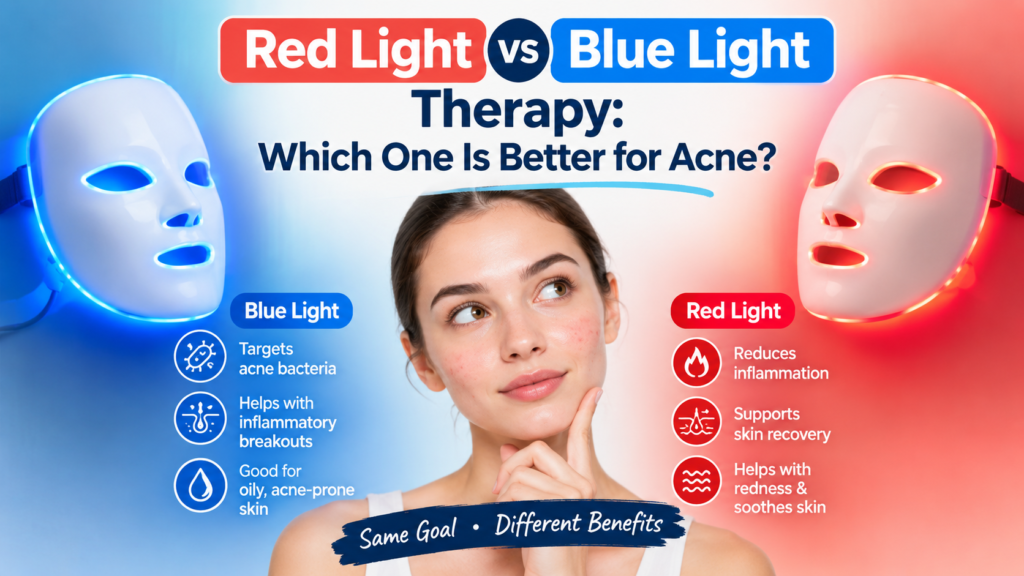
If both red and blue LED masks are marketed for acne, which one should you actually choose? Walk into any skincare aisle or scroll through enough ads and you’ll see LED face masks promising clearer skin in both colors, sometimes both at once. It’s a fair question to have, and it doesn’t have a one-word answer.
The truth is that red light vs blue light therapy for acne isn’t a simple contest with one winner. The right choice depends on the type of acne you’re dealing with, the device you’re using, the wavelength and dose it delivers, how often you use it, and how your own skin responds. Some people see more benefit from blue light. Others do better with red. Many at-home users end up with a combination device because the two wavelengths work on different parts of the acne process.
This guide walks through what the research actually shows, where each light tends to help, and how to think through the decision if you’re shopping for an LED acne device.
Red Light vs Blue Light for Acne at a Glance
| Light | Common Wavelength Range | Main Role | Acne Benefit | Best Suited For | Main Limitation |
|---|---|---|---|---|---|
| Blue Light | Roughly 405–470 nm | Interacts with bacterial byproducts (porphyrins) inside acne-causing bacteria | May reduce active, inflamed pimples | Active inflammatory breakouts | Doesn’t treat blackheads, cysts, or nodules |
| Red Light | Roughly 620–700 nm | Calms inflammation, supports skin recovery | May reduce redness and support healing of acne lesions | Redness, inflammation, sensitive-feeling skin | Less direct antibacterial action than blue |
| Red + Blue Combination | Both ranges together | Targets bacteria and inflammation together | May offer broader coverage of the acne process | People who want to address multiple acne factors at once | More variables (dose, timing) that affect results |
Keep in mind that wavelength ranges vary by manufacturer, and not every device on the market has been tested in a clinical study.
How Blue Light Therapy Works for Acne
Most blue light acne devices sit somewhere in the 405 to 470 nanometer range. That’s the visible blue part of the light spectrum, the wavelength band researchers have studied most for acne.
The idea behind blue light is tied to acne-causing bacteria. These bacteria naturally produce compounds called porphyrins as part of their normal metabolism. Porphyrins happen to absorb blue light. When blue light hits them, it triggers a reaction that can damage the bacteria. According to DermNet NZ’s overview of lasers, lights, and acne , this is the main mechanism researchers point to when explaining why blue light is commonly studied for inflammatory acne, meaning the red, swollen pimples and pustules rather than blackheads or whiteheads.
Blue light also appears to have a mild anti-inflammatory effect on skin cells, though this role is studied less than its interaction with bacteria.
Here’s what blue light can realistically do, based on the current evidence:
- It may help reduce the number of inflammatory pimples over several weeks of consistent use.
- It’s generally well tolerated, with most side effects being mild and temporary.
- It doesn’t reach or affect the bacteria hiding deeper in clogged, non-inflamed pores.
Here’s what it can’t do. Blue light does not clear blackheads or whiteheads, and it isn’t a treatment for cystic or nodular acne. It also shouldn’t be marketed, or thought of, as a guaranteed fix. Response varies quite a bit from person to person, and no study has shown it works for everyone.
How Red Light Therapy Works for Acne
Red light devices for skin typically fall in the 620 to 700 nanometer range, penetrating a bit deeper into the skin than blue light. This is the same general category of light used in a lot of anti-aging devices, which is part of why some people assume red light is “only” for wrinkles. That’s not accurate. Red light has a documented role in acne care too, just a different one than blue light.
Red light’s main mechanism in skincare is thought to involve reducing inflammation and supporting the skin’s natural repair processes at the cellular level. As a Mayo Clinic dermatologist has explained, red light can have oxidative and anti-oxidative properties on the skin that are sometimes used to treat both acne and photoaging. Because inflammation drives a lot of what makes acne look and feel worse, red light’s calming effect can translate into visible improvement in acne lesions for some people, even without the antibacterial action blue light relies on.
What red light tends to offer for acne-prone skin:
- Potential reduction in redness and irritation associated with active breakouts
- Support for the skin’s recovery process after a breakout
- A generally gentle, well-tolerated treatment profile
Red light’s popularity in anti-aging routines comes from its separate effects on collagen-related skin processes, which is a different conversation from its role in acne. Both uses can be true at once. A device can support skin recovery and calm redness while also playing a role in longer-term skin appearance, without either use canceling out the other.
Red Light vs Blue Light: What Does the Research Say?
This is the part worth slowing down for, because headlines about LED masks often flatten nuanced findings into a single, simple claim. Here’s what two relevant pieces of research actually found.
A Small Trial Comparing Red and Blue Light Directly
A randomized clinical study published in the journal Photodermatology, Photoimmunology & Photomedicinecompared red and blue light head-to-head in people with mild-to-moderate acne. The study involved 28 participants, which is a small group by research standards. Both the red-light group and the blue-light group saw improvement in their acne over the course of treatment, and the overall difference in effectiveness between the two colors was not statistically significant. In other words, neither light clearly outperformed the other on improvement alone.
One notable difference did show up: the red-light group reported fewer treatment-related adverse reactions than the blue-light group. That’s a meaningful data point for anyone weighing tolerability, but it comes with an important caveat. A study of 28 people is too small to prove that red light is universally better or gentler for everyone. It’s one piece of evidence, not the final word, and larger trials would be needed to confirm the pattern holds.
What a Broader Review of At-Home Devices Found
Looking beyond a single trial, a systematic review and meta-analysis of at-home LED acne devices, published in JAMA Dermatology, pooled data across multiple randomized trials of portable, consumer-grade devices. The review found that red, blue, and combination red-and-blue devices could all improve acne lesions, with improvement generally building over several weeks of regular use rather than appearing overnight.
That’s a useful, if unglamorous, takeaway. The review’s authors also noted real limitations in the evidence: the studies they analyzed varied in wavelength, device power (fluence), treatment duration, and study design, which makes it hard to say definitively that any one product or protocol is the best. This is common in a field where the technology and study methods are still evolving.
Put together, these two sources support the same general conclusion: red and blue light both have a place in acne care, the differences between them are more about mechanism and tolerability than one being flatly superior, and the research base, while promising, still has gaps.
Is Blue Light Better for Active Acne?
Blue light may make the most sense when you’re dealing with active, inflamed breakouts, the kind with visible redness, swelling, or pus. That’s the acne type where its interaction with bacterial porphyrins has the clearest theoretical rationale, and it’s the population most acne light-therapy studies have focused on.
That said, “may make sense” isn’t the same as “will always work better.” Individual response varies, and some people with inflammatory acne respond just as well, or better, to red light or a combination approach. Skin type, acne severity, and consistency of use all factor in. Blue light isn’t automatically the right pick for every kind of acne, and it has no meaningful effect on blackheads, whiteheads, or deeper cystic lesions.
If you’re shopping specifically with inflammatory breakouts in mind, it can help to look at devices built around that use case, such as the best blue light therapy masks for oily and acne-prone skin.
Is Red Light Better for Redness and Skin Recovery?
Red light tends to shine, so to speak, when the goal is calming inflammation and supporting the skin as it heals. If your acne comes with a lot of visible redness or your skin generally feels reactive and irritated, red light’s gentler mechanism may be worth considering.
It’s worth being precise about language here, because these terms get used interchangeably online and shouldn’t be. Acne redness (the flush around an active pimple), post-acne redness, post-inflammatory hyperpigmentation (dark marks left behind after a blemish heals), and acne scars (textural changes in the skin) are four different things. Red light is most associated with calming active inflammation and supporting general skin recovery. It is not a proven treatment for established scarring, and claims that any LED mask erases scars should be treated with skepticism.
What About Red + Blue Light Together?
A lot of the acne LED masks sold to consumers combine red and blue diodes in one device, and the reasoning makes sense on paper. Acne isn’t caused by a single factor. Bacteria, inflammation, and oil production all play a role, and blue and red light are thought to address different pieces of that puzzle, bacteria and inflammation, respectively.
Combination devices have supporting evidence, including the JAMA Dermatology review mentioned above, which found that red, blue, and combined devices could all produce improvement. But it’s worth being careful with the framing here. “Combination devices have shown benefit in studies” is not the same as “every combination mask on the market will work the same way.” Wavelength accuracy, power output, session length, and how consistently someone uses the device all affect real-world results, and not every product has been independently tested.
For readers exploring this option, a good next step is comparing full-face options like the best LED face masks for acne and breakouts, which typically include red, blue, and combination models.
Which One Should You Choose?
There’s no universal winner here, but you can narrow things down based on what’s actually going on with your skin.
| Your Main Concern | Light to Consider | Why |
|---|---|---|
| Active inflammatory breakouts (visible pimples, pustules) | Blue light | May be worth considering for its studied interaction with acne-related bacteria |
| Red, irritated-looking acne | Red light | May be worth considering for its calming, anti-inflammatory role |
| Mild-to-moderate acne overall | Either, or combination | Research suggests both can help; individual response varies |
| Acne plus anti-aging concerns | Red light or combination | Red light’s role in skin recovery overlaps with common anti-aging uses |
| Oily, breakout-prone skin | Blue light or combination | May be worth considering alongside your existing routine for oil-related breakouts |
| Acne marks or scars | Neither, as a primary treatment | LED light is not established scar treatment; a dermatologist can advise on options |
| Severe, painful, cystic, or nodular acne | Professional treatment first | LED light therapy is not a substitute for medical acne care in these cases |
If acne marks or lingering discoloration are your main concern rather than active breakouts, it’s worth reading up on devices marketed for that specific issue, like the <a href=”https://sylomaskincare.com/best-led-masks-acne-scars-post-inflammatory-hyperpigmentation-2026/”>LED masks for acne scars and post-inflammatory hyperpigmentation</a>, with realistic expectations about what LED light can and can’t do for marks versus active acne.
Red vs Blue Light for Different Skin Types
Light-based skin treatments can behave differently depending on skin tone and pigmentation tendencies, and this is an area where it pays to be cautious rather than make sweeping claims. There isn’t solid evidence that one LED color is universally safe, or universally risky, for any particular ethnicity or skin type. What matters more is the individual device, the wavelength it uses, and how your specific skin tends to respond to light-based treatments in general.
People who are concerned about post-inflammatory hyperpigmentation, melasma, or generally reactive or sensitive skin should pay close attention to manufacturer instructions, including recommended session length and frequency, and consider a conversation with a dermatologist before starting regular use, especially if they’ve had pigmentation issues from other treatments in the past. This isn’t about avoiding LED therapy altogether; it’s about approaching it with the same care you’d apply to any new skin treatment.
If you’re specifically researching options for acne-prone skin with these considerations in mind, the roundup of best LED face masks for acne-prone skin is a useful starting point.
How Long Does LED Light Therapy Take to Work for Acne?
If you’re hoping for overnight results, LED therapy probably isn’t the right tool. The research consistently points to gradual improvement over a period of several weeks, not days, and outcomes tend to build with continued, consistent use rather than appearing after one or two sessions.
The American Academy of Dermatology notes that some at-home devices require use for 30 to 60 minutes, twice a day, over 4 to 5 weeks. The AAD also points out that visible blue, red, and blue-plus-red light devices can treat pimples, but visible light does not effectively treat blackheads, whiteheads, acne cysts, or nodules. That’s a substantial time and consistency commitment, and it’s a good reminder that light therapy works more like a daily skincare habit than a quick fix. Skipping sessions, or expecting visible change within the first week, is a common reason people give up on LED devices before they’ve had a fair chance to work.
Can LED Light Therapy Replace Acne Medication?
Not automatically, and not for everyone. Different types of acne call for different approaches, and LED light therapy is one tool among several rather than a universal replacement for topical or oral treatments.
For mild, primarily inflammatory acne, some people use LED therapy as their main approach or alongside a simple over-the-counter routine. But acne that’s painful, deep under the skin, cystic, nodular, or simply not responding to at-home efforts over a reasonable period is a signal to talk to a dermatologist rather than escalating LED use on your own. Prescription treatments exist for a reason, and severe or persistent acne often needs more than light exposure can offer.
Possible Side Effects and Safety
LED light therapy is generally considered low-risk compared to many other acne treatments, but “low-risk” doesn’t mean “risk-free.” Reported side effects tend to be mild and temporary, including:
- Temporary redness after a session
- Dryness or a tight feeling in the treated area
- Mild irritation, especially with overuse
- General discomfort from prolonged or overly frequent sessions
- Pigmentation changes in some individuals, particularly with inconsistent or excessive use
A few practical safety points worth following with any LED device:
- Eye protection matters. Many devices come with built-in eye protection or recommend closing your eyes during use; follow the manufacturer’s specific guidance rather than assuming your device works the same as another one.
- Stick to the instructions. Session length and frequency recommendations exist for a reason. More time under the light isn’t automatically better and may increase the risk of irritation.
- Avoid overuse. Using a device more often or longer than directed doesn’t speed up results and can backfire on sensitive skin.
If you notice unusual or worsening irritation, stop use and check in with a dermatologist rather than pushing through it.
What to Look for in an LED Acne Mask
If you’re shopping for a device, a few specifics separate a well-documented product from a vague one:
- Clearly stated wavelengths. The listing should tell you the specific nanometer range for each light color, not just “red” or “blue.”
- Acne-appropriate wavelengths. Look for blue light in the commonly studied range and red light in the commonly studied range described earlier in this guide.
- FDA clearance where applicable. Some at-home LED devices have FDA clearance for cosmetic use. This is worth checking, though it’s important to understand what it does and doesn’t mean (more on that below).
- Eye-safety information. The product should specify how it protects your eyes during use.
- Clear treatment instructions. Session length, frequency, and total expected treatment duration should be spelled out.
- Irradiance or power information when available. This affects how much light energy actually reaches your skin, though not every brand publishes it.
- Warranty and return policy. LED masks are an investment; a reasonable return window gives you room to test whether it works for your skin.
- Manufacturer transparency. Brands that publish study data, device specs, and clear usage guidance are generally easier to trust than those relying only on before-and-after photos.
One clarification worth repeating: FDA clearance for an at-home cosmetic device does not mean the product is guaranteed to work for every person. Clearance relates to safety and intended use claims, not a promise of individual results.
Frequently Asked Questions
Is blue light or red light better for acne? Neither is universally better. Research shows both can improve acne, and the right choice depends on your acne type, skin sensitivity, and the specific device. This is really the core of the red light vs blue light question, and the honest answer is that it depends on your situation rather than one color winning outright.
Can red light help acne? Yes. While red light is often associated with anti-aging, it also has a role in acne care through its anti-inflammatory and skin-recovery effects, and studies have found it can improve acne lesions.
Does blue light kill acne bacteria? Blue light interacts with porphyrins produced by acne-causing bacteria, triggering a reaction that can damage the bacteria. It’s not accurate to say it “kills all acne bacteria,” since effectiveness varies and it doesn’t reach every type of acne lesion.
Can I use red and blue light together? Yes, many at-home devices combine both, and research suggests combination devices can offer benefits across different aspects of acne. Results still vary by device and by individual.
How long does LED therapy take to work? Generally several weeks of consistent use, not days. Some devices call for daily or twice-daily sessions over roughly a month or more before noticeable change appears.
Can LED masks get rid of acne scars? LED light therapy is not an established treatment for acne scars specifically. It may support general skin recovery, but existing scars typically need other approaches, and a dermatologist is the best resource for scar-specific options.
Can LED light replace acne medication? Not automatically. It can be a helpful addition for some people with mild acne, but it isn’t a substitute for prescription treatment in moderate to severe cases.
Is LED light therapy safe for daily use? Many devices are designed for daily or near-daily use, but you should follow the specific manufacturer’s instructions rather than assuming more use is better. Overuse can lead to irritation.
What type of acne responds best to LED therapy? Inflammatory acne, meaning red, swollen pimples and pustules, tends to be the type most studied and most associated with visible improvement. Blackheads, whiteheads, cysts, and nodules are not effectively treated by visible light therapy.
When should I see a dermatologist for acne? If your acne is painful, deep, cystic, nodular, spreading, or not improving with consistent at-home care over a reasonable period, it’s time to get a professional opinion rather than continuing to self-treat.
Conclusion
There isn’t one wavelength that wins this comparison outright. Blue light has a documented role in targeting the bacteria involved in inflammatory acne. Red light has a documented role in calming inflammation and supporting skin recovery, alongside its more familiar reputation in anti-aging. Direct comparisons, including a small randomized trial, have found the two produce similar overall improvement, with red light showing fewer adverse reactions in that particular study, and broader reviews of at-home devices support the idea that red, blue, and combination options can all help, with results building gradually over weeks of consistent use.
For many people interested in both acne and general skin health, a combination red-and-blue device may offer the broadest approach, since it’s built to address more than one part of the acne process at once. But the right pick still comes down to your specific skin and acne type. And if your acne is severe, painful, or persistent, no LED mask replaces a conversation with a dermatologist who can evaluate your skin directly and recommend treatment suited to you.
Meta Description: Red light vs blue light therapy for acne: what the research actually shows, when each works best, and how to choose the right LED mask for your skin.