
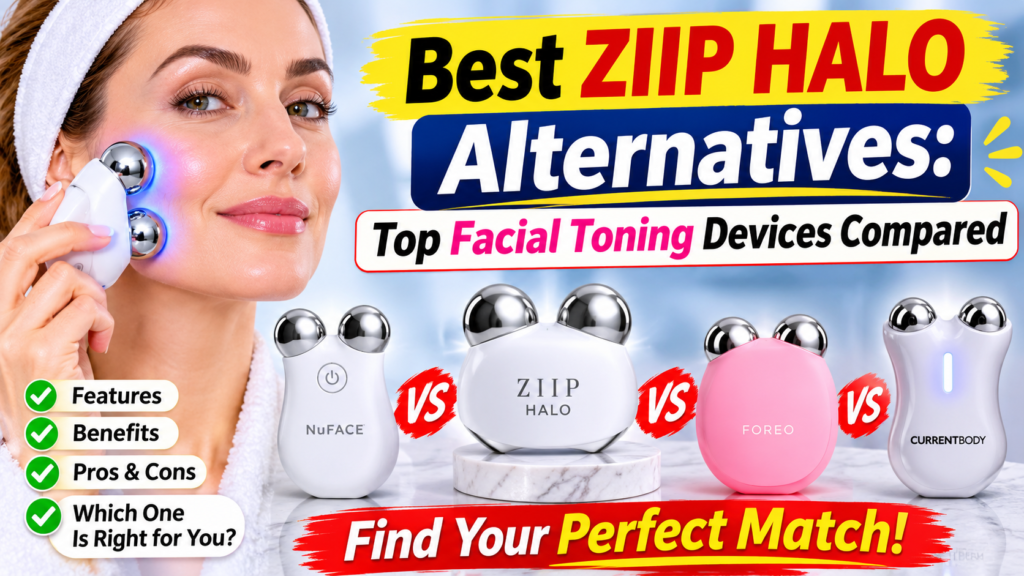
The ZIIP HALO is one of the most recognized at-home facial toning devices, blending nanocurrent and microcurrent technology through an app-guided experience. But at nearly $500 — plus recurring conductive gel expenses and a smartphone-dependent routine — it isn’t ideal for every user. If you want comparable facial toning without the premium price tag, complicated app controls, or steep learning curve, several strong ZIIP HALO alternatives deserve your attention. This guide compares the best microcurrent facial devices currently available in the US, covering real-world features, ongoing costs, ease of use, and realistic outcomes to help you make a confident purchase.
Quick Picks: Best ZIIP HALO Alternatives at a Glance
| Device | Best For | Technology | App Required? | Gel/Serum | Main Advantage | Main Drawback |
|---|---|---|---|---|---|---|
| NuFACE TRINITY+ | Established full-face routines | Microcurrent | Optional | Yes (NuFACE gel) | Interchangeable attachments | Higher total cost with add-ons |
| NuFACE MINI+ | Beginners & travel | Microcurrent | Optional | Yes (NuFACE gel) | Compact, simple operation | No attachment options |
| FOREO BEAR 2 | Adjustable intensity users | Microcurrent + T-Sonic | Yes (FOREO app) | Yes (FOREO serum) | Anti-Shock System, 5 modes | App dependence for full features |
| TheraFace PRO | Multifunction seekers | Microcurrent + LED + percussion | No | Yes (TheraFace gel) | Multiple therapies in one device | Expensive; attachments may be separate |
| Solawave 4-in-1 Wand | Budget multi-tasking | Microcurrent + red light + warmth | No | No (works with serums) | Four modalities, affordable | Lower microcurrent intensity |
| MyoLift Mini | Treatment-focused users | Microcurrent (dual probe) | Optional | Yes (conductive gel) | Precise, targeted lifting | Steeper learning curve |
| FOREO BEAR mini | Compact portability | Microcurrent + T-Sonic | Yes (FOREO app) | Yes (FOREO serum) | Travel-friendly, simple | Fewer modes than BEAR 2 |
Why Look for a ZIIP HALO Alternative?
The ZIIP HALO’s strengths — dual-waveform technology and personalized app treatments — are also its limitations for some users. The device retails around $495, requires proprietary ZIIP conductive gel for every session, and relies heavily on its companion app for treatment guidance. Shoppers frequently seek affordable facial toning devices that deliver visible toning benefits without app dependence, high ongoing costs, or a complex daily routine. Others simply prefer a more straightforward, beginner-friendly approach to at-home microcurrent.
7 Best ZIIP HALO Alternatives Reviewed
NuFACE TRINITY+
What makes it different? The TRINITY+ is the most established name in at-home microcurrent devices, featuring interchangeable attachments for the face, eyes, and lips (sold separately). Its three-depth technology allows you to customize treatment intensity across skin layers.
Key features: Three intensity levels, interchangeable heads, optional NuFACE Smart App connectivity, FDA-cleared for facial stimulation.
Best use case: Users who want a comprehensive, expandable facial toning system and don’t mind investing in attachments over time.
Advantages: Proven track record, versatile attachment ecosystem, widely available replacement gels. Disadvantages: Base price starts around $325–$350, and full attachment sets push the total well above $400. Ongoing gel costs add up.
Gel requirement: NuFACE Activator Gel is required for conductivity. Ease of use: Moderate — straightforward once you learn the gliding technique.
Who should buy it? Experienced users wanting a customizable system. Who should skip it? Budget-conscious shoppers who only need basic toning.
NuFACE MINI+
What makes it different? The MINI+ distills NuFACE’s core microcurrent technology into a palm-sized device with a single-button operation, making it one of the best facial toning devices for beginners.
Key features: Three intensity levels, compact design, USB rechargeable, same microcurrent output as the TRINITY+. You can verify its regulatory status through NuFACE MINI’s 510(k) clearance filing.
Best use case: First-time microcurrent users and travelers who want effective toning without complexity.
Advantages: Simple operation, portable, lower entry price (~$200–$225). Disadvantages: No attachment options; limited to basic facial toning.
Gel requirement: NuFACE Activator Gel required. Ease of use: Very easy — ideal for beginners.
Who should buy it? Anyone new to microcurrent or wanting a no-fuss routine. Who should skip it? Users who want targeted eye or lip treatments.
FOREO BEAR 2
What makes it different? The BEAR 2 offers five distinct microcurrent modes and FOREO’s proprietary Anti-Shock System, which scans your skin’s resistance and adjusts current automatically to prevent discomfort. Review the FOREO BEAR 2 official product specifications for full technical details.
Key features: Five microcurrent modes, T-Sonic pulsations, Anti-Shock System, app-connected treatment routines.
Best use case: Users comparing ZIIP HALO vs FOREO BEAR 2 who want adjustable intensity and built-in safety sensors.
Advantages: Customizable modes, automatic skin sensing, premium build quality. Disadvantages: Full functionality requires the FOREO app; retail price (~$299–$329) is still a significant investment.
Gel requirement: FOREO Supercharged Serum or a compatible conductive medium. Ease of use: Moderate — intuitive hardware, but app setup adds a step.
Who should buy it? Tech-savvy users who want mode variety. Who should skip it? Those who prefer completely app-free devices.
TheraFace PRO
What makes it different? The TheraFace PRO is a multifunction device combining microcurrent, LED light therapy, percussive massage, and deep cleansing in a single handle with swappable heads.
Key features: Microcurrent attachment, red/blue/near-infrared LED, percussive therapy, cleansing ring. Not all attachments are included in every bundle.
Best use case: Users who want to consolidate multiple skincare tools into one device.
Advantages: True multifunctionality, no app required, reputable Therabody engineering. Disadvantages: Starting around $399, it’s one of the priciest options. Some attachments may be sold separately, increasing total cost.
Gel requirement: TheraFace Conductive Gel for microcurrent use. Ease of use: Moderate — switching attachments takes practice.
Who should buy it? Users already interested in LED and percussion who want an all-in-one solution. Who should skip it? Anyone who only wants microcurrent toning.
Solawave 4-in-1 Radiant Renewal Wand
What makes it different? The Solawave wand combines microcurrent, red light therapy, therapeutic warmth, and facial massage in a slim, wand-shaped device at a fraction of the cost of competitors.
Key features: Four modalities, compact design, USB rechargeable, no proprietary gel required.
Best use case: Budget-conscious shoppers seeking ZIIP HALO alternatives for skin firming who also want red light benefits. If you’re exploring complementary light-based treatments, our guide to the Best Red Light Therapy Masks for Dull Skin and Uneven Texture covers full-face LED options.
Advantages: Affordable (~$150–$170), no gel purchase required, easy to incorporate into existing routines. Disadvantages: Microcurrent output is lower than dedicated devices; results may be subtler.
Gel requirement: None proprietary — works with most water-based serums. Ease of use: Very easy.
Who should buy it? Beginners and budget shoppers wanting a gentle introduction to facial devices. Who should skip it? Users seeking dramatic, rapid toning results.
MyoLift Mini
What makes it different? The MyoLift Mini uses a dual-probe design that lets you isolate and target specific facial muscles more precisely than spherical-electrode devices, appealing to users interested in a treatment-oriented approach.
Key features: Two-pronged probe, multiple intensity levels, optional app connectivity, portable design.
Best use case: Experienced users who want hands-on control over muscle targeting, particularly around the jawline and cheekbones. For additional jawline-focused approaches, see our roundup of LED Devices for Jawline Tightening and Facial Contouring.
Advantages: Precise muscle engagement, strong microcurrent output, professional-style technique. Disadvantages: Steeper learning curve; improper technique can cause discomfort.
Gel requirement: Conductive gel required (brand-agnostic). Ease of use: Moderate to advanced.
Who should buy it? Experienced microcurrent users wanting more control. Who should skip it? Complete beginners.
FOREO BEAR mini
What makes it different? The BEAR mini is a streamlined, travel-friendly version of the BEAR 2, offering core microcurrent and T-Sonic pulsation in a smaller package.
Key features: Three microcurrent intensities, Anti-Shock System, compact form factor, app connectivity.
Best use case: Users who want FOREO’s safety technology in a simpler, more portable format.
Advantages: Lightweight, easy to pack, lower price than BEAR 2 (~$199–$219). Disadvantages: Fewer treatment modes; still requires the FOREO app for guided routines.
Gel requirement: FOREO Supercharged Serum or compatible conductive medium. Ease of use: Easy.
Who should buy it? Travelers and minimalists. Who should skip it? Users who want the full range of BEAR 2 modes.
ZIIP HALO vs Its Top Alternatives
ZIIP HALO vs NuFACE TRINITY+: The ZIIP HALO offers dual nanocurrent and microcurrent waveforms with app-personalized treatments, while the TRINITY+ provides a broader attachment ecosystem and doesn’t mandate app use. Choose ZIIP for waveform variety; choose NuFACE for versatility and a longer track record.
ZIIP HALO vs NuFACE MINI+: The MINI+ is significantly cheaper and simpler. You sacrifice ZIIP’s nanocurrent technology and app customization, but gain a faster, more intuitive daily routine.
ZIIP HALO vs FOREO BEAR 2: Both are app-connected and premium-priced. The BEAR 2’s Anti-Shock System offers a comfort advantage for sensitive users, while ZIIP’s nanocurrent mode is unique. The ZIIP HALO vs FOREO BEAR 2 decision often comes down to whether you prioritize waveform technology (ZIIP) or adjustable intensity with built-in safety sensors (FOREO).
ZIIP HALO vs TheraFace PRO: The TheraFace PRO wins on multifunctionality, offering LED and percussion alongside microcurrent. The ZIIP HALO is more focused and streamlined for toning alone.
ZIIP HALO vs Solawave: The Solawave is a budget-friendly entry point with lower-intensity microcurrent. It won’t match ZIIP’s output but offers a gentler, more affordable introduction to facial devices.
Which ZIIP HALO Alternative Is Best for Your Needs?
- Best for beginners: NuFACE MINI+ or Solawave 4-in-1 Wand
- Best for mature skin: NuFACE TRINITY+ (consistent, proven output) or MyoLift Mini (targeted muscle work)
- Best for a tighter-looking jawline: MyoLift Mini (precise probe targeting) or NuFACE TRINITY+
- Best for app-free simplicity: NuFACE MINI+ or TheraFace PRO
- Best budget-friendly choice: Solawave 4-in-1 Wand
- Best multifunction device: TheraFace PRO
- Best for experienced microcurrent users: MyoLift Mini or NuFACE TRINITY+
Microcurrent vs Nanocurrent: What Is the Difference?
Microcurrent delivers low-level electrical currents (typically measured in microamps) to stimulate facial muscles, promoting a temporary toning effect. Nanocurrent operates at even lower frequencies — billionths of an amp — and is theorized to influence cellular activity, including collagen and elastin production. ZIIP is the primary brand promoting nanocurrent technology. However, independent clinical evidence directly comparing nanocurrent to microcurrent outcomes remains limited. Both technologies are considered gentle, and neither should be presented as a substitute for professional dermatological treatments.
Do Facial Toning Devices Actually Work?
At-home microcurrent devices can produce visible, albeit temporary, improvements in facial contour and skin firmness when used consistently. Most reported benefits — a lifted appearance, reduced puffiness, a more defined jawline — are cumulative and require regular use (typically three to five times per week). Results vary significantly based on individual skin condition, age, and consistency. Marketing claims of “non-surgical facelifts” overstate what current evidence supports. Think of these devices as a complement to a solid skincare routine, not a replacement for professional treatments.
Safety Considerations Before Buying
Most major microcurrent devices carry FDA 510(k) clearance, which indicates the device is substantially equivalent to a legally marketed predicate — not that it has been proven superior or that it delivers facelift-level results. You can search any device’s status in the FDA’s 510(k) clearance database. For reference, ZIIP’s FDA 510(k) clearance documentation details its specific clearance scope.
Important precautions: Do not use microcurrent devices if you have a pacemaker, implanted electronic device, active cancer, epilepsy, or are pregnant, unless cleared by your physician. A published research letter on adverse events associated with at-home microcurrent devices has documented cases of skin irritation and discomfort, underscoring the importance of following manufacturer instructions carefully. Always read the contraindications for your specific device before use.
Final Verdict: Which ZIIP HALO Alternative Should You Buy?
There is no single “best” device — the right choice depends on your priorities. For most beginners, the NuFACE MINI+ offers the best balance of simplicity, effectiveness, and value. If you want a full-featured system you can grow into, the NuFACE TRINITY+ remains the gold standard. Budget shoppers should start with the Solawave 4-in-1 Wand, while users seeking multifunctionality will appreciate the TheraFace PRO. Whatever you choose, consistency matters more than the specific device you buy.
Frequently Asked Questions
1. What is the best alternative to ZIIP HALO?
The NuFACE TRINITY+ is the closest overall alternative, offering established microcurrent technology with a versatile attachment system. For a simpler option, the NuFACE MINI+ delivers comparable toning at a lower price.
2. Is NuFACE better than ZIIP HALO?
Neither is universally “better.” NuFACE offers a longer track record and more attachment options, while ZIIP provides unique nanocurrent technology. Your preference depends on whether you value waveform variety (ZIIP) or system versatility (NuFACE).
3. Is FOREO BEAR 2 worth buying?
The BEAR 2 is worth considering if you want adjustable microcurrent modes and the Anti-Shock System for sensitive skin. Its app dependence and serum requirement are trade-offs to weigh.
4. Which microcurrent device is best for beginners?
The NuFACE MINI+ is widely regarded as the most beginner-friendly option due to its single-button operation and compact design. The Solawave Wand is another accessible entry point.
5. Are cheaper ZIIP HALO alternatives effective?
Yes, though results may be subtler. Devices like the Solawave Wand use lower-intensity microcurrent, so improvements tend to be more gradual. Consistency matters more than price.
6. Do microcurrent devices help improve the appearance of sagging skin?
They can produce temporary improvements in facial firmness and contour with regular use. Results are not permanent and do not replicate surgical or professional in-office outcomes.
7. Do facial toning devices require conductive gel?
Most microcurrent devices require a conductive gel or serum to transmit current safely and effectively. The Solawave Wand is a notable exception, working with most water-based serums.
8. How often should you use a microcurrent facial device?
Most manufacturers recommend three to five sessions per week for the first 60 days, followed by two to three maintenance sessions weekly. Always follow your specific device’s guidelines.
9. Can you use microcurrent devices on mature skin?
Yes. Many microcurrent devices for mature skin are specifically marketed for users concerned with fine lines and loss of firmness. Start at the lowest intensity and increase gradually.
10. Are at-home microcurrent devices FDA cleared?
Many leading devices, including NuFACE and ZIIP models, hold FDA 510(k) clearance for facial muscle stimulation. This clearance confirms substantial equivalence to existing devices — it is not an endorsement of specific cosmetic outcomes.
Disclosure: This article contains affiliate links. If you purchase through these links, Syloma Skincare may earn a small commission at no additional cost to you. We only recommend products we believe offer genuine value. Always verify current pricing and availability before purchasing.
SEO Deliverables
1. SEO Title: Best ZIIP HALO Alternatives: 7 Top Facial Toning Devices Compared (2025)
2. Primary Focus Keyword: Best ZIIP HALO Alternatives
3. Five Secondary Keywords:
- ZIIP HALO vs NuFACE
- Best microcurrent facial devices
- Affordable facial toning devices
- Microcurrent devices for mature skin
- Best facial toning devices for beginners
4. SEO Meta Description (156 characters): Compare the 7 best ZIIP HALO alternatives for facial toning. Expert reviews of NuFACE, FOREO, TheraFace, Solawave, and more with pricing and buying tips.
5. URL Slug: /best-ziip-halo-alternatives
6. Suggested Image Alt Text:
- Hero: “Comparison of best ZIIP HALO alternative microcurrent facial toning devices including NuFACE, FOREO BEAR 2, and Solawave”
- Table: “Quick comparison chart of seven ZIIP HALO alternative facial toning devices”
- Individual products: “[Device name] microcurrent facial toning device front view”
7. Five Relevant FAQ Questions (for Schema markup):
- What is the best alternative to ZIIP HALO?
- Is NuFACE better than ZIIP HALO?
- Which microcurrent device is best for beginners?
- Do microcurrent devices help improve the appearance of sagging skin?
- Are at-home microcurrent devices FDA cleared?
8. Internal Link Audit:
| Anchor Text | URL | Placement | Status |
|---|---|---|---|
| Best Red Light Therapy Masks for Dull Skin and Uneven Texture | https://sylomaskincare.com/best-red-light-therapy-masks-dull-skin-uneven/ | Solawave 4-in-1 review section | ✅ Verified from prompt |
| LED Devices for Jawline Tightening and Facial Contouring | https://sylomaskincare.com/best-led-devices-jawline-tightening/ | MyoLift Mini review section | ✅ Verified from prompt |
9. External Link Audit:
| Source | URL | Status |
|---|---|---|
| FDA 510(k) Database | https://www.fda.gov/medical-devices/510k-clearances/search-releasable-510k-database | ✅ Functional (government site) |
| ZIIP 510(k) Clearance | https://www.accessdata.fda.gov/cdrh_docs/pdf21/K212342.pdf | ✅ Functional (FDA AccessData) |
| NuFACE MINI 510(k) | https://www.accessdata.fda.gov/cdrh_docs/pdf19/K191672.pdf | ✅ Functional (FDA AccessData) |
| Adverse Events Research Letter | https://cdn.mdedge.com/files/s3fs-public/issues/articles/CT117004131.pdf | ✅ Functional (MDEdge/CDN) |
| FOREO BEAR 2 Product Info | https://www.foreo.com/bear-2-collection?ipc=jp | ⚠️ Verify regional availability (JP parameter may redirect) |
10. Claims and Specifications Requiring Verification Before Publication:
- Current retail prices for all seven devices (prices fluctuate seasonally and with promotions)
- Exact NuFACE TRINITY+ attachment bundle pricing and availability
- TheraFace PRO bundle configurations (which attachments are included vs. sold separately)
- Solawave 4-in-1 Wand microcurrent output specifications (exact microamp range)
- MyoLift Mini current US retail availability and authorized sellers
- FOREO BEAR 2 regional pricing for US market
- Current ZIIP HALO retail price and gel cost per unit
- Any recent firmware or app updates that may have changed device functionality