
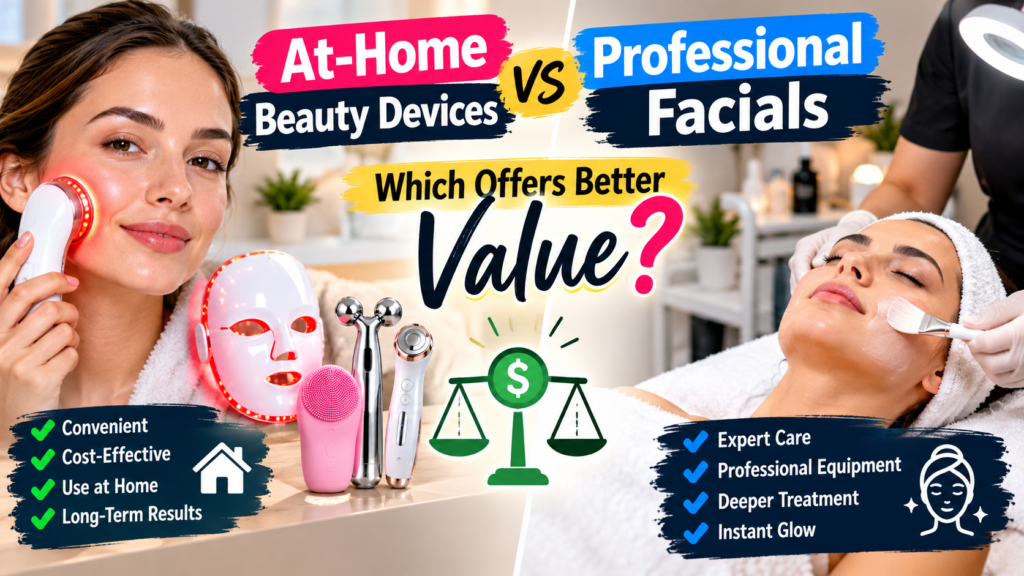
The skincare aisle and the spa menu are both crowded with promises. On one side, sleek at-home beauty devices claim to deliver clinical-grade results from your couch. On the other, professional facials offer expert hands, medical-grade products, and the reassurance of a trained esthetician. So which option actually gives you more for your money?
The honest answer: it depends on the technology, how often you’ll use it, your specific skin concerns, and the real costs involved over time. Neither at-home beauty devices nor professional facials automatically win for every person. A $300 LED mask used twice a week can outperform a $150 facial you book once a year — but that same mask won’t replicate the deep exfoliation of a professional chemical peel. Understanding the differences is the only way to spend wisely.
At-Home Beauty Devices vs Professional Facials: Quick Comparison
| Factor | At-Home Beauty Devices | Basic Spa Facial | Advanced Clinical Treatment |
|---|---|---|---|
| Upfront cost | $50–$600+ per device | None | None |
| Long-term cost | Low after purchase | $600–$1,800+/year | $1,500–$5,000+/year |
| Convenience | High — use at home | Requires booking and travel | Requires booking, travel, possible downtime |
| Personalization | Limited to device settings | Moderate | High — clinician-directed |
| Treatment intensity | Low to moderate | Moderate | High |
| Potential results | Gradual, maintenance-level | Moderate, short-term glow | More dramatic for targeted concerns |
| Maintenance | Ongoing home use | Regular appointments | Series + maintenance sessions |
| Safety supervision | Self-directed | Esthetician present | Dermatologist or licensed clinician |
| Best for | Consistent maintenance, mild concerns | Relaxation, general upkeep | Significant pigmentation, scarring, laxity |
Note: “Basic spa facial” refers to cleansing, exfoliation, and hydration treatments. “Advanced clinical treatment” includes procedures like chemical peels, microneedling, and laser therapy performed by licensed professionals.
What Counts as an At-Home Beauty Device?
At-home beauty devices are consumer-grade tools designed for non-invasive skincare use without professional supervision. The most common categories include:
- LED light therapy masks and panels that emit specific wavelengths (typically red, near-infrared, or blue light) to support collagen production or target acne-causing bacteria.
- Microcurrent devices that deliver low-level electrical currents intended to stimulate facial muscles and temporarily improve the appearance of tone.
- Cleansing brushes and sonic tools that assist with surface exfoliation and product removal.
- Radiofrequency and ultrasonic devices marketed for skin tightening and product penetration.
These technologies are not interchangeable. An LED mask and a microcurrent wand address different concerns through entirely different mechanisms, so comparing “at-home devices” as a single category to “professional facials” can be misleading. Each device should be evaluated on its own evidence base and intended use.
What Do Professional Facials Offer?
Professional facials span a wide spectrum. A basic spa facial typically includes cleansing, gentle exfoliation, steam, extractions, a mask, and moisturizer. The primary benefits are thorough deep-cleaning, short-term hydration, and the value of a trained esthetician assessing your skin in person.
More advanced clinical treatments — such as medical-grade chemical peels, microneedling, and laser resurfacing — go well beyond a standard facial. These procedures can address deeper pigmentation, textural irregularities, and scarring that no consumer device is designed to treat. The American Academy of Dermatology notes that microneedling performed by a professional can help reduce the appearance of acne scars, a result that at-home rollers cannot safely replicate at comparable depths.
The real value of professional care often lies in the assessment and customization a trained provider offers, not just the products they apply.
At-Home Devices vs Professional Facials: Which Gives Better Results?
LED Masks vs Professional LED Facials
At-home LED masks deliver lower irradiance (light energy output) than the large clinical panels used in medspas. This means results from a home mask accumulate more slowly and require consistent use — typically three to five sessions per week over several months. Professional LED sessions deliver a higher dose in a single visit but are usually spaced weeks apart.
For general skin maintenance and mild redness, a well-made home LED mask used consistently can offer comparable cumulative benefits at a fraction of the long-term cost. If you’re curious about the evidence behind this technology, our guide on whether LED face masks really work breaks down the published research in plain language. The American Academy of Dermatology also provides an overview of red light therapy and its current evidence base.
Microcurrent Devices vs Professional Treatments
Consumer microcurrent devices operate at a fraction of the power used in professional treatments. Realistic expectations matter here: home microcurrent may offer a temporary, subtle improvement in the appearance of facial contour, but it does not permanently lift or restructure tissue. Professional microcurrent sessions are stronger but still require ongoing maintenance. Neither option replaces surgical or injectable interventions for significant skin laxity.
Cleansing Devices vs Professional Extractions
Sonic cleansing brushes can improve daily product removal and mild surface exfoliation. However, they do not replicate manual extractions performed by a licensed esthetician, who can safely clear clogged pores with minimal risk of scarring. The AAD recommends caution with at-home exfoliation to avoid irritation, particularly for sensitive or acne-prone skin.
Home Devices vs Chemical Peels, Microneedling, and Laser Procedures
These professional procedures are not simply “stronger versions” of a home facial device. They involve controlled tissue injury, medical-grade formulations, and recovery periods that require clinical oversight. Consumer devices are not designed — and should not be used — to replicate these treatments. At-home microneedling rollers, in particular, carry significant infection and scarring risks when used without proper training and sterile technique.
The Real Cost Comparison: Which Option Saves More Money?
The following scenarios use illustrative US dollar figures based on commonly reported price ranges. Actual costs vary significantly by city, provider, and device brand. These examples are meant to demonstrate the math, not to represent verified market averages.
Key formulas:
- Annual professional cost = cost per visit × visits per year
- First-year home-device cost = purchase price + accessories and consumables
- Estimated break-even visits = device cost ÷ cost of one comparable professional session
Scenario 1: Occasional Professional Facials
- Cost per basic facial: ~$125
- Visits per year: 4
- Annual cost: $500
- No device purchase
Scenario 2: Monthly Professional Facials
- Cost per basic facial: ~$125
- Visits per year: 12
- Annual cost: $1,500
- No device purchase
Scenario 3: At-Home LED Mask (Consistent Use)
- Device purchase price: ~$300 (mid-range FDA-cleared LED mask)
- Accessories and replacement parts (first year): ~$0–$30
- First-year total: ~$300–$330
- Ongoing annual cost: ~$0–$30
Break-even illustration: If you currently pay $125 per professional LED session, a $300 home LED mask reaches break-even after roughly 2 to 3 comparable sessions ($300 ÷ $125 ≈ 2.4). After that point, the home device costs less per use.
Important caveat: This calculation is meaningful only when the home device and professional treatment target reasonably comparable goals. A $300 LED mask does not replace a $250 HydraFacial or a $400 chemical peel — they address different concerns with different mechanisms. The cheaper option is not automatically the equivalent treatment.
The FDA provides guidance on home-use aesthetic devices and what consumers should understand before purchasing.
Which Option Offers Better Value for Different Skin Goals?
- Mild dullness and basic maintenance: A consistent at-home routine with a gentle cleansing device or LED mask often provides sufficient support between occasional facials.
- Early signs of aging: An LED mask or microcurrent device used regularly may complement a good topical routine. For more targeted concerns, consider our picks for LED face masks for mature skin and fine lines.
- Acne-prone skin: Blue-light home devices may help with mild breakouts, but moderate to severe acne typically requires professional evaluation and possibly prescription treatment.
- Sensitive skin: Proceed cautiously with any device. Professional guidance helps you avoid irritation from inappropriate wavelengths or intensities.
- Deep scars, pronounced pigmentation, or significant laxity: Professional clinical treatments are generally more appropriate. Consumer devices are not designed for these concerns.
- People who value expert guidance: Regular professional visits offer personalized skin assessments that no device can replicate.
- People who prioritize convenience: At-home devices eliminate travel, scheduling, and per-visit costs — but only if you’ll actually use them consistently.
Safety, Evidence, and Realistic Expectations
Not all at-home beauty devices are created equal. Evidence quality varies widely by technology, brand, and study design. A few principles to keep in mind:
- FDA clearance is not a results guarantee. The FDA regulates aesthetic and cosmetic devices for safety and substantial equivalence, but clearance does not mean the agency has verified specific cosmetic outcomes for every product.
- Follow manufacturer instructions precisely. Overuse of LED devices, excessive microcurrent intensity, or aggressive sonic cleansing can cause irritation, burns, or barrier damage.
- Be skeptical of dramatic before-and-after photos. Lighting, angles, and makeup can significantly alter appearance in marketing images.
- Avoid at-home microneedling beyond very superficial depths. The risk of infection, scarring, and granuloma formation increases with needle length and improper sterilization.
- Consult a board-certified dermatologist if you have a diagnosed skin condition, are using prescription retinoids, or are considering combining devices with professional procedures.
Can You Combine At-Home Beauty Devices and Professional Facials?
In many cases, yes — and this combination often delivers the best overall value. A practical approach might look like this:
- Use an at-home LED mask several times per week for ongoing maintenance.
- Book a professional facial quarterly for deep cleansing, extractions, and expert skin assessment.
- Reserve clinical treatments like peels or microneedling for specific concerns, following your provider’s guidance on when to pause home devices before and after the procedure.
Always check with your esthetician or dermatologist before combining active treatments. Some professional procedures require you to stop using certain devices for a period before and after your appointment to minimize irritation.
How to Choose the Best Value for Your Budget
Use this checklist before spending:
- Define your primary skin concern. Match the technology to the problem, not the marketing.
- Calculate your real annual spend. Include travel, tips, and booking fees for professional visits; include accessories and replacement parts for devices.
- Check the evidence. Look for published, peer-reviewed studies specific to the device type — not just brand-funded testimonials.
- Be honest about consistency. A device that sits in a drawer costs more per use than a monthly facial.
- Review safety and clearance. Verify FDA status and read the contraindications.
- Check the return policy and warranty. A 30-day return window lets you test the device risk-free.
- Consider your comfort level. If you’re unsure about self-treating, a professional session may be the safer starting point.
Final Verdict — Which Offers Better Value?
At-home beauty devices offer better long-term value for people with mild to moderate concerns who will use the device consistently and whose goals align with what the technology can realistically deliver. An LED mask used four times a week for a year costs a fraction of monthly professional facials and can provide meaningful cumulative benefits for skin tone and texture.
Professional facials offer better value when you need expert assessment, deep extractions, or clinical-grade treatments that consumer devices simply cannot replicate. If you have significant pigmentation, scarring, or laxity, investing in professional care is both safer and more effective.
The best financial decision for many people is a combination: a reliable at-home device for daily or weekly maintenance, supplemented by quarterly professional visits for deeper treatment and expert guidance. And sometimes, the most cost-effective choice is neither — a well-formulated topical routine with sunscreen may be all your skin actually needs.
Frequently Asked Questions
1. Are at-home beauty devices worth the money?
They can be, if you choose a device backed by credible evidence, use it consistently, and have realistic expectations. A device that addresses your specific concern and replaces frequent professional visits may pay for itself within a few months. A gadget that doesn’t match your goals is an expensive paperweight.
2. Are home facial devices as effective as professional facials?
Not directly. Home devices operate at lower intensities and cannot replicate professional-grade procedures like chemical peels or clinical microneedling. For maintenance-level concerns like mild dullness or early signs of aging, consistent home use can deliver gradual results that complement — but don’t fully replace — professional care.
3. How many professional facials would equal the cost of a home LED mask?
Using illustrative figures, a $300 LED mask reaches cost parity with approximately two to three professional LED sessions at $100–$150 each. After that point, the home device costs less per use, assuming you continue using it regularly.
4. Can an LED mask replace a professional facial?
An LED mask can replace the LED-light component of a professional facial, but it does not replicate the cleansing, extractions, exfoliation, and personalized assessment that a full facial provides. They address overlapping but distinct aspects of skin health.
5. Which is better for long-term skincare, a home device or a facial?
Long-term skin health depends more on consistency than on the setting. A home device used several times per week may provide more cumulative benefit than an occasional facial. However, periodic professional assessments help catch changes early and adjust your routine appropriately.
6. Are professional facials worth the extra cost?
For deep cleansing, expert extractions, clinical-grade treatments, and personalized skin analysis, yes. For basic hydration and relaxation, a well-designed home routine may offer similar benefits at lower cost.
7. Can you use an at-home beauty device between professional treatments?
Generally yes, but always confirm with your provider. Some procedures require you to pause certain devices for several days before and after treatment to reduce the risk of irritation or adverse reactions.
On-Page SEO Deliverables
SEO Title: At-Home Beauty Devices vs Professional Facials: Cost, Results & Value Compared
Primary Focus Keyword: at-home beauty devices vs professional facials
Secondary Keywords:
- at-home beauty devices vs professional treatments
- are at-home beauty devices worth it
- at-home facial devices cost comparison
- LED mask vs professional facial
- professional facial cost vs home device
- at-home skincare device benefits
- cost-effective skincare treatments
SEO Slug: /at-home-beauty-devices-vs-professional-facials/
Meta Description: At-home beauty devices vs professional facials: compare real costs, results, and long-term value with transparent break-even math and expert safety guidance.
Featured Image Alt Text: Side-by-side comparison of a woman using an at-home LED face mask and receiving a professional facial treatment at a spa
Image Placement Suggestions:
- Hero image at the top: split visual of home device use and spa facial.
- After the quick comparison table: an infographic summarizing the cost break-even math.
- In the LED section: a close-up of an LED mask in use at home.
- In the safety section: a visual checklist of FDA clearance and contraindication reminders.
Final Link Audit
Internal Links Used
| URL | Anchor Text | Placement | Verification Status |
|---|---|---|---|
| https://sylomaskincare.com/do-led-face-masks-really-work/ | whether LED face masks really work | LED Masks vs Professional LED Facials section | URL provided by client; live verification recommended before publishing |
| https://sylomaskincare.com/best-led-face-masks-mature-skin-fine-lines/ | LED face masks for mature skin and fine lines | Value for Different Skin Goals section | URL provided by client; live verification recommended before publishing |
Note: The remaining four Syloma URLs provided in the brief (ultimate LED buying guide, best at-home red light therapy, LED masks for beginners over 40, red light therapy for firmness) were reviewed for contextual relevance but not forced into the article where they did not fit naturally. They can be added during editorial review if the content is expanded.
External Links Used
| URL | Anchor Text | Placement |
|---|---|---|
| https://www.aad.org/public/cosmetic/safety/red-light-therapy | American Academy of Dermatology overview of red light therapy | LED Masks vs Professional LED Facials |
| https://www.fda.gov/medical-devices/products-and-medical-procedures/aesthetic-cosmetic-devices | FDA regulates aesthetic and cosmetic devices | Safety, Evidence, and Realistic Expectations |
| https://www.aad.org/public/cosmetic/scars-stretch-marks/microneedling-fade-scars/ | American Academy of Dermatology notes on professional microneedling | What Do Professional Facials Offer |
| https://www.fda.gov/medical-devices/home-use-devices/frequently-asked-questions-about-home-use-devices | FDA guidance on home-use aesthetic devices | Real Cost Comparison section |
| https://www.aad.org/public/everyday-care/skin-care-secrets/routine/safely-exfoliate-at-home | AAD recommendations on safe at-home exfoliation | Cleansing Devices vs Professional Extractions |
Claims Requiring Editorial Verification
- Illustrative cost figures ($125 per facial, $300 LED mask) are clearly labeled as hypothetical examples, not verified market averages. Confirm that these ranges align with current US pricing in your target market before publishing.
- All external links point to authoritative government and medical association pages. Verify that URLs remain active and that page content still supports the referenced claims at time of publication.