
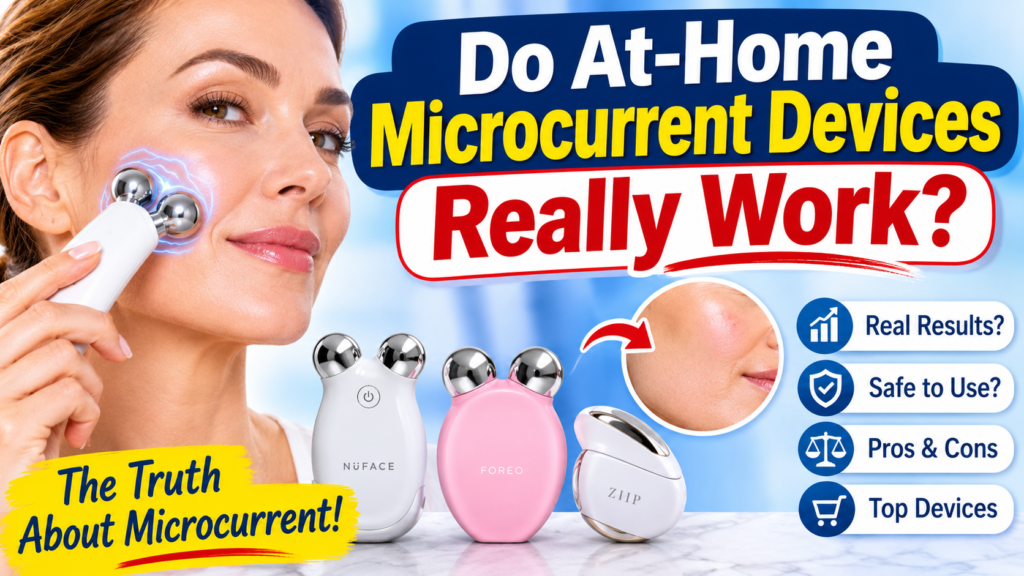
You’ve seen the glowing before-and-after photos. You’ve watched the influencer tutorials. But the real question remains: do at-home microcurrent devices really work, or are they just another expensive beauty trend gathering dust in your bathroom drawer?
The short answer is nuanced. These devices can produce subtle, temporary improvements in facial tone for some users, but the scientific evidence for dramatic, lasting results is still limited. Here’s what the research actually shows — and what you should know before spending $200 or more.
Quick Verdict
At-home microcurrent facial devices may deliver modest visible changes, particularly in the short term. Most users report a temporary “lifted” look immediately after use, with incremental improvements over several weeks of consistent treatment. However, independent clinical research remains sparse, and results vary significantly between individuals. These devices are most worthwhile for people who enjoy a daily skincare ritual and maintain realistic expectations — not for anyone seeking the dramatic, permanent results of a surgical facelift.
What Is Microcurrent Technology?
Microcurrent therapy uses extremely low-level electrical currents — typically between 10 and 500 microamps — to stimulate facial muscles and skin cells. Unlike the stronger electrical muscle stimulation (EMS) devices regulated by the FDA for physical therapy and rehabilitation, microcurrent operates below the threshold of visible muscle contraction. Think of it as a gentle nudge rather than an intense workout. According to Medical News Today’s overview of microcurrent facials, the technology originated in clinical settings for wound healing before being adapted for cosmetic use.
How Do At-Home Microcurrent Devices Work?
When you glide a microcurrent device across your face, two electrodes deliver a low-level current through your skin. This current is proposed to stimulate facial muscles, encouraging subtle contractions that may improve tone over time. Manufacturers also claim microcurrent boosts adenosine triphosphate (ATP) production at the cellular level, potentially supporting collagen and elastin synthesis.
However, much of the ATP research originates from in-vitro laboratory studies, and it’s important to separate established findings from proposed mechanisms and marketing claims. Conductive gel is essential — it reduces skin resistance and allows the current to flow evenly. Without it, the device won’t function properly and may cause uncomfortable tingling or irritation.
Do At-Home Microcurrent Devices Really Work? What Does Science Say?
This is where honesty matters most. A 2024 comprehensive review of home-use beauty devices published in peer-reviewed literature found that while consumer interest in at-home devices is surging, the clinical evidence supporting their efficacy remains limited by small sample sizes, short follow-up periods, and frequent industry sponsorship.
The NuFACE device received FDA 510(k) clearance as a facial toning device, but it’s critical to understand that FDA clearance is not the same as FDA approval. Clearance indicates the device is substantially equivalent to an already-marketed product — it does not independently verify every cosmetic claim made in advertising.
Recent research on home-based dermatologic devices reinforces that while some studies show short-term improvements in skin texture and firmness, robust randomized controlled trials specifically isolating microcurrent’s effects on facial lifting are scarce. Many positive studies combine microcurrent with other technologies like LED or radiofrequency, making it impossible to attribute results to microcurrent alone.
In short: the science is promising but preliminary. No peer-reviewed study to date has conclusively demonstrated that at-home microcurrent produces permanent facial lifting.
What Results Can You Actually Expect?
Immediately after treatment: Many users notice a subtle “snatched” look — reduced puffiness and slightly more defined contours. This effect is largely temporary, driven by mild muscle stimulation and improved circulation.
After 2–4 weeks: With daily use, some people report firmer-feeling skin and a more toned appearance along the jawline and cheekbones.
After 6–8 weeks: Incremental improvements may become more noticeable in microcurrent facial before-and-after photos, though individual results vary widely.
After 60 days: You’ll likely have a good sense of whether the device works for your skin and facial structure.
When you stop: Results gradually fade within a few weeks as muscles return to their baseline state. Consistency is the key factor.
These timelines reflect commonly reported consumer experiences, not guaranteed clinical outcomes.
Which At-Home Microcurrent Devices Are Worth Considering?
| Device | Best For | Key Feature | Approx. Price |
|---|---|---|---|
| NuFACE MINI+ | Beginners, travel | Compact, simple one-button use | ~$199 |
| NuFACE TRINITY+ | Full-face routines | Interchangeable attachments | ~$349 |
| FOREO BEAR 2 | Tech-savvy users | Anti-Shock System, app modes | ~$299 |
| ZIIP HALO | Dual-wave therapy | Microcurrent + nanocurrent | ~$399 |
The NuFACE MINI+ is a compact, beginner-friendly option ideal for quick sessions. You can read more about its performance in our NuFACE MINI+ review. The NuFACE TRINITY+ offers interchangeable attachments for more targeted treatments across the face, eyes, and lips.
The FOREO BEAR 2 stands out with its Anti-Shock System and app-connected treatment modes — our full FOREO BEAR 2 review covers its features in detail. The ZIIP HALO combines microcurrent with nanocurrent technology for a dual-wave approach targeting both muscle tone and skin texture.
Each device requires its own proprietary or compatible conductive gel, which adds to long-term costs. If you’re exploring options beyond the major brands, our guides to the best NuFACE alternatives, best FOREO BEAR alternatives, and best ZIIP HALO alternatives cover additional choices at various price points.
Microcurrent vs. Other Facial Rejuvenation Treatments
Microcurrent, LED light therapy, and radiofrequency each target different aspects of skin aging. LED uses specific wavelengths to support collagen production and reduce inflammation. Radiofrequency heats deeper skin layers to stimulate tightening. Microcurrent focuses on muscle stimulation and cellular energy.
Professional in-office treatments deliver stronger, more immediate results because they use higher energy levels under clinical supervision. These technologies aren’t interchangeable — they’re complementary. Some devices now combine two or more modalities, which can be beneficial but also makes it harder to isolate which technology is driving your microcurrent device results.
Microcurrent Facial Benefits
Realistic potential benefits of consistent microcurrent use include:
- Temporary improvement in facial contour and muscle tone
- Reduced morning puffiness and fluid retention
- A subtle “lifted” appearance with regular, ongoing use
- Enhanced product absorption when paired with conductive gel
- A relaxing, spa-like self-care ritual at home
These benefits are modest and cumulative, not transformative.
Microcurrent Facial Side Effects and Safety Concerns
Most users tolerate microcurrent well, but potential side effects include:
- Temporary redness or flushing
- Mild tingling or discomfort during use
- Skin irritation, especially without adequate conductive gel
- Metallic taste in the mouth (a common but harmless sensation)
You should avoid microcurrent entirely if you have a pacemaker, any implanted electronic device, epilepsy or a seizure disorder, or if you are pregnant. Active acne, open wounds, rosacea flares, and certain skin conditions may also be contraindicated. Always read your specific device’s warning label carefully and consult a board-certified dermatologist if you’re unsure whether microcurrent is safe for your situation.
Are Expensive Microcurrent Devices Worth the Money?
A quality microcurrent device costs between $150 and $400 upfront, but the real expense is ongoing. Proprietary conductive gels run $25–$50 per bottle and need regular replacement. Factor in the time commitment — most protocols require five-minute sessions five days a week — and you’re looking at a meaningful investment of both money and routine.
If you’ll realistically stick with it and value the subtle improvements, it can be worthwhile. If you tend to abandon gadgets after a month, your money may be better spent on proven topical retinoids, sunscreen, or occasional professional treatments.
Who Should Buy a Microcurrent Device?
A microcurrent device makes sense if you’re in your 30s or older, notice early signs of sagging, and genuinely enjoy a consistent skincare routine. It’s less ideal if you expect dramatic results, have significant skin laxity that would benefit more from professional intervention, or struggle with daily device compliance.
Final Verdict
So, do at-home microcurrent devices really work? Yes — but with important caveats. They can deliver subtle, temporary improvements in facial tone and contour when used consistently over several weeks. Independent evidence for lasting, dramatic lifting remains limited, and results fade when you stop. If you approach these devices with realistic expectations and commit to regular use, they can be a satisfying addition to your skincare routine. They are not, however, a replacement for professional treatments or a facelift. Check current prices on Amazon to compare models before you decide.
Frequently Asked Questions
1. Do at-home microcurrent devices really work?
They can produce subtle, temporary improvements in facial tone and contour with consistent use. However, independent evidence for dramatic or permanent lifting is still limited.
2. How long does it take to see microcurrent results?
Most users notice a temporary lifted look immediately. More sustained improvements typically appear after 4–8 weeks of daily use, though individual timelines vary.
3. Do microcurrent devices permanently lift your face?
No. Results are temporary and maintenance-dependent. When you stop using the device, your facial muscles gradually return to their baseline state within a few weeks.
4. What happens when you stop using microcurrent?
The toning and lifting effects fade gradually over two to four weeks. Consistent, ongoing use is required to maintain any visible improvements.
5. Can microcurrent help define the jawline?
Some users report improved jawline definition after several weeks of consistent use, particularly along the lower face. Results are subtle and vary between individuals.
6. Are microcurrent devices safe for mature skin?
Generally yes, and mature skin is one of the primary target demographics. However, avoid using microcurrent over broken skin, active irritation, or if you have any medical contraindications.
7. How often should you use a microcurrent device?
Most manufacturers recommend five sessions per week for the first 60 days, then two to three sessions per week for maintenance. Always follow your specific device’s instructions.
8. Is NuFACE better than FOREO BEAR?
Neither is objectively superior. NuFACE offers more attachment versatility with the TRINITY+, while the FOREO BEAR 2 features an Anti-Shock System and app integration. Your preference depends on budget, desired features, and comfort. For a direct comparison, see our FOREO BEAR 2 vs NuFACE MINI+ breakdown.
9. Are cheaper microcurrent devices effective?
Budget devices may deliver weaker or less consistent currents. FDA-cleared devices from established brands have undergone at least basic regulatory review, which cheaper alternatives may lack. Proceed with caution and research thoroughly.
10. Is microcurrent worth the investment?
It depends on your expectations and consistency. If you want subtle improvements and will use the device regularly, it can be worthwhile. If you expect dramatic results or won’t maintain the routine, save your money.
SEO Deliverables
1. SEO Title:
Do At-Home Microcurrent Devices Really Work? Honest 2025 Review
2. Focus Keyword:
Do at-home microcurrent devices really work
3. Secondary Keywords:
Do microcurrent facial devices work, at-home microcurrent facial devices, microcurrent facial before and after, microcurrent facial benefits, microcurrent device results, are microcurrent devices worth it, best microcurrent devices for face, NuFACE vs FOREO BEAR, microcurrent facial side effects, how long do microcurrent results last
4. Meta Description:
Do at-home microcurrent devices really work? We break down the science, realistic results, safety concerns, and whether expensive devices like NuFACE and FOREO are worth it.
5. URL Slug:/do-at-home-microcurrent-devices-really-work/
6. Image Alt Text:
Woman using an at-home microcurrent facial device along the jawlineNuFACE TRINITY+ and FOREO BEAR 2 microcurrent devices side by side comparisonMicrocurrent facial before and after results showing subtle jawline improvement
7. Internal Link Audit:
| # | URL Used | Anchor Text | Section |
|---|---|---|---|
| 1 | https://sylomaskincare.com/nuface-mini-plus-review/ | our NuFACE MINI+ review | Devices |
| 2 | https://sylomaskincare.com/foreo-bear-2-review/ | our full FOREO BEAR 2 review | Devices |
| 3 | https://sylomaskincare.com/best-nuface-alternatives/ | best NuFACE alternatives | Devices |
| 4 | https://sylomaskincare.com/best-foreo-bear-alternatives/ | best FOREO BEAR alternatives | Devices |
| 5 | https://sylomaskincare.com/best-ziip-halo-alternatives/ | best ZIIP HALO alternatives | Devices |
| 6 | https://sylomaskincare.com/foreo-bear-2-vs-nuface-mini-plus/ | FOREO BEAR 2 vs NuFACE MINI+ breakdown | FAQs |
8. External Reference Audit:
| # | URL Used | Anchor Text | Section |
|---|---|---|---|
| 1 | https://pmc.ncbi.nlm.nih.gov/articles/PMC10929553/ | 2024 comprehensive review of home-use beauty devices | Science |
| 2 | https://www.medicalnewstoday.com/articles/microcurrent-facial | Medical News Today’s overview of microcurrent facials | What Is Microcurrent |
| 3 | https://www.fda.gov/medical-devices/consumer-products/electronic-muscle-stimulators | FDA for physical therapy and rehabilitation | What Is Microcurrent |
| 4 | https://www.accessdata.fda.gov/cdrh_docs/pdf7/K072260.pdf | FDA 510(k) clearance as a facial toning device | Science |
| 5 | https://pubmed.ncbi.nlm.nih.gov/42545315/ | Recent research on home-based dermatologic devices | Science |