
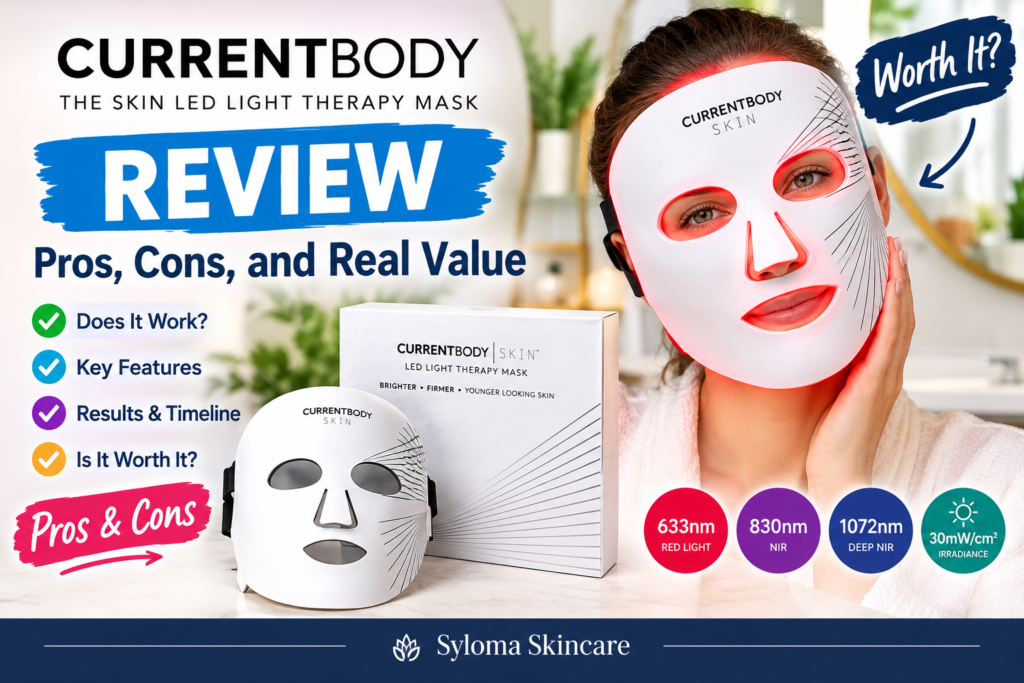
The CurrentBody Skin LED Light Therapy Mask is one of the most talked-about at-home red light devices on the market, and the current version buyers should actually care about is the Series 2. It’s a flexible silicone face mask that combines red, near-infrared, and deep near-infrared light to target fine lines, firmness, and overall skin tone in 10-minute sessions. It’s mainly built for people who already have a skincare routine in place and want to add a science-backed anti-aging step, not for anyone chasing overnight results or looking for a dedicated acne treatment.
SylomaSkincare is a reader-supported website. This means that when you click on certain links on our site and make a purchase, we may earn a small commission—at no extra cost to you.As an affiliate, we may participate in programs such as the Amazon Services LLC Associates Program and other affiliate networks designed to provide a means for websites to earn advertising fees by advertising and linking to products.We only recommend skincare products and services that we genuinely believe can provide value to our readers. Our reviews and recommendations are based on research, personal opinions, and industry knowledge—not influenced by affiliate partnerships.Your support helps us continue to create helpful, high-quality skincare content for our readers.If you have any questions regarding this disclosure, feel free to contact us through our website.

- Enhanced collagen production capability significantly reduces fine lines, wrinkles and redness, for younger-looking skin…
- Upgraded light coverage provides our famous instant glow, for a healthier, brighter and smoother complexion.
- An all-new, exclusive layout of 236 LED bulbs emits three clinically recognised wavelengths: red (633nm), near-infrared …
This CurrentBody Skin LED Light Therapy Mask review is built around one question a lot of competing reviews skip: is it actually worth the money in 2026, or are you mostly paying for the marketing and the celebrity endorsements? Short answer — it depends heavily on how consistently you’ll use it and what you’re comparing it against. Below, we break down the specs, the evidence, the honest pros and cons, and how it stacks up against Omnilux, Shark CryoGlow, and HigherDOSE.
Quick Verdict
| Overall Rating | 4.2 / 5 |
| Best For | People focused on early-to-moderate signs of aging who want a low-effort, high-consistency routine |
| Main Strength | Three clinically relevant wavelengths (633nm/830nm/1072nm) with strong full-face coverage and comfort |
| Biggest Weakness | Premium price with gradual, not dramatic, results |
| Best Alternative Type | A rigid or multi-light mask if you specifically need acne-focused blue light |
| Worth It? | Yes, for consistent users focused on anti-aging — not automatically the “best” mask for everyone |
Pricing for the Series 2 has fluctuated in recent listings, so check the official CurrentBody product page for the current price before buying, since premium beauty tech pricing shifts often with promotions and bundles.
What Is the CurrentBody Skin LED Light Therapy Mask?
The CurrentBody Skin LED Light Therapy Mask is a wearable, flexible face mask embedded with LED bulbs that emit specific wavelengths of red and near-infrared light. This process, known as photobiomodulation, is simply the use of light at particular wavelengths to influence how skin cells behave — primarily by supporting the energy production process inside cells (mitochondria), which is thought to help stimulate collagen synthesis and calm inflammation.
Red and near-infrared wavelengths are used because they penetrate the skin at different depths without generating damaging heat or UV exposure. Red light works closer to the surface, in the dermis, while near-infrared and deep near-infrared wavelengths reach deeper layers. The mask is primarily intended to address fine lines and wrinkles, loss of firmness, uneven texture, and dullness — not acne, which relies on a different wavelength (blue light) that this particular mask doesn’t include.
If you’re weighing LED masks specifically for breakouts rather than aging, it’s worth reading our breakdown of the best LED face masks for acne-prone skin instead, since this device isn’t built for that job.
- Enhanced collagen production capability significantly reduces fine lines, wrinkles and redness, for younger-looking skin…
- Upgraded light coverage provides our famous instant glow, for a healthier, brighter and smoother complexion.
- An all-new, exclusive layout of 236 LED bulbs emits three clinically recognised wavelengths: red (633nm), near-infrared …
CurrentBody Series 2: Key Specifications
The Series 2 replaced the original CurrentBody mask with a redesigned, more flexible shape and an added wavelength. Here are the manufacturer-listed specifications, sourced directly from CurrentBody’s official product page.
| Specification | CurrentBody Series 2 |
|---|---|
| Wavelengths | Red (633nm), near-infrared (830nm), deep near-infrared (1072nm) |
| Total LED bulbs | 236 (110 red, 110 near-infrared, 16 deep near-infrared) |
| Power density (irradiance) | 30mW/cm² |
| Treatment time | 10 minutes per session |
| Recommended frequency | 3–5 times per week |
| Design | Flexible liquid silicone, full-face coverage, multiway strap, clip-on controller |
| Optional accessories | Eye inserts for reading/screen use during treatment |
| Regulatory status | FDA-cleared for the U.S. market; UKCA registered in the UK |
| Weight | Approximately 1,220g |
How Does the CurrentBody LED Mask Work?
Each wavelength in the Series 2 does a slightly different job:
- 633nm red light works largely at the skin’s surface layer, where it’s associated with supporting collagen production and reducing the visible appearance of fine lines.
- 830nm near-infrared light reaches somewhat deeper, and is generally associated with cellular energy support that may help firm and even out skin tone.
- 1072nm deep near-infrared light goes deeper still, targeting areas where more advanced signs of aging tend to show up, with the aim of supporting collagen production further beneath the surface.
It’s worth being clear about one thing competing reviews often gloss over: irradiance (power density) alone doesn’t determine how effective a mask is. A device with a higher mW/cm² number isn’t automatically superior — in fact, excessive power delivered too quickly can irritate skin rather than help it. What matters more is the combination of wavelength accuracy, how evenly the light covers the whole face, and how consistently a person actually uses the device over weeks and months. A mask that’s comfortable enough to wear daily will likely outperform a more “powerful” one that ends up in a drawer after two uses.
CurrentBody LED Mask Benefits
Fine Lines and Wrinkles
CurrentBody’s own marketing, based on its commissioned SGS clinical testing, claims measurable reductions in forehead and crow’s feet wrinkle volume after 8 weeks of consistent use. That’s a product-specific claim from an industry-commissioned lab study, not independent, peer-reviewed research — a distinction worth keeping in mind. Separately, broader peer-reviewed research on red and near-infrared light supports the general premise: a randomized controlled trial on 137 women found meaningful reductions in periocular (crow’s feet) wrinkle volume after a course of red light sessions, and a more recent sham-controlled study found a majority of users saw measurable improvement in crow’s feet after 12 weeks of home LED/infrared mask use, compared to a much smaller improvement in the placebo group. These studies didn’t test the CurrentBody device specifically, but they support the underlying mechanism the mask relies on.
Firmness and Skin Elasticity
CurrentBody’s commissioned testing reported improvements in skin elasticity and firmness measurements after 56 days of use. Broader LED and photobiomodulation research on collagen stimulation generally supports the idea that consistent red/NIR exposure can contribute to modest firmness gains over time, though results in independent literature tend to be more measured than brand-reported figures.
Skin Texture
Users and CurrentBody’s own testing report smoother-feeling, more refined-looking texture with regular use. This tracks with the general LED/PBM literature, which associates consistent red light exposure with improved skin surface quality, though texture is also one of the more subjective outcomes to measure.
Redness and Overall Skin Appearance
CurrentBody’s testing reported a reduction in visible redness after 8 weeks. This aligns with general findings in the anti-inflammatory effects of red and near-infrared light, an area with a reasonably solid base of independent research, separate from any single brand’s claims.
Radiance / Glow
Both CurrentBody’s own before-and-afters and general LED research point to a brighter, more even-looking complexion as one of the more consistently reported benefits — likely tied to improved circulation and reduced inflammation rather than any single dramatic mechanism.
None of this amounts to a guarantee. Individual skin responds differently, and “improvement in appearance” is the right way to frame expectations, not full correction of established wrinkles.
What Results Can You Realistically Expect?
- First 1–2 weeks: Most people notice little to no visible change yet, though some report skin feeling calmer or smoother almost immediately.
- Around 4 weeks: CurrentBody states that with consistent 3–5x weekly use, initial results — often smoother texture or a slightly brighter tone — can start to appear.
- Around 8 weeks: This is the point at which CurrentBody’s own clinical testing and much of the independent LED literature report the more meaningful changes in wrinkle appearance, firmness, and tone.
- Longer-term consistent use: Ongoing use appears necessary to maintain results, similar to most non-invasive skin treatments — benefits are not generally described as permanent once treatment stops.
Individual results vary significantly based on skin type, age, consistency of use, and skincare routine. An improvement in the appearance of wrinkles is not the same thing as permanently removing them — LED therapy is a maintenance and support tool, not a substitute for procedures like injectables or resurfacing.
Pros
- Three clinically relevant wavelengths in one device. Combining 633nm, 830nm, and 1072nm gives more depth range than most two-wavelength competitors, without needing separate devices.
- Short, realistic treatment time. A 10-minute session is genuinely easy to fit into a morning or evening routine, which matters more for long-term adherence than raw power output.
- Full-face, flexible-fit coverage. The Series 2’s liquid silicone shape and added chin strap are designed to reduce the gaps and hot spots that rigid masks can leave around the jaw and cheeks.
- FDA-cleared for the U.S. market. This means the device has been reviewed for safety and found substantially equivalent to legally marketed light-therapy devices — an important baseline that not every budget mask can claim.
- Established brand with a real testing infrastructure. CurrentBody’s Veritace® bulb-testing process and multiple rounds of commissioned clinical studies (SGS, Eurofins) give buyers more documentation than many newer competitors.
- Cordless, wireless design. The clip-on controller lets you move around during treatment rather than being tethered to an outlet.
- Optional eye inserts. A small but genuinely useful feature for anyone who wants to read, scroll, or watch something during the session rather than sitting still with eyes closed.
- Strong track record on reviews. With thousands of verified customer reviews averaging well above 4 stars, satisfaction rates are consistently high across both skin quality and ease of use.
Cons
- Premium price point. At roughly the same cost as several competitors, it’s a meaningful investment relative to serums or in-office single treatments, and the value only shows up with consistent, long-term use.
- No blue light for acne. If breakouts are your primary concern, this specific mask isn’t built for that job — CurrentBody sells a separate blue light device for that purpose.
- Results are gradual, not dramatic. Even the most favorable testing data describes measured, incremental change over 8 weeks — not a “wrinkles gone” transformation.
- Comfort and fit vary by face shape. While the flexible silicone is a real upgrade over the rigid Series 1, some users with smaller or larger faces report the strap and nose bridge area needing adjustment to sit comfortably.
- Consistency is non-negotiable. Skipping sessions for weeks at a time appears to blunt or delay results based on both brand and independent data — this isn’t a “use once a month” device.
- It’s not a replacement for sunscreen or a core skincare routine. LED therapy is a complement to, not a substitute for, daily SPF and active ingredients like retinoids or vitamin C.
- Brand-commissioned testing should be read carefully. Figures like “reduces wrinkles by 30%” originate from CurrentBody’s own SGS-commissioned study, not an independent, peer-reviewed trial of this specific device — a meaningful distinction for buyers comparing marketing claims to science.
- Not ideal for every skin concern. Deep pigmentation, active cystic acne, or significant sagging are better addressed by other modalities or a dermatologist, not red/NIR light alone.
Is CurrentBody LED Mask Worth It in 2026?
Here’s the honest breakdown, weighing price, technology, evidence, and how it stacks against the field.
Yes, if you’re mainly concerned with early-to-moderate fine lines, dullness, and firmness; you already have a consistent skincare routine and want to add a science-backed anti-aging step; and you’re realistic that results build gradually over 8+ weeks rather than instantly.
No, if your primary concern is acne (this mask doesn’t include blue light), you’re looking for dramatic, fast transformation, or you know from past experience that you don’t stick with at-home routines for more than a few weeks.
Maybe, if you’re deciding between CurrentBody and a similarly priced competitor like Omnilux or HigherDOSE — in that case, the decision often comes down to fit preference, whether you want the extra deep near-infrared wavelength, and which brand’s before-and-after documentation you trust more, since the underlying wavelengths across all three are broadly comparable.
For anti-aging specifically, the Series 2’s combination of three wavelengths and full-face flexible coverage puts it near the top of the premium mask category — but “worth it” ultimately depends on whether you’ll actually use it three to five times a week for two months before judging results. If you want a broader look at how LED masks compare across brands and price points for wrinkles and firmness specifically, see our guide to the best LED face masks for wrinkles and firm skin.
CurrentBody Series 1 vs Series 2
| Feature | Series 1 | Series 2 |
|---|---|---|
| Wavelengths | Red (633nm), near-infrared (830nm) | Red (633nm), near-infrared (830nm), deep near-infrared (1072nm) |
| Total LEDs | 132 (66 red, 66 NIR) | 236 (110 red, 110 NIR, 16 deep NIR) |
| Power density | 30mW/cm² | 30mW/cm² (same) |
| Design | Rigid, flat shape | Flexible liquid silicone with multiway strap and chin coverage |
| Weight | ~350g | ~1,220g |
| Treatment time | 10 minutes, 4x/week | 10 minutes, 3–5x/week |
Should Series 1 owners upgrade? If your Series 1 still works well and fits comfortably, the case for upgrading is moderate rather than urgent — the core red and near-infrared wavelengths are unchanged, and power density is identical. The upgrade mainly buys you the added deep near-infrared wavelength, meaningfully better full-face coverage from the flexible silicone shape, and improved comfort from the redesigned strap. If your Series 1 fit was never great, or you specifically want the deeper-penetrating wavelength, the Series 2 is the more compelling buy.
CurrentBody vs Competitors
Rather than attempting a full “best LED masks” roundup, here’s what genuinely differentiates CurrentBody from three major premium alternatives.
| CurrentBody Series 2 | Omnilux Contour Face | Shark CryoGlow | HigherDOSE Red Light Mask | |
|---|---|---|---|---|
| Wavelengths | 633 / 830 / 1072nm | 633 / 830nm | 630 / 415 / 830nm | 630 / 830nm |
| Blue light for acne | No | No | Yes | No |
| Total LEDs | 236 | 132 | 480 light sources | 132 diodes |
| Design | Flexible silicone, tethered controller | Flexible, lightweight (~125g) | Flexible, includes under-eye cooling | Flexible, cordless/battery |
| FDA cleared | Yes | Yes | Yes | Yes |
| Distinct feature | Three-wavelength depth range | Clinical pedigree, editor-tested lightweight fit | Acne + anti-aging + eye cooling in one device | Simplicity, cordless portability |
What makes CurrentBody different? It’s the only one of these four with a third, deeper near-infrared wavelength built in, which theoretically extends its reach into deeper skin layers where more advanced aging shows up. Omnilux leans on its clinical/professional-device pedigree and lighter weight. Shark CryoGlow is the most multi-purpose option, since it’s the only one in this group with blue light for acne alongside anti-aging modes. HigherDOSE competes mainly on simplicity, portability, and aesthetic appeal rather than added technology. None of these is a “best overall” pick — they suit different priorities.
Who Should Buy CurrentBody?
Best for:
- People primarily concerned with fine lines, firmness, and overall signs of aging rather than acne
- Users who are realistically willing to commit to 3–5 sessions a week for at least 8 weeks
- People who prefer a short, 10-minute home treatment over longer in-office visits
- Buyers who specifically want the added depth of a deep near-infrared wavelength
Who Should Skip It?
- People whose primary concern is acne or blemishes — a blue-light-inclusive mask like Shark CryoGlow, or a dedicated anti-acne device, is better suited
- Anyone who knows they won’t use a device consistently for two-plus months
- People expecting fast, dramatic wrinkle removal rather than gradual, cumulative improvement
- Buyers who find premium LED devices poor value compared to consistent sunscreen, retinoids, and professional treatments — for some skin goals, a strong anti-aging serum may deliver more noticeable results per dollar
This isn’t medical advice — anyone with specific skin conditions or concerns should speak with a dermatologist about what treatment approach fits their situation.
How to Use the CurrentBody Mask
- Perform a sensitivity test on a small area (inner arm, back of hand) before your first full-face session, per CurrentBody’s manufacturer instructions.
- Cleanse and dry your skin completely. Apply a few drops of a compatible serum if desired to potentially enhance the session.
- Secure the mask using the multiway strap, adjusting until it sits evenly across the face without gaps.
- Run a 10-minute session, 3 to 5 times per week, per CurrentBody’s recommended usage.
- Wipe the mask dry and store it in the included protective bag after each use.
- Follow all manufacturer safety instructions, including the contraindications listed in the product manual.
Safety and Side Effects
LED light therapy is generally considered low-risk for short-term use. Possible temporary effects can include mild redness or a warm sensation immediately after a session, which typically subsides quickly. As with any light-based device, people with photosensitive conditions (such as lupus or photosensitive eczema) or those taking photosensitizing medications should avoid use, per manufacturer contraindications. This is not an exhaustive medical list — anyone with a relevant skin condition, eye condition, or medication concern should consult a dermatologist or physician before starting any LED device, including this one.
What Competitor Reviews Miss
Most existing reviews repeat CurrentBody’s marketing copy almost verbatim — “3 wavelengths,” “236 LEDs,” “clinically proven” — without walking through what those numbers actually mean for someone deciding between a $300–$450 mask and a cheaper alternative, or a totally different anti-aging investment. A few things worth weighing that often get skipped:
- Wavelength count isn’t the same as wavelength precision. A mask with more LEDs isn’t automatically better if the light isn’t consistently and accurately delivered across the whole face — this is where CurrentBody’s Veritace® bulb-testing claim matters more than the raw LED count.
- Irradiance parity across generations. The Series 2 has the same power density as the Series 1 — the real upgrade is coverage and an added wavelength, not more power.
- Brand-commissioned studies vs. independent research. CurrentBody’s SGS and Eurofins reports are real data points, but they’re commissioned by the company, tested only on its own device, and use smaller sample sizes than a large peer-reviewed trial. Independent research on red/NIR light generally supports the mechanism, but doesn’t validate every specific percentage CurrentBody advertises.
- Comfort drives adherence, and adherence drives results. A device that’s mildly uncomfortable to wear for 10 minutes, 3–5 times a week, is far less likely to be used consistently — which matters more to real-world results than any spec sheet.
- Long-term routine fit is the real value question, not which mask has the flashiest before-and-after photo.
Final Verdict
Best for: Buyers focused on fine lines, firmness, and overall complexion who are ready to commit to a consistent 8-week-plus routine. Not ideal for: Anyone seeking acne treatment, instant results, or a budget option. Biggest advantage: Three clinically relevant wavelengths with genuinely full-face, flexible coverage and FDA clearance. Biggest drawback: A premium price for results that build gradually and require real consistency to see. Final verdict: The CurrentBody Skin LED Light Therapy Mask Series 2 is a legitimately well-engineered device backed by real (if company-commissioned) testing and a broader base of independent LED research supporting its underlying mechanism. It’s not the “best” LED mask for every skin goal or budget, but for anti-aging-focused buyers who will actually use it, it’s a reasonable and defensible investment — not simply an expensive placebo. For a broader sense of how it fits into your overall anti-aging routine, our guide on red light therapy masks for anti-aging at home covers where LED fits alongside other treatments, and our piece on whether LED face masks actually work digs deeper into the general evidence base.
FAQ
Does the CurrentBody LED mask really work? Available evidence — both CurrentBody’s own commissioned testing and broader independent research on red/near-infrared light — supports modest, gradual improvements in fine lines, firmness, and tone with consistent use. It’s not a guarantee for every skin type or concern.
How long does it take to see results from CurrentBody? CurrentBody states some users notice initial changes around 4 weeks, with more meaningful results typically reported around 8 weeks of consistent 3–5x weekly use.
Is CurrentBody Series 2 better than Series 1? The Series 2 adds a deep near-infrared wavelength and a more flexible, full-face-fitting design, but keeps the same power density as the Series 1. It’s an improvement in coverage and comfort more than raw power.
How often should you use the CurrentBody LED mask? CurrentBody recommends 3 to 5 sessions per week, 10 minutes per session, for at least 8 weeks to evaluate results.
Can CurrentBody reduce wrinkles? It may help reduce the visible appearance of fine lines and wrinkles with consistent use, based on both brand testing and general LED/photobiomodulation research — it does not permanently eliminate existing wrinkles.
Is CurrentBody good for acne? No. This specific mask uses red and near-infrared wavelengths aimed at anti-aging concerns, not blue light for acne-causing bacteria. CurrentBody sells a separate device for blemish-focused treatment.
Are LED masks safe? Generally yes, when FDA-cleared and used according to manufacturer instructions. Some people should avoid use due to photosensitivity, certain medications, or specific eye or skin conditions — consult a dermatologist if unsure.
Is CurrentBody worth the money? For buyers focused on anti-aging who will use it consistently for two months or more, most evidence and reviewer feedback suggest it’s a reasonable investment. It’s a harder case to make for occasional or inconsistent use.
Can you use skincare products before an LED mask? Yes — cleansed, dry skin is standard practice, and CurrentBody suggests certain compatible serums may enhance results, though this claim is brand-specific and not independently verified at the same level as the core LED research.
How does CurrentBody compare with Omnilux? Both use similar red and near-infrared wavelengths; CurrentBody’s Series 2 adds a third, deeper near-infrared wavelength, while Omnilux is known for a lighter-weight design and strong clinical-device pedigree. Neither is definitively “better” — the right pick depends on fit preference and whether the added wavelength matters to you.