
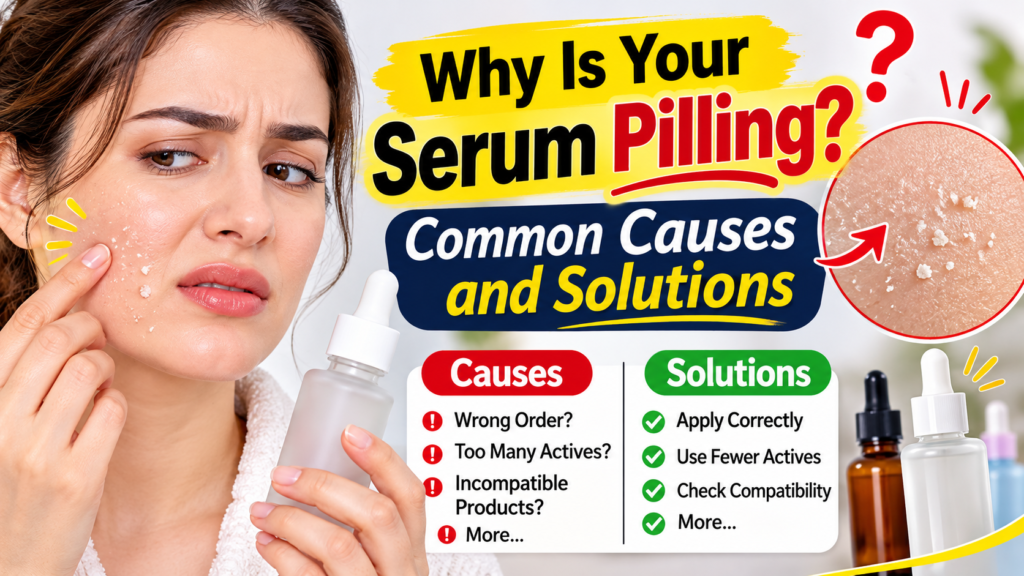
You just smoothed on your favorite serum, waited a few seconds, then reached for your moisturizer — only to watch the product roll into tiny, frustrating little balls across your cheeks. If you have ever asked yourself why is my serum pilling, you are far from alone. Pilling is one of the most common skincare frustrations, and it happens with products at every price point. The good news? Pilling rarely means your serum is defective or ineffective. In most cases, a few simple adjustments to how you apply and layer your products can eliminate the problem entirely.
What Is Serum Pilling?
Serum pilling occurs when a skincare product fails to absorb or bind properly to the skin’s surface and instead gathers into small, round flakes or balls as you touch or rub your face. Think of it like rolling a pencil eraser across a desk — the friction lifts and bunches the material into little clumps. That is essentially what is happening on your skin.
It is important to distinguish pilling from actual skin peeling. Peeling involves your skin itself flaking or shedding, often due to dryness, irritation, or active ingredients like retinoids. Pilling, by contrast, is entirely a product-level issue. The tiny balls you see are dried or semi-dried product residue, not your skin. If you are unsure which one you are dealing with, this overview of what skin pilling looks like offers a helpful visual comparison.
Why Is Your Serum Pilling? 8 Common Causes
Understanding serum pilling causes is the fastest path to fixing the problem. Here are the eight most frequent culprits.
1. Applying Too Much Serum
More product does not mean better results. Your skin can only absorb a limited amount of active ingredients at a time. When you apply three or four pumps instead of the recommended one or two, the excess sits on the surface and rolls into pills as soon as you layer anything on top.
Solution: Start with a pea-sized amount or follow the dosage on the label. You can always add a thin second layer if needed.
2. Not Waiting Between Skincare Layers
Layering a moisturizer over a serum that is still wet on your skin is a recipe for pilling. The two products mix on the surface rather than absorbing in sequence, creating a gummy film that bunches up under your fingers.
Solution: Allow each product to settle until your skin feels slightly tacky or dry to the touch before adding the next layer. The exact time varies by formulation — a lightweight vitamin C serum may set in thirty seconds, while a richer treatment could take a minute or two.
3. Incompatible Product Formulations
You may have heard that water-based and silicone-based products should never be mixed, but the reality is more complex. Finished skincare formulations contain emulsifiers, film-formers, and texture modifiers that interact in ways a simple “water vs. silicone” label cannot predict. What matters most is the full ingredient list and how specific polymers behave when layered. The Ordinary’s product pilling guide explains how certain ingredient combinations within their own line can still cause pilling despite sharing a similar base.
Solution: If two products consistently pill together, try using them at different times of day rather than assuming one ingredient category is to blame.
4. Layering Products in the Wrong Order
The general rule is to apply products from thinnest to thickest consistency. A heavy, occlusive serum applied before a lightweight toner will trap the thinner product underneath and encourage pilling.
Solution: Arrange your routine by texture — watery toners first, then lightweight serums, then thicker treatments, then moisturizer, then sunscreen.
5. Thick or Sticky Hyaluronic Acid Serums
Hyaluronic acid serum pilling is especially common because many HA formulas rely on high-molecular-weight hyaluronic acid, which creates a film on the skin’s surface to lock in moisture. That film is effective for hydration but prone to rolling up when you rub it. If you love HA but hate the pilling, exploring a well-formulated hyaluronic acid serum designed for deep hydration can help you find an option with a lighter finish.
Solution: Apply HA serum to damp skin in a thin layer and press it in gently rather than rubbing.
6. Rubbing Your Skin Too Aggressively
A 2024 peer-reviewed study involving 528 female volunteers found that rubbing products in circular and linear motions was associated with significantly more pilling than gentler application methods. The friction literally lifts the product film off the skin and rolls it into balls.
Solution: Pat or press your serum into the skin using your fingertips. Avoid circular rubbing motions, especially when layering multiple products.
7. Applying Serum Over Excessively Dry or Flaky Skin
When your skin barrier is compromised or your face has patches of dry, flaky skin, serum cannot spread evenly. It catches on rough texture and clumps together instead of forming a smooth layer.
Solution: Gently exfoliate no more than one to two times per week and always apply serum to a clean, slightly damp face. If your skin barrier is damaged, focus on repair before adding active serums.
8. Using Too Many Skincare Products Together
A ten-step routine sounds impressive, but every additional layer increases the chance of formulation conflicts and surface buildup. The same 2024 study noted that 41% of participants experienced pilling, with the likelihood increasing as more products were layered.
Solution: Simplify. A cleanser, one targeted serum, a moisturizer, and sunscreen are enough for most people on most days.
Does Your Serum Pill Under Moisturizer or Sunscreen?
Serum pilling under moisturizer typically happens when the serum has not fully settled or when the moisturizer’s texture is too heavy for the serum underneath. Gel-based serums, which often contain film-forming polymers, are particularly prone to this because the polymer film can lift when a thick cream is rubbed over it. Try switching to a lighter moisturizer or pressing it on instead of sweeping it across your face.
Serum pilling under sunscreen is the most frequently reported pilling scenario. The 2024 study found that sunscreen application was associated with the majority of observed pilling events, likely because sunscreens contain high concentrations of UV filters and film-forming agents that interact with whatever is layered beneath them. Allure’s guide to preventing skincare pilling also highlights sunscreen layering as a primary trigger. Mineral sunscreens, which rely on zinc oxide or titanium dioxide particles suspended in a cream base, can be especially prone to pilling when applied over silicone-heavy serums.
If you are dealing with this issue and have oily skin, a lightweight matte sunscreen formulated for oily skin may pill less than a richer mineral option. Regardless of the cause, never skip sunscreen to solve pilling. Instead, experiment with your serum and sunscreen combination, allow extra settling time between layers, and apply your sunscreen with gentle pressing motions.
How to Stop Your Serum From Pilling
Here is a practical, step-by-step approach to how to stop serum from pilling:
- Start with clean skin. Wash your face with a gentle cleanser to remove residue that could interfere with absorption.
- Apply a small amount of serum. One to two pumps or a pea-sized drop is usually sufficient.
- Follow the manufacturer’s application instructions. Some serums are designed for damp skin; others work best on dry skin.
- Allow each layer to settle. Wait until the product feels tacky or mostly absorbed before adding the next step. The timing depends on the specific formulation, not a universal clock.
- Press or gently pat products into your skin. Avoid circular rubbing, which the research links to increased pilling.
- Use a lightweight moisturizer when appropriate. Heavier creams are more likely to disturb the serum layer beneath them.
- Apply sunscreen carefully as your final skincare step. Use gentle, downward pressing motions and avoid going back over areas you have already covered.
The Correct Order to Layer Skincare Products
How to layer serums correctly depends on your specific products, but these frameworks work for most routines.
Morning:
- Cleanser
- Toner (optional)
- Serum (for example, a vitamin C serum for brightening)
- Moisturizer
- Broad-spectrum SPF 30 or higher
Evening:
- Cleanser
- Toner (optional)
- Treatment serum (such as an anti-aging serum targeting wrinkles)
- Moisturizer
Keep in mind that specific treatment instructions may override this general order. Always defer to the directions on your product labels.
How to Identify Which Product Is Causing Pilling
When your entire routine is pilling, figuring out the culprit can feel overwhelming. Use this simple troubleshooting method:
- Test each product individually on clean skin and observe whether it pills on its own.
- Introduce products one at a time over several days rather than starting a full new routine all at once.
- Test the suspected combination on a small area of your jawline or forearm.
- Remove one layer at a time from your routine and note whether the pilling stops.
- Avoid changing everything simultaneously, or you will not know which adjustment actually solved the problem.
Should You Stop Using a Serum That Pills?
Not necessarily. Pilling is a cosmetic texture issue, not a sign that an ingredient is harmful or that the serum has stopped working. In many cases, adjusting your application technique — using less product, patting instead of rubbing, or changing the order of your layers — resolves the problem completely.
If a specific product combination consistently pills no matter what you try, consider swapping one of the products rather than overhauling your entire routine. However, if pilling is accompanied by redness, stinging, or breakouts, discontinue the product and evaluate whether your skin barrier needs attention.
Frequently Asked Questions
Why does my serum turn into little balls on my face?
The product is gathering into small clumps on the skin’s surface instead of absorbing. This is usually caused by excess product, incompatible layers, or aggressive rubbing.
Why does my hyaluronic acid serum pill?
HA serums often contain high-molecular-weight hyaluronic acid that forms a film on the skin. When rubbed or layered too quickly, that film rolls into pills. Applying a thin layer to damp skin and pressing gently can help. For more options, explore hyaluronic acid serums formulated for plumping skin.
Why does my serum pill under moisturizer?
The serum likely has not fully settled, or the moisturizer’s texture is too heavy for the serum underneath. Try waiting longer between steps and pressing the moisturizer on gently.
Why does my serum pill under sunscreen?
Sunscreens contain high levels of UV filters and film-formers that can interact with serum residue on the skin. Research shows sunscreen application is the most common trigger for pilling. Allow your serum to fully absorb and apply sunscreen with gentle pressing motions.
Does serum pilling mean the product is not absorbing?
Not entirely. Pilling involves the excess product that sits on the surface. The portion that has already absorbed into your skin is still doing its job. Skincare.com’s guide to serum pilling offers additional context on absorption versus surface residue.
Should I wait before applying moisturizer after serum?
Yes, but the exact timing depends on the product. Wait until your skin feels slightly tacky or dry to the touch rather than following a rigid timer.
Can silicone-based products cause serum pilling?
Silicone-based ingredients can contribute to pilling in some combinations, but the full formulation matters more than a single ingredient category. Not all silicone-containing products pill, and not all pilling involves silicones.
How much serum should I apply to prevent pilling?
Start with a pea-sized amount or one to two pumps. You can add a thin second layer if needed, but using less product is the simplest way to reduce pilling.
Conclusion
Serum pilling is frustrating, but it is almost always fixable without replacing your entire skincare collection. The most effective strategies are straightforward: use less product, allow each layer to settle, pat instead of rub, and pay attention to which product combinations cause trouble. Simplifying your routine and following the correct layering order will resolve most pilling issues within a few days.
For more evidence-based skincare guidance, explore the full collection of routines, ingredient breakdowns, and product guides at Sylomaskin care.