
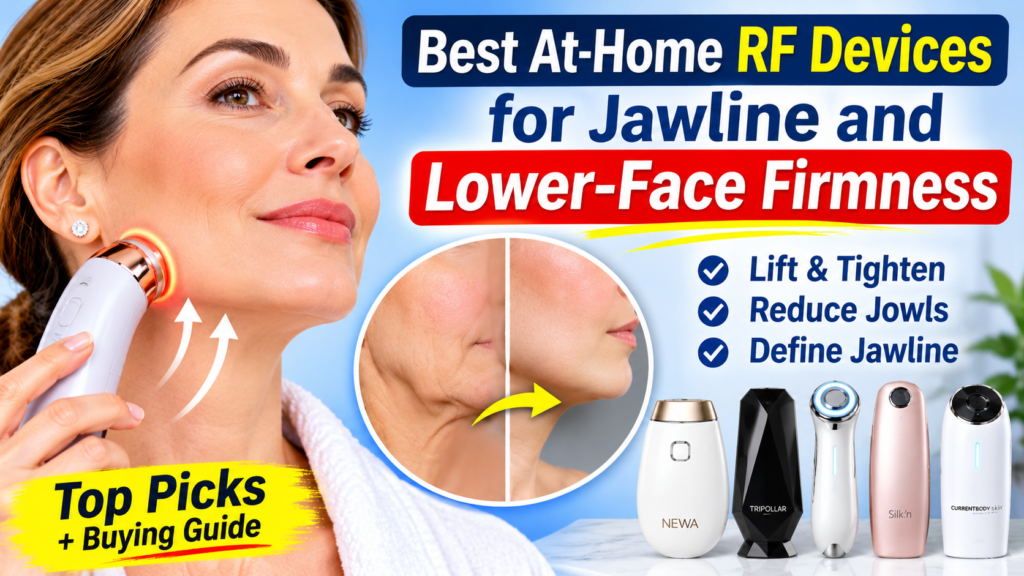
The jawline is one of the first areas to reveal the passage of time. As collagen production slows and gravity takes its toll, the lower face loses the crisp definition it once had. Jowls begin to form, the chin-to-neck transition softens, and the once-sharp jawline blurs. For many people, this is the change that bothers them most — and the one they are most eager to address at home.
Radiofrequency (RF) skin-tightening devices have emerged as one of the most promising at-home technologies for this concern. By delivering controlled heat to the deeper layers of skin, RF devices aim to stimulate collagen remodeling over time. But not every device is equally suited to the lower face, and the results you can realistically expect depend heavily on the severity of laxity, the device’s technology, and your consistency.
This guide cuts through the marketing noise. We compare six of the most popular at-home RF devices specifically for jawline and lower-face firmness, explain what the science actually supports, and help you choose the right tool for your skin.
This article contains affiliate links. If you purchase through these links, we may earn a small commission at no extra cost to you. We only recommend products we have thoroughly researched.
Quick Comparison Table
| Device | Technology | Best For | Jawline Suitability | Frequency | Gel Required | Main Advantage | Main Limitation |
|---|---|---|---|---|---|---|---|
| NEWA | 3DEEP multi-polar RF | Wrinkle reduction, overall firmness | ★★★★☆ | 3×/week (initial) | Yes (proprietary) | Strongest clinical evidence base | Small treatment head; slower for larger areas |
| TriPollar STOP VX2 | Multi-RF + DMA | Collagen and elastin remodeling | ★★★★★ | 2–3×/week | Yes (TriPollar gel) | DMA targets muscle tone for jawline | Higher price point |
| TriPollar STOP Vx Gold | Multi-RF + DMA (gold electrodes) | Premium anti-aging, firmness | ★★★★★ | 2–3×/week | Yes (TriPollar gel) | Enhanced conductivity and comfort | Most expensive option |
| CurrentBody Skin RF | RF energy | Full-face tightening | ★★★☆☆ | 2–3×/week | Yes | Simple interface, reputable brand | Limited independent evidence |
| Sensica Sensilift | RF + skin sensor + massage | Beginners, sensitive skin | ★★★☆☆ | 2×/week | Yes (Sensilift serum) | Built-in temperature sensor | Less powerful than competitors |
| Silk’n Titan | Bipolar RF + LED + IR | Multi-modal anti-aging | ★★★☆☆ | 2×/week | Yes (Slider gel) | Combines three technologies | Longest treatment sessions |
Best At-Home RF Devices for Jawline and Lower-Face Firmness
1. NEWA RF Wrinkle Reduction Device
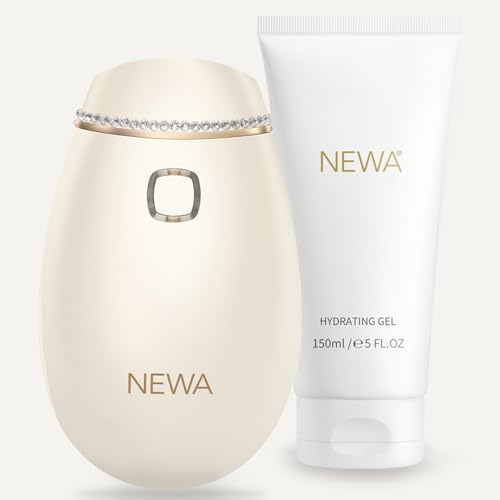
- SKIN TIGHTENING DEVICE: NEWA uses the power of radio frequency to: ✔️Boost the skin’s collagen production ✔️Visibly redu…
- FDA CLEARED – BACKED BY CLINICAL STUDIES: The NEWA device and gel were clinically tested on various skin types aged 37 t…
- TRUSTED TECHNOLOGY: One of the most clinically validated skin tightening technologies around today, radio frequency mach…
Overview and Technology: NEWA uses EndyMed’s 3DEEP radiofrequency technology, a multi-polar system that delivers focused heat to the dermis while keeping the skin surface comfortable. It is FDA-cleared for facial wrinkle reduction and is backed by multiple peer-reviewed studies — giving it one of the strongest evidence profiles among home RF devices. For a deeper look at its performance, see our full NEWA RF device review.
Jawline Suitability: The compact treatment head allows precise work along the jawline and under the chin. The 3DEEP technology penetrates deeply enough to target the collagen-rich dermal layers responsible for structural support in the lower face. However, the small head means treating the entire jawline takes patience.
Treatment Routine: Four minutes per treatment zone, three times per week for the first month, then twice weekly for maintenance. NEWA requires its proprietary conductive gel.
Pros: Robust clinical evidence; FDA-cleared; comfortable treatment; precise for jawline contouring.
Cons: Small treatment head; proprietary gel adds ongoing cost; not ideal for very advanced laxity.
Best for: Evidence-driven buyers who want a clinically validated device for mild-to-moderate lower-face laxity. If you are exploring at-home beauty devices for mature skin over 50, NEWA is a strong contender.
Value: Mid-range pricing with ongoing gel costs. Strong value given the evidence base.
2. TriPollar STOP VX2

- AIDS IN COLLAGEN PRODUCTION: new Triple-Wave Multi-RF Technology delivers interchanging RF waves that comb the dermis la…
- PERSONALIZED TREATMENT: 2nd Generation Thermal Mapping provides the skin with the most accurate temperature for effectiv…
- PLEASANT TREATMENT & SUPERIOR RESULTS: the 3rd Generation features automatically adjusts in real-time to ensure a pleasa…
Overview and Technology: The TriPollar STOP VX2 combines multi-RF energy with Dynamic Muscle Activation (DMA), a technology that stimulates the underlying facial muscles. This dual approach targets both skin collagen and the muscular layer — making it particularly relevant for jawline definition, where muscle tone plays a visible role. Read our detailed TriPollar STOP VX2 review for a complete breakdown.
Jawline Suitability: Excellent. The DMA function is specifically designed to engage the platysma and masseter-adjacent muscles that influence lower-face contour. Combined with RF-driven collagen stimulation, the VX2 addresses both structural and muscular contributors to jawline sagging.
Treatment Routine: Approximately 12–15 minutes per session, two to three times per week. Uses TriPollar’s proprietary conductive gel.
Pros: Dual RF + DMA technology; specifically effective for lower-face contouring; well-established brand; comfortable glide.
Cons: Premium price; requires consistent use; gel is an ongoing expense.
Best for: Users whose primary concern is jawline definition and jowl reduction. One of the best luxury skincare devices for a comprehensive at-home routine.
Value: Higher upfront cost, but the dual-technology approach justifies the investment for lower-face-focused users.
3. TriPollar STOP Vx Gold

- Helps to diminish the appearance of fine lines and wrinkles.
Overview and Technology: The Vx Gold builds on the VX2 platform with 24-karat gold-plated electrodes that improve conductivity and heat distribution. It delivers the same multi-RF and DMA combination but with enhanced comfort and more uniform energy delivery. Our TriPollar STOP Vx Gold review covers the differences in detail.
Jawline Suitability: Excellent, matching the VX2 for lower-face work. The gold electrodes provide smoother contact along the angular jawline, which can improve treatment consistency in bony areas.
Treatment Routine: Similar to the VX2 — 12–15 minutes per session, two to three times weekly, with TriPollar gel.
Pros: Enhanced conductivity; more comfortable on bony jawline areas; premium build quality; same proven dual-technology.
Cons: Highest price in the TriPollar lineup; incremental improvement over VX2.
Best for: Buyers who want the most refined TriPollar experience and are willing to pay a premium for comfort and build quality.
Value: Best suited for those who prioritize luxury and comfort. The performance gap over the VX2 is real but modest.
4. CurrentBody Skin RF
Overview and Technology: CurrentBody’s RF device delivers radiofrequency energy to heat the dermis and promote collagen production. It features a straightforward design with a single treatment head and simple controls, making it approachable for first-time RF users.

- Enhanced collagen production capability significantly reduces fine lines, wrinkles and redness, for younger-looking skin…
- Upgraded light coverage provides our famous instant glow, for a healthier, brighter and smoother complexion.
- An all-new, exclusive layout of 236 LED bulbs emits three clinically recognised wavelengths: red (633nm), near-infrared …
Jawline Suitability: Moderate. The device can be used along the jawline and lower face per the manufacturer’s instructions, but it lacks the muscle-targeting technology found in TriPollar devices. It is better suited for general firmness than dramatic jawline reshaping.
Treatment Routine: Two to three sessions per week, approximately 10–15 minutes per area. Requires a conductive gel.
Pros: User-friendly; clean design; from a trusted beauty-tech retailer; suitable for full-face use.
Cons: Fewer independent clinical studies; no muscle-stimulation component; less targeted for jowls.
Best for: Beginners who want a simple, no-fuss RF device for overall facial firmness rather than jawline-specific work.
Value: Competitive pricing for the category. A reasonable entry point if you are exploring at-home beauty devices under $500.
5. Sensica Sensilift
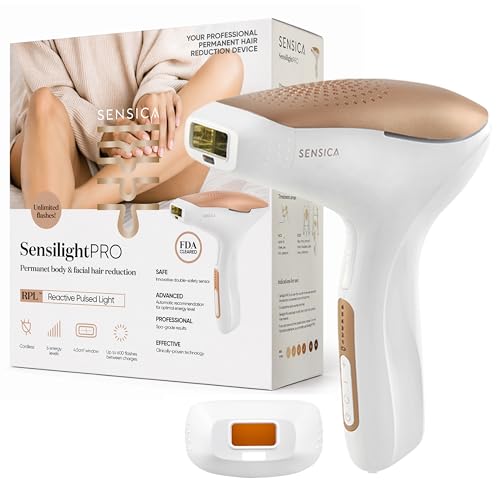
- AT-HOME CORDLESS IPL PERMANENT HAIR REDUCTION FOR FACE & BODY Sensilight PRO is an IPL hair removal device for women and…
- POWERFUL YET SAFE Sensilight PRO features 6 adjustable energy levels, allowing you to choose the level that feels right …
- VISIBLE RESULTS IN JUST 4 SESSIONS Includes 2 flash windows: an XL window (0.7 in² / 4.5 cm²) for fast coverage on large…
Overview and Technology: Sensilift combines RF energy with a built-in skin temperature sensor and a gentle massage function. The sensor monitors skin temperature in real time and adjusts energy output to prevent overheating — a valuable safety feature for at-home use.
Jawline Suitability: Moderate. The massage function can help with lymphatic drainage along the jawline, which may temporarily reduce puffiness. However, the RF output is less powerful than NEWA or TriPollar, making it better suited for early signs of laxity.
Treatment Routine: Twice weekly, roughly 10–15 minutes per area, using Sensilift’s proprietary serum.
Pros: Built-in temperature sensor; massage function; gentle and comfortable; good for sensitive skin.
Cons: Lower RF power; less effective for moderate-to-advanced sagging; proprietary serum required.
Best for: Cautious beginners or those with sensitive skin who want a gentle introduction to RF technology.
Value: Mid-range pricing. Good value for safety-conscious buyers, but less effective for significant lower-face concerns.
6. Silk’n Titan
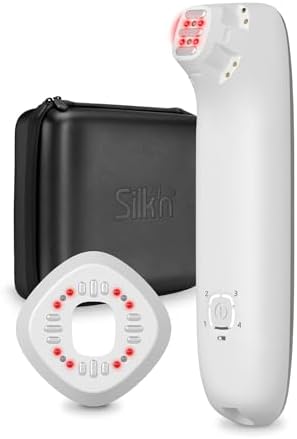
- VISIBLE WRINKLE REDUCTION IN AS LITTLE AS 5 WEEKS – Clinically tested technology helps visibly reduce wrinkles and fine …
- ADVANCED RF COLLAGEN BOOSTING TECHNOLOGY – Radio Frequency energy gently heats the deeper skin layers to stimulate natur…
- MULTI-PLATFORM ANTI-AGING SYSTEM – Combines RF energy with LED light therapy to improve skin elasticity, texture, and ov…
Overview and Technology: The Silk’n Titan uses a triple-energy approach combining bipolar RF, red LED light, and infrared (IR) energy. This multi-modal design aims to address skin texture, tone, and firmness simultaneously.
Jawline Suitability: Moderate. The device can be used on the lower face, but the RF component is less powerful than dedicated single-technology devices. The LED and IR additions are beneficial for overall skin quality but do not specifically enhance jawline tightening.
Treatment Routine: Twice weekly, 15–20 minutes per area — the longest sessions in this comparison. Requires Silk’n Slider gel.
Pros: Three technologies in one device; good for overall skin rejuvenation; widely available.
Cons: Longest treatment times; RF output is secondary to the multi-modal approach; less targeted for jowls.
Best for: Users who want a multi-purpose anti-aging device rather than a jawline-specific tool.
Value: Reasonably priced for a multi-technology device, but the trade-off is less focused RF performance. If you are comparing options, our guide to the best NEWA RF alternatives for at-home skin tightening covers several of these devices side by side.
How RF Technology Works
Radiofrequency devices deliver electromagnetic energy that heats the dermis — the collagen-rich layer beneath the skin’s surface. When dermal tissue reaches a therapeutic temperature range (typically around 40–45°C), it triggers a wound-healing response that stimulates new collagen and elastin production over the following weeks and months. Research published in the Journal of Cosmetic Dermatology confirms that controlled RF heating can produce measurable improvements in skin laxity and texture.
It is important to understand how RF differs from other popular technologies:
- Microcurrent stimulates facial muscles with low-level electrical currents. It provides a temporary lifting effect but does not heat tissue or directly stimulate collagen.
- LED light therapy uses specific wavelengths to support cellular function. It is gentler and works best for inflammation and surface-level concerns.
- Professional RF treatments (such as Thermage or Morpheus8) deliver significantly higher energy levels and produce more dramatic results in fewer sessions.
- RF microneedling combines RF energy with penetrating needles. This is a professional procedure with distinct risks — the FDA has issued specific safety warnings about certain RF microneedling uses that do not apply to non-invasive at-home RF devices.
Can At-Home RF Devices Actually Improve Jowls?
The honest answer: it depends on the severity of your concern. At-home RF devices can improve mild skin laxity — the early softening of the jawline and slight loss of firmness that begins in your late 30s and 40s. Clinical evidence supports modest improvements in skin tightness and elasticity with consistent RF use.
However, at-home devices cannot replicate surgical results. If you have significant jowl formation caused by fat pad descent, substantial tissue sagging, or major volume loss, an at-home RF device will provide limited visible improvement. These concerns typically require professional treatments such as ultrasound lifting, professional RF, or surgical intervention. Set realistic expectations: at-home RF is best understood as a maintenance and early-intervention tool, not a facelift alternative.
RF vs Microcurrent for Jawline Tightening
RF and microcurrent address different aspects of lower-face aging. RF targets the dermis to rebuild collagen and improve skin firmness over time. Microcurrent targets facial muscles to create a temporary lifting and toning effect.
For jawline definition specifically, the ideal approach may involve both technologies — microcurrent for short-term muscle tone and RF for longer-term structural support. If you must choose one, RF is generally more appropriate for skin laxity and jowl concerns, while microcurrent is better for overall facial contouring and “de-puffing.”
How to Choose an RF Device
Consider these factors before purchasing:
- Primary concern: Jawline sagging benefits most from devices with deeper penetration and, ideally, muscle stimulation (TriPollar VX2/Vx Gold). General firmness suits any device on this list.
- Treatment commitment: If you struggle with consistency, choose a device with shorter sessions (NEWA’s four-minute zones) rather than longer protocols.
- Temperature control: Devices with built-in sensors (Sensica Sensilift) reduce the risk of overheating, which is important for beginners.
- Ongoing costs: Factor in the price of proprietary conductive gels, which are required for every session and add up over time.
- Budget: Options range from mid-range to premium. The most expensive device is not always the best fit for your specific concern.
How Long Does It Take to See Results?
Patience is essential. Most users report subtle improvements in skin texture and tightness around 4–6 weeks of consistent use. More noticeable firmness along the jawline typically emerges at 8–12 weeks. Recent reviews of RF technology outcomes suggest that collagen remodeling continues for several months after treatment initiation. Results vary significantly based on age, skin condition, genetics, and adherence to the treatment schedule.
Safety, Side Effects, and Who Should Avoid RF
At-home RF devices are generally well-tolerated when used according to manufacturer instructions. Common temporary side effects include mild redness, warmth, and slight tingling during and immediately after treatment. These typically resolve within minutes to hours.
The primary risk is thermal injury from improper use — holding the device in one spot too long, using excessive heat settings, or skipping conductive gel. Always follow the specific instructions provided with your device.
Contraindications vary by device but commonly include: implanted electronic devices (pacemakers, cochlear implants), pregnancy, active skin infections or open wounds in the treatment area, and certain autoimmune conditions. Consult the manufacturer’s guidelines and your dermatologist if you have any medical concerns.
Final Verdict
- Best Overall: NEWA — strongest evidence base, FDA-cleared, precise for lower-face work.
- Best for Jawline-Focused Treatment: TriPollar STOP VX2 — dual RF + DMA technology directly addresses both skin laxity and muscle tone in the lower face.
- Best Premium Option: TriPollar STOP Vx Gold — enhanced comfort and conductivity for those who want the most refined experience.
- Best for Beginners: Sensica Sensilift — built-in temperature sensor and gentle massage make it the most forgiving option.
- Best Value: CurrentBody Skin RF — straightforward, affordable, and from a reputable brand for general firmness.
Frequently Asked Questions
1. What is the best at-home RF device for jawline tightening?
The TriPollar STOP VX2 is our top pick for jawline-specific treatment due to its combination of multi-RF energy and Dynamic Muscle Activation, which targets both skin laxity and underlying muscle tone.
2. Can RF devices reduce jowls?
At-home RF devices can improve mild jowl formation caused by early skin laxity. They are unlikely to significantly reduce moderate-to-severe jowls caused by fat pad descent or substantial tissue sagging.
3. Do home RF devices tighten loose skin under the chin?
They can provide modest tightening for mild laxity under the chin with consistent use over 8–12 weeks. Significant submental fullness or loose skin typically requires professional treatment.
4. How often should you use an RF facial device?
Most manufacturers recommend 2–3 sessions per week during the initial treatment phase (typically 4–8 weeks), followed by 1–2 maintenance sessions per week. Always follow your specific device’s instructions.
5. How long does RF skin tightening take?
Initial improvements may appear at 4–6 weeks, with more visible firmness developing at 8–12 weeks. Collagen remodeling continues for several months. Results are gradual and cumulative.
6. Is NEWA or TriPollar better for the lower face?
NEWA has a stronger clinical evidence base and is excellent for overall firmness. TriPollar’s DMA technology gives it an edge for jawline-specific contouring. The best choice depends on whether you prioritize evidence (NEWA) or muscle-targeting capability (TriPollar).
7. Can RF devices cause facial fat loss?
At-home RF devices operate at energy levels far below those associated with fat reduction. There is no strong evidence that properly used home RF devices cause facial fat loss. Professional high-intensity RF treatments are a different category.
8. Are at-home RF devices safe for mature skin?
Yes, when used according to manufacturer instructions. Mature skin may actually benefit more from RF’s collagen-stimulating effects. However, thinner or more fragile skin requires careful attention to heat settings and treatment duration.
9. Can RF devices replace professional skin tightening?
No. At-home RF devices deliver significantly less energy than professional treatments like Thermage, Profound, or Morpheus8. They are best used as maintenance tools or for early intervention, not as replacements for in-office procedures.
10. Is RF better than microcurrent for jawline definition?
For long-term structural improvement, RF is generally more effective because it stimulates collagen production. Microcurrent provides temporary muscle toning. Many experts recommend combining both for optimal jawline results.
SEO Metadata
Primary Focus Keyword: Best At-Home RF Devices for Jawline and Lower-Face Firmness
Secondary Keywords:
- Best RF device for jawline tightening
- At-home radiofrequency skin tightening
- Best RF device for jowls
- RF device for sagging cheeks
- Home RF device for mature skin
SEO Title: Best At-Home RF Devices for Jawline & Lower-Face Firmness (2025 Guide)
Meta Description: Compare the top at-home RF devices for jawline tightening and jowl reduction. Expert reviews, realistic results, and buying advice for every budget.
URL Slug: best-at-home-rf-devices-jawline-lower-face-firmness
Suggested Image Alt Text: At-home radiofrequency skin tightening device being used along the jawline for lower-face firmness
Featured Image Concept: A clean, well-lit flat lay of two or three RF devices (NEWA and TriPollar) on a marble surface with a subtle jawline silhouette graphic overlay, conveying premium skincare technology.
FAQ Schema Questions:
- What is the best at-home RF device for jawline tightening?
- Can RF devices reduce jowls?
- How long does RF skin tightening take?
- Is RF better than microcurrent for jawline definition?
- Are at-home RF devices safe for mature skin?