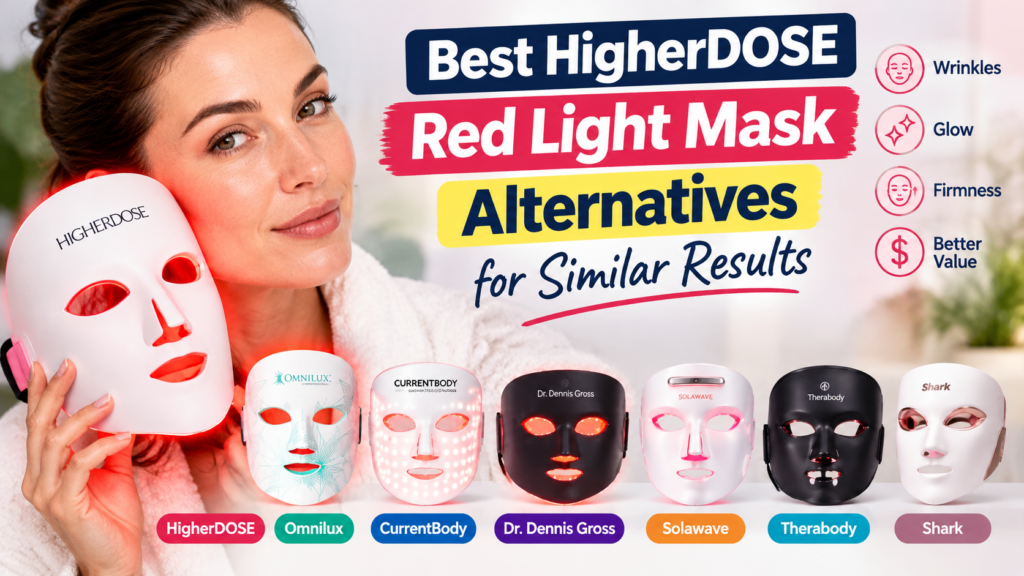
If you’ve been eyeing the HigherDOSE Red Light Face Mask, you’ve probably also noticed how crowded the LED mask category has gotten. Prices range from under $150 to nearly $900, LED counts range from 132 to 648, and every brand claims its wavelengths are “clinically proven.” That makes it genuinely hard to tell which HigherDOSE alternative is worth your money — and whether a cheaper or pricier option will actually get you similar results.
This guide breaks down 8 real alternatives to the HigherDOSE mask, what makes each one different, and how to think about “similar results” in a category where no two masks are built quite the same way.
Quick Answer
There isn’t one universal HigherDOSE replacement — the right pick depends on your priorities:
- Closest match to HigherDOSE’s red + NIR combo: Omnilux Contour Face
- More wavelength coverage: CurrentBody Skin LED Mask (Series 2)
- Acne + anti-aging in one device: Dr. Dennis Gross DRx SpectraLite FaceWare Pro
- Shortest sessions: Solawave Wrinkle Retreat Pro (3 minutes)
- Most features in one mask: Therabody TheraFace Mask
- Under-eye cooling plus LED: Shark CryoGlow
- Highest LED count: iRestore Illumina
- Lowest price with FDA clearance: Nanoleaf LED Light Therapy Face Mask
What Makes a Good HigherDOSE Alternative?
Before comparing specific masks, it helps to know what actually matters. A good alternative doesn’t need to copy HigherDOSE’s exact spec sheet — it needs to deliver a comparable type of benefit through a device with verifiable, published information behind it. That generally means:
- Wavelengths in a clinically studied range — typically red light around 630–660nm and near-infrared around 810–850nm
- A published irradiance figure (measured in mW/cm²), since this tells you the dose of light your skin actually receives, not just how many LEDs are inside the mask
- A realistic, repeatable treatment time you’ll actually stick with
- FDA clearance status that’s stated accurately — not implied
- A comfortable, flexible fit so the light reaches your skin evenly
A higher LED count can help with even coverage, but it isn’t the same thing as a stronger dose. Two masks with the same number of LEDs can still deliver very different amounts of light depending on their power output and how tightly the mask fits the face.
HigherDOSE Red Light Face Mask: What Are You Actually Replacing?
Before looking at alternatives, it’s worth understanding what the HigherDOSE mask itself offers. According to the brand, the mask uses 630nm red light and 830nm near-infrared light through 66 dual-core LEDs (132 total diodes), with a published 50 mW/cm² total irradiance. It’s FDA-cleared as a light-based, over-the-counter wrinkle-reduction device, offers 10- or 20-minute sessions, and uses a flexible silicone design with a rechargeable, cordless controller.
Those are manufacturer-published specifications, not independent clinical findings, and that distinction matters for every device in this article — including HigherDOSE itself. An alternative that shares similar wavelengths and a similar intended use isn’t guaranteed to perform identically; coverage, irradiance, fit, session length, and the underlying evidence can all differ even when the core wavelengths line up.
Comparison Table
| Product | Approx. Price | Wavelengths | Irradiance | Treatment Time | FDA Status | Best For | Main Difference From HigherDOSE |
|---|---|---|---|---|---|---|---|
| HigherDOSE Red Light Face Mask | $349 (often discounted) | 630nm red, 830nm NIR | 50 mW/cm² (manufacturer) | 10 or 20 min | FDA-cleared | Baseline comparison | — |
| Omnilux Contour Face | ~$395 | 633nm red, 830nm NIR | Not publicly stated | 10 min | FDA-cleared | Closest red + NIR match | Fewer LEDs (132), longer market track record |
| CurrentBody Skin LED Mask (Series 2) | ~$469 | 633nm red, 830nm NIR, 1072nm deep NIR | Not publicly stated | 10 min | FDA-cleared | Broader wavelength coverage | Adds a third, deeper wavelength |
| Dr. Dennis Gross DRx SpectraLite FaceWare Pro | ~$455 | Red + blue light (specific nm not publicly stated) | Not publicly stated | 3 min | FDA-cleared | Acne + anti-aging combo | No NIR; adds blue light for acne |
| Solawave Wrinkle Retreat Pro | ~$399 | 605nm amber, 630nm red, 660nm deep red, 830nm NIR | ~65 mW/cm² (manufacturer) | 3 min | FDA-cleared | Very short sessions | Four wavelengths, higher published irradiance |
| Therabody TheraFace Mask | ~$649 | Red, red+infrared, blue (specific nm not publicly stated) | Not publicly stated | 9 min | FDA-cleared | Most features (adds vibration) | 648 LEDs plus massage function |
| Shark CryoGlow | ~$349 | 630nm red, 630nm blue, 830nm infrared | Not publicly stated | 4–8 min by mode | FDA-cleared | Under-eye cooling + LED | Adds cooling; modes split by concern |
| iRestore Illumina | ~$399 (frequently discounted from $699–799) | 635nm red, 830nm infrared, 415nm blue | Not publicly stated | 10 min | FDA-cleared (per brand) | Highest LED count | 360 LEDs, adds blue light |
| Nanoleaf LED Light Therapy Face Mask | ~$150 | 640nm red + 850nm NIR (plus 6 other color/NIR combos) | ~92 mW/cm² on red mode (manufacturer) | 5–10 min | FDA-cleared | Budget buyers | Lower price, 7 modes, newer brand |
Prices change often and vary by retailer and promotion — always confirm current pricing on the official product page before buying.
Best HigherDOSE Red Light Mask Alternatives
1. Omnilux Contour Face
Omnilux Contour Face is a flexible silicone LED mask built on Omnilux’s professional light-therapy technology, using 633nm red light and 830nm near-infrared light through 132 medical-grade LEDs. Sessions run 10 minutes, and the device is FDA-cleared.
Compared with HigherDOSE, the wavelengths are nearly identical, which makes this one of the closer matches on this list. The main differences are LED count (132 vs. HigherDOSE’s 132 diodes across 66 dual-core units — similar on paper, though irradiance for Omnilux isn’t publicly published) and a longer track record in dermatology offices. Advantages include a well-established brand history and broad third-party certification (FDA, CE, TGA). Drawbacks include a higher price point than HigherDOSE at full retail and mixed reports about customer service response times.
Omnilux may suit readers who want the closest wavelength match to HigherDOSE with a device that has a longer clinical history. Readers who prioritize a lower price or a shorter session time might prefer HigherDOSE instead.
2. CurrentBody Skin LED Mask (Series 2)
The CurrentBody Skin LED Light Therapy Mask (Series 2) uses 236 LEDs across three wavelengths: 633nm red, 830nm near-infrared, and 1072nm deep near-infrared. It’s FDA-cleared and uses a 10-minute session.
Compared with HigherDOSE, CurrentBody adds a third, deeper wavelength and roughly 100 more LEDs, aiming for broader tissue penetration. Advantages include that extra wavelength and a well-reviewed flexible silicone fit. Drawbacks include a noticeably higher price than HigherDOSE and no publicly stated irradiance figure to compare dose directly.
This mask may suit people specifically interested in the deeper 1072nm wavelength for more pronounced skin concerns. Those who prefer a simpler two-wavelength device at a lower price may prefer HigherDOSE.
3. Dr. Dennis Gross DRx SpectraLite FaceWare Pro
This mask takes a different approach: 100 red LEDs plus 62 blue LEDs (162 total), FDA-cleared, with a 3-minute treatment time. According to the brand, red mode targets wrinkles while blue mode targets acne-causing bacteria, and either can be run alone or combined.
Compared with HigherDOSE, the biggest difference is that this device has no near-infrared light at all, but adds blue light for acne — something HigherDOSE doesn’t offer. Advantages include the very short session and dual-purpose acne/anti-aging design. The main drawback is the lack of NIR, which some people specifically want for deeper skin firmness support.
This is a strong option for anyone who wants to treat breakouts and fine lines with one device. Those focused purely on firmness and NIR penetration may prefer HigherDOSE or Omnilux instead.
4. Solawave Wrinkle Retreat Pro
Solawave’s Wrinkle Retreat Pro uses four wavelengths — 605nm amber, 630nm red, 660nm deep red, and 830nm near-infrared — through 320 LEDs, in a 3-minute session. It’s FDA-cleared, and the brand publishes an irradiance figure of roughly 65 mW/cm², notably higher than HigherDOSE’s stated 50 mW/cm².
Compared with HigherDOSE, Solawave adds two more wavelengths (amber and deep red) and reaches a shorter session time by running at higher published irradiance. Advantages include the short 3-minute session and the added amber wavelength for tone. A drawback is that irradiance and LED-count comparisons across brands aren’t always tested using the same methods, so “higher irradiance” figures from different manufacturers aren’t perfectly apples-to-apples.
Solawave may suit people who want the shortest possible daily routine. Readers who prefer a longer-established two-wavelength approach may lean toward HigherDOSE or Omnilux.
5. Therabody TheraFace Mask
TheraFace Mask is the most feature-heavy option here: 648 LEDs offering red, red+infrared, and blue light, plus built-in vibration/massage therapy. It’s FDA-cleared as a Class II device, with a preset 9-minute treatment (or 3-minute targeted sessions).
Compared with HigherDOSE, this is a considerably more expensive, more complex device — it adds acne treatment and facial massage on top of anti-aging light therapy. The main advantage is versatility in one mask. The main drawback is price: at roughly $649, it costs nearly double HigherDOSE.
This suits readers who want an all-in-one skincare and relaxation tool and don’t mind paying more for it. Budget-focused readers or those who just want light therapy without extra features will likely prefer HigherDOSE.
6. Shark CryoGlow
Shark’s first foray into skincare devices combines red, blue, and infrared LEDs (630nm red, 630nm blue, 830nm infrared, per published specifications) with under-eye cooling pads. It offers four treatment modes ranging from 4 to 8 minutes and is FDA-cleared.
Compared with HigherDOSE, CryoGlow adds acne-focused blue light and a cooling feature aimed at puffiness — something no other mask on this list includes. Advantages include the added cooling function and a competitive price near $349. A drawback is that treatment time varies by mode, so it’s a slightly more involved routine than HigherDOSE’s single-mode sessions.
This may suit readers who deal with under-eye puffiness alongside fine lines. Those who want the simplest possible routine may prefer HigherDOSE.
7. iRestore Illumina
iRestore’s Illumina Face Mask uses 360 medical-grade LEDs across three wavelengths — 635nm red, 830nm infrared, and 415nm blue — in a 10-minute session. The brand describes it as FDA-cleared and notes additional IEC safety testing and ISO quality assurance.
Compared with HigherDOSE, Illumina has close to three times as many LEDs and adds blue light for acne, though it doesn’t publish an irradiance figure for direct dose comparison. Advantages include the added blue-light mode and integrated eye shields. A drawback is that list price runs considerably higher than HigherDOSE, though it’s frequently sold at a discounted price closer to $399.
This may suit people who want the largest LED count on this list along with acne coverage. Those who prefer HigherDOSE’s simpler two-wavelength, lower-LED design may stick with it.
8. Budget-Friendly Alternative: Nanoleaf LED Light Therapy Face Mask
Nanoleaf, better known for smart lighting products, entered the skincare space with an FDA Class II–cleared LED mask. It offers 7 treatment modes (red, blue, green, cyan, yellow, purple, white), each paired with near-infrared light, through 432 LEDs. The red mode uses 640nm red plus 850nm NIR, with a manufacturer-published irradiance of about 92 mW/cm² on that setting. Sessions run 5–10 minutes, and it typically sells for around $150.
Compared with HigherDOSE, this is the most affordable FDA-cleared option here by a wide margin, with more treatment modes but a shorter market history. Advantages include the price and mode variety. Drawbacks include less independent, long-term testing and a newer entry into the skincare category compared with more established dermatology-adjacent brands.
This may suit budget-conscious readers who still want FDA clearance and verifiable specs. Readers who prioritize brand history in dermatology may prefer HigherDOSE or Omnilux.
HigherDOSE vs Omnilux
Both masks use nearly identical core wavelengths — HigherDOSE at 630/830nm and Omnilux at 633/830nm — so the biological target is similar. Design-wise, both are flexible silicone masks with rechargeable controllers, and both run 10-minute sessions (HigherDOSE also offers a 20-minute option). Omnilux carries a longer history of use in dermatology clinics, while HigherDOSE positions itself more as a direct-to-consumer wellness brand. On comfort, both use similar strap-and-silicone designs. On price, HigherDOSE is typically the less expensive of the two at full retail.
HigherDOSE vs CurrentBody
The wavelength gap is the main story here: CurrentBody’s Series 2 adds a 1072nm deep near-infrared wavelength that HigherDOSE doesn’t have, alongside nearly double the LED count. Coverage may feel broader with CurrentBody, and its 10-minute session matches HigherDOSE’s shorter setting. Design is similarly flexible silicone in both cases. CurrentBody costs noticeably more at full price, though both brands run frequent promotions.
HigherDOSE vs Dr. Dennis Gross
This comparison highlights a real trade-off: Dr. Dennis Gross’s SpectraLite FaceWare Pro treats acne and aging in the same device using red and blue light, but skips near-infrared entirely. HigherDOSE, by contrast, is built purely around red and NIR for firmness and fine-line support, with no acne-specific mode. Session time is a clear point of difference too — 3 minutes for Dr. Dennis Gross versus 10–20 minutes for HigherDOSE. Mask design differs slightly: the Dr. Dennis Gross device is a semi-rigid shell rather than fully flexible silicone.
HigherDOSE vs Solawave
Solawave’s Wrinkle Retreat Pro covers a wider wavelength range (four bands versus HigherDOSE’s two) and claims a higher published irradiance, which the brand says lets it use a much shorter 3-minute session. Both are fully flexible silicone masks. Solawave’s intended goals — smoother tone, firmness, and glow — overlap closely with HigherDOSE’s stated goals, though the added amber and deep-red wavelengths mean Solawave is marketed with a slightly broader tone-focused claim set.
Does a Cheaper Mask Give Similar Results?
Not automatically — but not never, either. A lower price doesn’t necessarily mean lower quality, and a higher price doesn’t guarantee better performance. What matters is whether the cheaper device still uses wavelengths in the studied range, publishes credible specifications, and carries FDA clearance. The Nanoleaf mask in this guide, for example, is a fraction of HigherDOSE’s price but still clears those bars on paper. What you’re more likely to give up at a lower price point is brand longevity, the depth of any brand-sponsored testing, and sometimes build quality or comfort over repeated use.
What to Look For Before Buying a HigherDOSE Alternative
- Confirm the exact wavelengths in nanometers, not just “red light” or “anti-aging light”
- Look for a published irradiance (mW/cm²) figure where available
- Check FDA clearance status directly, rather than relying on marketing copy alone
- Consider your main concern: firmness and fine lines call for red + NIR; acne calls for added blue light
- Factor in treatment time you’ll realistically stick to several times a week
- Review return policy and warranty, since results take weeks to assess
Which HigherDOSE Alternative Fits Your Needs?
- Want a close HigherDOSE-style red + NIR experience? Omnilux Contour Face
- Want more wavelength coverage? CurrentBody Skin LED Mask (Series 2)
- Want acne and anti-aging in one device? Dr. Dennis Gross DRx SpectraLite FaceWare Pro
- Want the shortest sessions? Solawave Wrinkle Retreat Pro
- Want the most features in one mask? Therabody TheraFace Mask
- Want cooling for puffiness plus LED? Shark CryoGlow
- Want the highest LED count? iRestore Illumina
- Want to spend less? Nanoleaf LED Light Therapy Face Mask
If you’re specifically comparing mask designs by treatment area, our guides on the best LED face masks for wrinkles and firmer skin and LED masks suited to mature skin and fine lines go deeper on specific use cases.
How Long Does It Take to See Results?
Across the devices in this guide, brands generally report early changes within 2 to 6 weeks of consistent use, with fuller results cited around 8 to 10 weeks. Results depend on wavelength, dose, how often you use the device, device design and fit, and individual skin response. Research on at-home LED devices is promising, but not all devices have been tested to the same degree, and studies across different brands and devices aren’t always directly comparable. Consistency — several short sessions per week over multiple weeks — tends to matter more than any single spec on the box. For a broader look at how these devices are studied, see our guide on whether LED face masks really work.
According to the American Academy of Dermatology’s overview of red light therapy, at-home devices can support the appearance of skin, though outcomes vary by device and by person. A broader look at the underlying mechanism is available in this PubMed review of photobiomodulation research, and a more recent look specific to cosmetic dermatology appears in this 2026 PubMed review of red light therapy in cosmetic dermatology.
FAQ
What is the best alternative to the HigherDOSE red light mask? There’s no single best option — it depends on your priority. Omnilux Contour Face is the closest wavelength match; Solawave and Dr. Dennis Gross offer the shortest sessions; Nanoleaf is the most affordable FDA-cleared option.
Is Omnilux better than HigherDOSE? Neither is universally “better.” Omnilux uses nearly identical core wavelengths to HigherDOSE and has a longer history in dermatology settings, but it costs more at full retail. Which one fits depends on your budget and preference for brand track record.
Is CurrentBody better than HigherDOSE? CurrentBody’s Series 2 adds a third, deeper wavelength and more LEDs, which may appeal to people wanting broader coverage, but it costs meaningfully more than HigherDOSE. “Better” depends on whether that extra wavelength matters for your goals.
What red light mask is most similar to HigherDOSE? Omnilux Contour Face is the closest match in wavelength (633nm/830nm vs. HigherDOSE’s 630nm/830nm) and general mask design.
Are cheaper red light masks worth it? They can be, as long as the device still publishes real wavelengths and irradiance figures and carries FDA clearance. Price alone isn’t a reliable signal of quality in either direction.
Do LED masks really work for wrinkles? Red and near-infrared light therapy has some supporting research for skin appearance, though effects tend to be gradual and vary by person, device, and consistency of use. It’s not a substitute for other dermatologist-recommended treatments if you have significant concerns.
How often should you use a red light mask? Most brands recommend 3 to 5 sessions per week for several weeks, followed by less frequent maintenance use — though exact guidance varies by device.
Does a higher LED count mean better results? Not by itself. LED count affects coverage evenness, but the dose your skin receives depends more on irradiance (power output) and how closely the mask fits your face than on the raw number of LEDs.
Final Thoughts
HigherDOSE’s red and near-infrared mask sits in a competitive field of alternatives that share its general goals — smoother-looking skin, added firmness, and a healthier glow — without being identical in coverage, irradiance, features, or price. Omnilux comes closest in wavelength design; CurrentBody and iRestore offer broader coverage; Solawave and Dr. Dennis Gross prioritize short sessions; Therabody and Shark CryoGlow add extra features; and Nanoleaf makes FDA-cleared light therapy available at a much lower price. The right choice comes down to which trade-offs — price, session length, added features, or wavelength range — matter most for your skin goals. For related buying guides, see our roundups on the best red light therapy masks for anti-aging and LED face masks for acne-prone skin.