
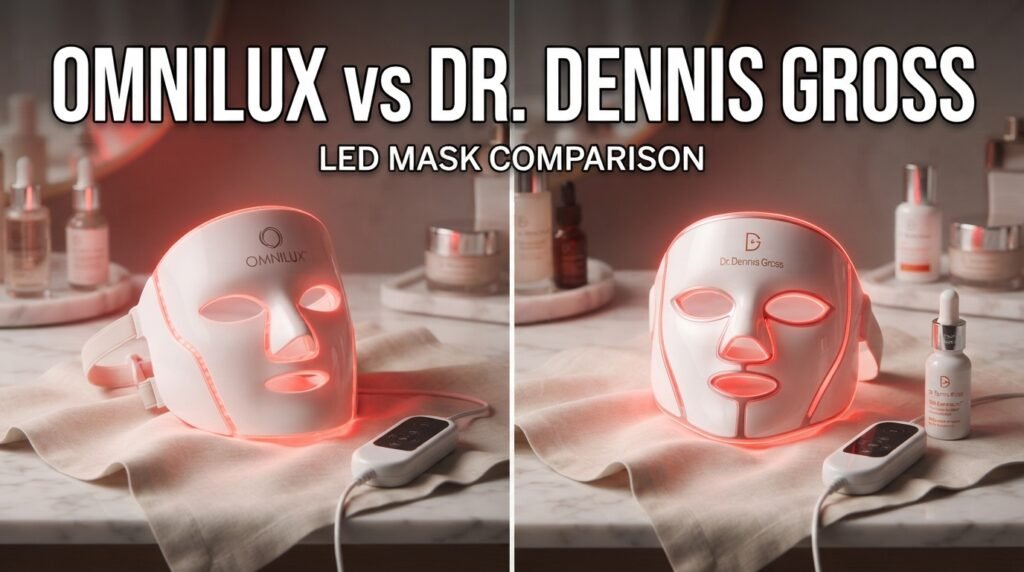
If you’re comparing the Omnilux Contour Face and the Dr. Dennis Gross DRx SpectraLite FaceWare Pro, you’re probably asking one simple question: which mask will actually do more for fine lines, wrinkles, firmness, and overall skin texture?
The honest answer is that no credible, publicly available head-to-head clinical trial has directly compared these two specific consumer devices against each other for anti-aging outcomes. Both are FDA-cleared, both use red light as their core anti-aging wavelength, and both have real photobiomodulation research behind the technology category — but the manufacturers have not published a study putting one mask on one side of a face and the other mask on the other side. Anyone who tells you one is “proven” to beat the other for wrinkles is going beyond what the evidence shows.
What we can do is compare their documented wavelengths, treatment protocols, coverage, and evidence quality in detail, so you can match the right device to your priorities. This guide breaks that down section by section, using only manufacturer-published specifications and identifiable research — with no invented numbers.
Quick Answer
For a focused, dermatologist-referenced anti-aging routine built around red and near-infrared light with a longer, once-daily-style session, the Omnilux Contour Face is the more research-anchored pick. Its 633nm/830nm combination matches wavelengths used in several published photorejuvenation studies, and the brand leans heavily on peer-reviewed research from its clinical-grade Omnilux Medical systems.
- WHAT IT IS: This LED device for the face targets wrinkles and acne for visibly smoother, clearer skin in just 3 minutes….
- HOW IT WORKS: Treat acne and breakouts with blue light, smooth wrinkles and build collagen with red light, or address bo…
- HOW TO USE: After cleansing, place the mask over your face, securing the strap around your head. Press & hold the power …
For someone who wants the shortest possible daily session, needs to treat both fine lines and active breakouts, or wants a single device that switches between red and blue light modes, the Dr. Dennis Gross DRx SpectraLite FaceWare Pro is the more flexible option. Its 3-minute cycle and dual-purpose acne/anti-aging design suit a faster, more multi-tasking skincare routine.
Neither mask has been shown in independent, head-to-head research to produce superior wrinkle reduction compared with the other. The right choice depends on your priorities, not a declared “winner.”
Omnilux vs Dr. Dennis Gross: Quick Comparison of the Best LED Face Masks for Wrinkles & Firm Skin
| Feature | Omnilux Contour Face | Dr. Dennis Gross DRx SpectraLite FaceWare Pro |
|---|---|---|
| Price (official, USD) | $395 | $455 |
| Wavelengths | 633nm red, 830nm near-infrared | 630nm red, 605nm amber, 880nm near-infrared (red-mode LEDs), 415nm blue (separate acne mode) |
| LED count | 132 LEDs (66 dual-chip red/NIR bulbs) | Approx. 160 LEDs (100 red-mode + 60 blue-mode, per current manufacturer listing; some retailers cite 162) |
| Irradiance/output | ~30 mW/cm² (manufacturer-published) | Not officially published in comparable mW/cm² units |
| Treatment time | 10 minutes per session | 3 minutes per session (auto shut-off) |
| Recommended frequency | 3–5x per week for 4–6 weeks, then maintenance | Daily use referenced in brand study protocol; clinical results measured at 2 weeks (acne) and 10 weeks (wrinkles/tone) |
| Light modes | Combined red + near-infrared only (single mode) | Red, blue, or red + blue (selectable) |
| Anti-aging focus | Primary purpose of the device | One of two purposes, alongside acne |
| Acne capability | Not indicated; brand recommends its separate Omnilux Clear device | Built-in blue light mode indicated for mild-to-moderate acne |
| Design | Flexible medical-grade silicone shell | Semi-rigid contoured shell with adjustable head strap |
| Coverage | Full face, including periorbital area (no eye protection required per brand) | Full face with eye cutouts |
| FDA-cleared status | FDA-cleared for treatment of fine lines and wrinkles | FDA-cleared for wrinkles and acne |
| Warranty | 2 years (device and controller) | 1 year |
| Best suited for | Users prioritizing a research-anchored, dedicated anti-aging protocol | Users who want speed, or who need acne and anti-aging in one device |
Only specifications that could be verified against current manufacturer materials are included above. Where sources conflicted (for example, LED counts reported as 160 vs. 162 for the SpectraLite FaceWare Pro), we used the manufacturer’s most recent published figure and flagged the discrepancy.
Verify FDA Clearance Status Directly
FDA clearance status for any LED device, including both masks in this comparison, can be independently checked through the FDA’s own premarket notification database rather than relying solely on brand claims.
Omnilux Contour Face: Full Review
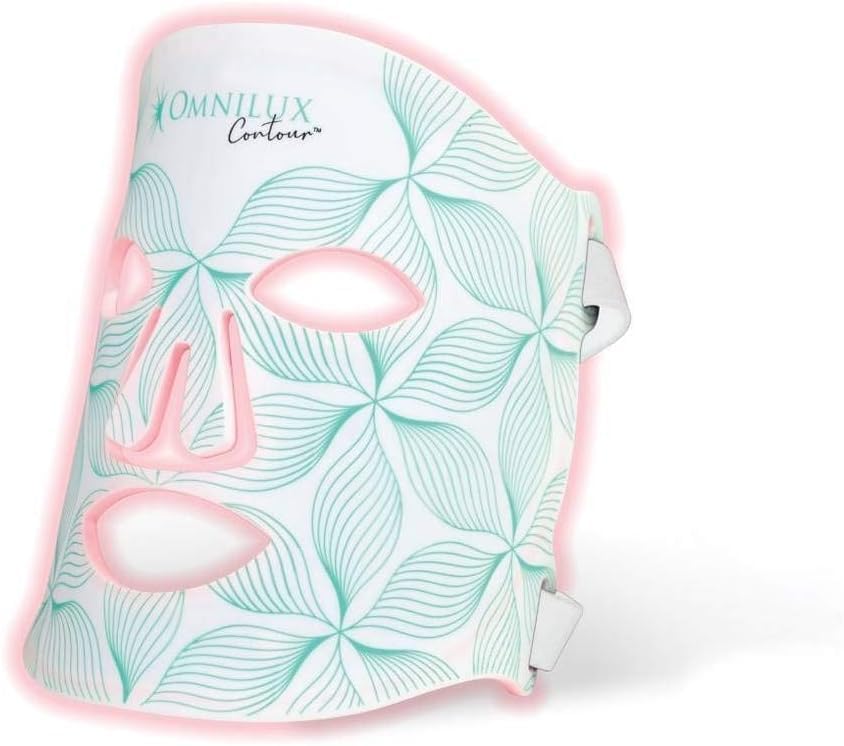
The Omnilux Contour Face is a flexible, medical-grade silicone mask built around two wavelengths: 633nm red light and 830nm near-infrared light, delivered through 132 LEDs arranged in 66 dual-chip bulbs. Each treatment runs for 10 minutes, and the brand recommends three to five sessions per week for four to six weeks, followed by maintenance sessions as needed.
Omnilux publishes an energy output of approximately 30 mW/cm² for the Contour Face and positions the device as delivering a dose comparable to its professional in-clinic Omnilux Medical systems, on the reasoning that direct skin contact concentrates the light more than a system positioned farther from the face. That is a manufacturer explanation, not an independently verified dosimetry comparison, so it should be read as the brand’s rationale rather than settled fact.
The device is FDA-cleared for the treatment of fine lines and wrinkles, carries a 2-year warranty on both the mask and controller, and does not require eye protection, according to Omnilux, because it has been tested against the IEC/EN 62471 photobiological eye safety standard.
Research background: Omnilux points to more than 40 peer-reviewed studies related to its LED technology platform, most of which were conducted on professional Omnilux Medical systems (Omnilux Revive, Omnilux Plus) rather than the consumer Contour Face mask itself. Several of those studies used the same 633nm and 830nm wavelength combination found in the Contour Face, which is meaningful supporting context — but it is not the same as a clinical trial run specifically on the at-home mask.
Strengths: Two well-studied wavelengths, published irradiance figure, longer warranty, flexible fit, strong professional/dermatology brand history.
Limitations: Longer session time, single light mode (no acne option), and the bulk of its clinical evidence comes from professional-grade sister devices rather than the mask itself.
Official Omnilux Contour Face Manufacturer Specifications
All wavelength, LED count, irradiance, warranty, and treatment-regimen figures above are drawn from Omnilux’s current official product listing, which is the most reliable source for confirming any spec before you buy.
Dr. Dennis Gross DRx SpectraLite FaceWare Pro
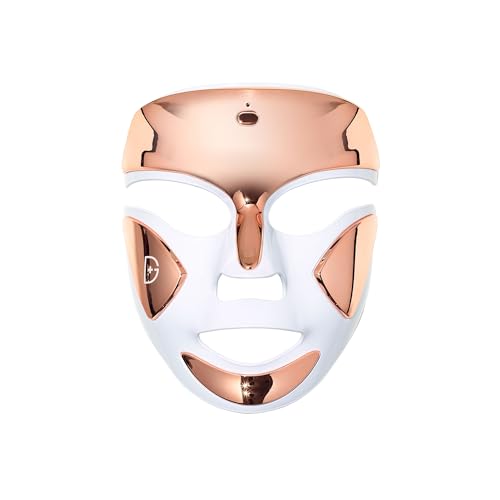
The SpectraLite FaceWare Pro is a semi-rigid, contoured mask that completes each session in just 3 minutes, with an automatic shut-off. Its red-light mode combines three wavelengths — 630nm red, 605nm amber, and 880nm near-infrared — while a separate blue-light mode uses 415nm light for acne. Users can select red, blue, or a combined red + blue setting depending on whether they’re targeting aging, breakouts, or both.
- WHAT IT IS: This LED device for the face targets wrinkles and acne for visibly smoother, clearer skin in just 3 minutes….
- HOW IT WORKS: Treat acne and breakouts with blue light, smooth wrinkles and build collagen with red light, or address bo…
- HOW TO USE: After cleansing, place the mask over your face, securing the strap around your head. Press & hold the power …
The current manufacturer specification sheet lists 100 red-mode LEDs and 60 blue-mode LEDs, for roughly 160 total; some third-party retailers list slightly different totals (around 162), which may reflect earlier product-page copy or rounding. Because this is a case where sources genuinely disagree, both figures are worth knowing, but we’ve prioritized the brand’s current official number.
The device is FDA-cleared for treating wrinkles and acne, includes a 1-year warranty, and Dr. Dennis Gross reports a consumer/clinical perception study finding that 97% of users showed improvement in fine lines, wrinkles, and skin tone after 10 weeks of use, and 97% showed acne improvement after 2 weeks. Those are brand-reported study results rather than an independently replicated peer-reviewed trial, and the source, sample size, and methodology of that specific study are not fully detailed in public brand materials.
Be careful not to confuse this device with the separate Dr. Dennis Gross SpectraLite EyeCare Pro, BodyWare Pro, or Lip Pro, which use different LED counts and are built for different areas of the body — specification mixing between these product lines is a common error in online comparisons.
Strengths: Fastest session time in this comparison, dual-purpose acne + anti-aging modes, contoured design that many users find easy to fit against the face, higher total LED count.
Limitations: No independently published irradiance/output figure to compare dose against the Omnilux, brand-reported (not independently peer-reviewed) efficacy statistics for the exact device, and a shorter warranty period.
Official Dr. Dennis Gross FaceWare Pro Manufacturer Specifications
All wavelength, LED count, treatment-time, and warranty figures above are drawn from the brand’s current official product listing, which should always be your reference point for the latest confirmed specs.
Which Has Better Anti-Aging Wavelengths? Comparing Red Light Therapy Masks
Red light (roughly 620–670nm) is generally understood, in photobiomodulation research, to act more superficially — supporting fibroblast activity, calming redness, and contributing to a more even-looking complexion. Near-infrared light (roughly 800–900nm, invisible to the eye) penetrates deeper into the dermis, where it’s associated with stimulating collagen- and elastin-producing cells. Blue light (around 400–420nm) works differently altogether — it targets acne-causing bacteria at the skin’s surface and isn’t considered an anti-aging wavelength. Amber light (around 590–605nm) is sometimes included in devices for its association with reducing redness and supporting even tone, though it has a smaller standalone research base than red or near-infrared light.
Omnilux uses a straightforward two-wavelength red + near-infrared combination. The SpectraLite FaceWare Pro’s red mode layers in an additional amber wavelength alongside red and near-infrared light, plus a separate blue mode for acne.
Having more wavelengths in one device is not the same as having better wrinkle results — each wavelength needs to be delivered at an effective, evidence-supported dose to matter, and simply adding more colors of light to a spec sheet doesn’t automatically translate into a stronger anti-aging effect.
Which Has Better Evidence for Wrinkles?
It helps to separate four distinct types of evidence here, because they are often blurred together in marketing copy.
General Red & Near-Infrared LED Research (PubMed)
There is a genuine, published body of research on photobiomodulation for facial rejuvenation. A controlled trial by Wunsch and Matuschka, published in Photomedicine and Laser Surgery (2014), found statistically significant improvements in periorbital wrinkles, skin roughness, and collagen density using combined red and near-infrared light over a nine-week course. This supports the wavelength category broadly, not any single consumer mask.
Wavelength-Specific Research on 633nm/830nm (PubMed)
Several older studies — including work by Russell, Kellett, and Reilly, published in the Journal of Cosmetic and Laser Therapy (2005) — specifically tested the 633nm-and-830nm combination used in the Omnilux Contour Face, using professional Omnilux devices, and reported measurable reductions in wrinkle depth alongside increased skin elasticity. This is a closer match to Omnilux’s specific wavelength choice than to any generic red-light claim, though it was conducted on clinical-strength equipment rather than the at-home mask.
Manufacturer claims: Both brands cite internal studies: Omnilux references its 40+ peer-reviewed study library (largely on professional systems), and Dr. Dennis Gross references a 97%-improvement consumer/clinical perception study on the FaceWare Pro itself. Manufacturer-funded studies can be genuinely informative, but they are not equivalent to independent, third-party peer review, and full methodology isn’t always publicly available.
Independent, device-specific evidence: Neither the Omnilux Contour Face nor the SpectraLite FaceWare Pro — as specific consumer products — has a large body of independent, non-brand-affiliated peer-reviewed research conducted directly on the retail device.
Direct head-to-head evidence: No publicly available study compares these two specific masks against each other for anti-aging outcomes. This is the piece of evidence that’s genuinely missing, and it’s the reason this article can’t declare an overall anti-aging winner.
Treatment Time: 3 Minutes vs 10 Minutes
A shorter session is not automatically less effective, and a longer session is not automatically more effective — the number that actually determines how much light energy reaches the skin is the dose, generally measured in irradiance (power per area, mW/cm²) multiplied by time, which gives total energy delivered (fluence, in J/cm²).
Omnilux publishes an irradiance figure of approximately 30 mW/cm² for the Contour Face. Dr. Dennis Gross has not published a comparable irradiance figure for the SpectraLite FaceWare Pro in its current consumer materials. Without that number, it is not possible to calculate the FaceWare Pro’s total energy dose or make an apples-to-apples comparison against the Omnilux — so a precise dose comparison cannot be made from publicly available manufacturer specifications. What can be said is that the FaceWare Pro’s much shorter session suggests a design built around convenience and daily-habit-forming use, while the Omnilux’s longer session is consistent with lower-intensity LEDs delivering light over more time.
Which Mask Is Better for Fine Lines and Wrinkles?
If your only goal is fine lines, wrinkles, firmness, and texture — with no interest in acne control — the practical differences that matter most are: wavelength simplicity and research alignment (Omnilux’s dedicated two-wavelength design mirrors several published photorejuvenation studies), warranty length (Omnilux’s 2 years vs. 1 year), and whether you’d rather commit to one longer session a few times a week or a quick daily habit (Dr. Dennis Gross). Neither manufacturer has published data proving faster or deeper wrinkle improvement than the other.
Which Is Better for Acne + Anti-Aging?
This is one area where the two devices are not directly comparable, because Omnilux does not position the Contour Face as an acne treatment at all — the brand explicitly recommends its separate Omnilux Clear device (blue + red light) for breakouts, and states the Contour line “will not clear acne breakouts.”
The SpectraLite FaceWare Pro, by contrast, was built as a two-in-one device from the start, with a dedicated blue-light acne mode alongside its red-light anti-aging mode. For someone managing both occasional breakouts and visible aging concerns in a single device, this built-in flexibility is a genuine practical advantage of the Dr. Dennis Gross mask — not because its anti-aging wavelengths are superior, but because it doesn’t require purchasing and rotating between two separate masks.
- WHAT IT IS: This LED device for the face targets wrinkles and acne for visibly smoother, clearer skin in just 3 minutes….
- HOW IT WORKS: Treat acne and breakouts with blue light, smooth wrinkles and build collagen with red light, or address bo…
- HOW TO USE: After cleansing, place the mask over your face, securing the strap around your head. Press & hold the power …
Comfort and Daily Use: Crow’s Feet & Under-Eye Considerations
The Omnilux Contour Face uses a flexible, medical-grade silicone shell designed to mold to the face, secured with head straps and connected to an external battery controller by a cable, which keeps weight off the face itself. The SpectraLite FaceWare Pro uses a semi-rigid, contoured shell with a detachable, adjustable strap and a self-contained rechargeable battery.
In practice (based on manufacturer materials and publicly available customer reviews, not personal testing), flexible silicone designs tend to be described as more adaptable across different face shapes, while semi-rigid contoured designs can offer a more consistent LED-to-skin distance if they fit your face shape well, but may sit less evenly on smaller or larger faces. Both devices are hands-free and cordless during use. Cleaning for both involves wiping the LED-contact surface with a damp or alcohol-based wipe rather than submerging the device. Fitting either mask into a routine mainly comes down to whether a 3-minute or 10-minute time block is easier to protect a few times a week (Omnilux) or every day (Dr. Dennis Gross), and eye-area coverage is worth a closer look for anyone specifically concerned about crow’s feet.
How Long Before You See Anti-Aging Results?
Realistic expectations matter more with LED masks than with almost any other category of at-home device, because the changes are gradual and cumulative rather than immediate.
- First few sessions: Most users report no visible wrinkle change yet; some describe temporary redness settling or a subtle glow.
- 4–6 weeks: Omnilux states that with consistent use, users should start to see results from the Contour device starting around week 4. This is also the point where early collagen-related changes are generally reported in the broader LED research base.
- 8–12 weeks (roughly 2–3 months): Dr. Dennis Gross’s own consumer study measured its reported 97% improvement figure for fine lines, wrinkles, and skin tone at the 10-week mark, which fits within this window. Independent photobiomodulation research also measured its clearest wrinkle and collagen improvements around this timeframe.
- Long-term maintenance: Both brands recommend ongoing sessions after the initial course, since photobiomodulation-driven changes are not thought to be permanent without continued use.
Results vary by individual, skin type, consistency of use, and baseline skin condition. LED masks do not erase wrinkles overnight, and no manufacturer data suggests they should be expected to.
Important Limitations: Do LED Face Masks Really Work?
LED face masks, including both devices covered here, are not equivalent to professional in-office procedures such as laser resurfacing, microneedling, or injectables, and neither manufacturer claims otherwise. Individual results vary significantly, and consistency of use appears to matter as much as, or more than, the specific device chosen. Research on red and near-infrared light technology broadly is not the same thing as proof for any single consumer mask — general category research provides supporting context, not a guarantee. Marketing language such as improvement percentages from brand-run studies should not be confused with independent, peer-reviewed clinical evidence, even when the underlying study was conducted in good faith. Neither the Omnilux Contour Face nor the Dr. Dennis Gross SpectraLite FaceWare Pro should be treated as a guaranteed wrinkle treatment, and neither has been shown in head-to-head testing to outperform the other.
Omnilux vs Dr. Dennis Gross: Who Should Choose Which?
| If you prioritize… | Consider… |
|---|---|
| A focused, dedicated anti-aging routine | Omnilux Contour Face |
| A red + near-infrared wavelength combination with more published wavelength-specific research | Omnilux Contour Face |
| The shortest possible daily session | Dr. Dennis Gross SpectraLite FaceWare Pro |
| Treating acne and aging with one device | Dr. Dennis Gross SpectraLite FaceWare Pro |
| A flexible, silicone mask that molds to the face | Omnilux Contour Face |
| A brand with a long professional/clinical LED therapy history | Omnilux Contour Face |
| A simple, single-mode routine (no settings to choose) | Omnilux Contour Face |
| Multi-light functionality (red, blue, or both) in one mask | Dr. Dennis Gross SpectraLite FaceWare Pro |
Neither device is the overall winner across every category — the better fit depends on which row above matches your priorities.
- WHAT IT IS: This LED device for the face targets wrinkles and acne for visibly smoother, clearer skin in just 3 minutes….
- HOW IT WORKS: Treat acne and breakouts with blue light, smooth wrinkles and build collagen with red light, or address bo…
- HOW TO USE: After cleansing, place the mask over your face, securing the strap around your head. Press & hold the power …
Final Verdict
So, which mask gives better anti-aging results: Omnilux or Dr. Dennis Gross? Based on everything currently published by both manufacturers and in the independent photobiomodulation literature, there is no credible, direct head-to-head clinical evidence proving that either specific mask produces superior anti-aging outcomes compared with the other.
The Omnilux Contour Face has the edge in wavelength-specific research alignment, a published irradiance figure, and a longer warranty, making it a strong pick for someone who wants a dedicated anti-aging device and values a track record of peer-reviewed research on its exact wavelength combination. The Dr. Dennis Gross SpectraLite FaceWare Pro has the edge in speed, multi-mode versatility, and dual acne-and-aging functionality, making it a better fit for someone who wants efficiency and flexibility in one device.
The right decision comes down to your priorities — wavelength philosophy, session length, whether acne matters to you, and how each mask’s evidence base lines up with what you’re comfortable trusting — rather than a manufactured “best overall” answer that the current evidence doesn’t support.
Frequently Asked Questions
Is Omnilux better than Dr. Dennis Gross for wrinkles?
Neither has been proven better than the other in direct, independent, head-to-head testing. Omnilux has more wavelength-specific published research behind its 633nm/830nm combination; Dr. Dennis Gross has brand-reported results specific to its own device. Both are reasonable choices depending on your priorities.
Which LED mask is better for fine lines?
Both target fine lines using red and near-infrared wavelengths associated with collagen-related processes in photobiomodulation research. There is no published study showing one produces measurably better fine-line results than the other.
Is Omnilux worth the money?
For someone wanting a research-anchored, dedicated anti-aging device backed by a brand with a long history in professional LED therapy, many users consider the $395 price justified. As with any LED mask, results depend on consistent use over weeks to months, not the purchase alone.
Is the Dr. Dennis Gross LED mask worth it?
At $455, it’s priced at a premium, but its 3-minute session and built-in acne mode may justify the cost for users who want speed and dual-purpose functionality in a single device.
Can LED masks really reduce wrinkles?
Published photobiomodulation research suggests red and near-infrared light can contribute to visible improvements in fine lines, skin roughness, and collagen density for some users, though effects are typically modest and gradual rather than dramatic.
How long does it take for an LED mask to work?
Most manufacturer and research timelines point to initial changes around 4–6 weeks, with more measurable results reported around 8–12 weeks of consistent use.
Can you use an LED mask every day?
It depends on the device. Dr. Dennis Gross’s protocol is built around short daily sessions. Omnilux recommends 3–5 sessions per week rather than daily use for the Contour Face, and states it hasn’t studied daily use for that specific device.
Is red light or near-infrared better for aging skin?
They’re generally understood to work at different depths — red light is associated with more surface-level effects, while near-infrared light penetrates deeper toward collagen-producing cells. Devices combining both, like the Omnilux Contour Face, are designed to address both layers rather than relying on one wavelength alone.
Can Dr. Dennis Gross help with acne and wrinkles?
Yes — its selectable red, blue, and combined red + blue modes are specifically designed to let users target acne, aging, or both from a single device, which is a meaningful practical difference from Omnilux’s aging-only Contour Face.
Do Omnilux and Dr. Dennis Gross use the same wavelengths?
Not exactly. Omnilux uses 633nm red and 830nm near-infrared light exclusively. Dr. Dennis Gross’s red mode combines 630nm red, 605nm amber, and 880nm near-infrared light, with a separate 415nm blue mode for acne — a broader wavelength set within its red-light setting.
This article compares publicly available manufacturer specifications for the Omnilux Contour Face and Dr. Dennis Gross DRx SpectraLite FaceWare Pro as of the time of writing. Specifications, pricing, and FDA clearance details are subject to change; always confirm current details directly with the manufacturer before purchasing.