
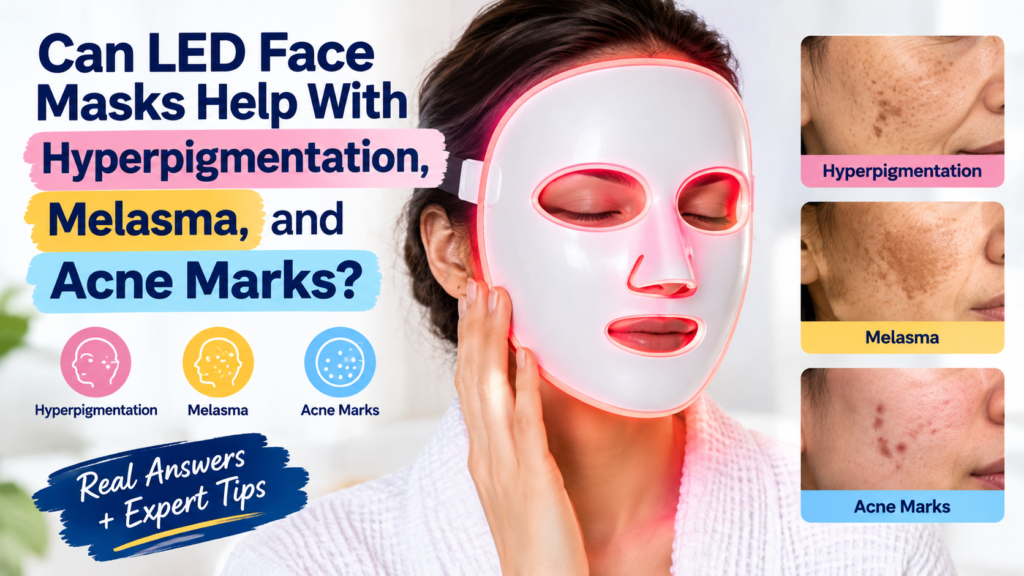
If you’ve been searching for whether an LED face mask can fade dark spots, even out your skin tone, or help with melasma, you’re probably tired of vague marketing promises. Here’s the honest, balanced answer: LED light therapy may offer some supportive benefits for certain types of discoloration, especially marks left behind by acne, but it is not a proven cure for melasma or long-standing pigmentation. The evidence varies a lot depending on what you’re actually dealing with, which is exactly what this guide breaks down.
Quick Answer: Can LED Face Masks Help?
Before going deeper, here’s a realistic snapshot of what LED masks can and can’t do for different types of discoloration.
| Concern | Might LED help? | Strength of evidence | Realistic expectation |
|---|---|---|---|
| Hyperpigmentation (general dark spots) | Possibly, as a supporting step | Limited to emerging | Subtle improvement over time, not dramatic fading |
| Melasma | Uncertain, use caution | Very limited | Not a substitute for dermatologist-guided care |
| Acne marks / PIH | Possibly, indirectly | Moderate for related acne treatment | May help by reducing new inflammation, not by erasing existing marks quickly |
| Active acne | Yes, more established | Reasonably studied for blue/red light | Can help manage breakouts as part of a routine |
| True acne scars (indented/raised) | Unlikely on its own | Weak for at-home devices | Usually needs in-office procedures |
First, Understand the Difference
A lot of confusion around LED masks comes from lumping different skin issues together. They are not the same thing, and they don’t respond the same way to light.
Hyperpigmentation is a general term for any patch of skin that’s darker than the surrounding area. It can be caused by sun exposure, inflammation, hormones, or injury.
Melasma is a specific, more complex form of pigmentation, usually appearing as brownish patches on the face. It’s strongly linked to hormones, sun exposure, heat, and even visible light, and it tends to be more stubborn and prone to recurrence than other dark spots.
Post-inflammatory hyperpigmentation (PIH) is the flat dark or reddish mark that shows up after a pimple, cut, or irritation heals. This is the “acne mark” most people are talking about when they say a pimple left a spot behind.
Acne scars are different from PIH. A true acne scar changes the skin’s texture, it can be indented (atrophic) or raised (hypertrophic/keloid). PIH is flat and typically fades on its own over months, while textural scars usually don’t fade without treatment.
If you’re not sure which one you have, a closer look at how LED face masks actually work can help you set realistic expectations before buying anything.
How LED Light May Affect Pigmentation
LED masks work by exposing skin to specific wavelengths of light, measured in nanometers. Different colors of light penetrate skin to different depths and are studied for different purposes.
Red light and near-infrared light penetrate deeper into the skin and are most associated with research on collagen stimulation, wound healing, and calming inflammation. Some of this anti-inflammatory effect is why red light gets discussed in relation to pigmentation that stems from inflammation, like PIH.
Blue light is mainly studied for its effect on the bacteria associated with acne breakouts, not for pigmentation itself.
It’s worth remembering that results from one clinical device with a specific wavelength, dose, and treatment protocol don’t automatically transfer to every consumer LED mask on the market. Devices vary widely in strength and specifications, so what worked in a study is not a guarantee of what your particular mask will do.
LED Face Masks for Hyperpigmentation
For general hyperpigmentation and uneven skin tone, some early research and clinical interest suggest that red and near-infrared light may support skin repair and calm the kind of inflammation that can lead to discoloration. This is promising, but it’s not the same as strong, large-scale clinical proof that LED masks fade existing dark spots.
It’s more accurate to think of LED light as a possible supporting tool rather than a primary pigmentation treatment. Established options like sunscreen, topical brightening ingredients, and professional treatments still have stronger evidence behind them. The American Academy of Dermatology’s overview of red light therapy safety is a useful starting point if you want to understand where the evidence currently stands.
LED Face Masks for Melasma
This is where caution matters most. Melasma isn’t just “dark spots,” it’s a condition that can be triggered or worsened by sunlight, visible light (including light from screens and indoor lighting), heat, and hormonal changes. Because melasma is so reactive to light and heat in general, it behaves differently than other types of pigmentation.
Research into photobiomodulation, the broader term for LED and light-based therapy, for melasma specifically is still limited compared to well-established melasma treatments like topical prescriptions, chemical peels, and consistent sun protection. Some case reports and small studies exist, but they don’t add up to strong, consistent evidence that an at-home LED mask can meaningfully treat melasma.
If you have melasma, an LED mask should not be treated as a replacement for dermatologist-guided care. The exact wavelength, the amount of heat a device generates, and how your individual skin reacts all matter more than they would for other skin concerns. Melasma is known to flare with heat, so a mask that feels warm during use is worth extra caution. The AAD’s guide to melasma treatment and its melasma self-care recommendations are worth reading before adding any new device to your routine.
LED Face Masks for Acne Marks / PIH
Acne marks form because inflammation from a breakout disrupts pigment-producing cells in the skin, leaving a flat mark behind after the pimple heals. The mark itself isn’t an open wound or active infection, it’s leftover discoloration.
Here’s an important distinction: treating active acne and reducing new inflammation can indirectly help prevent additional marks from forming. That’s different from directly fading pigment that’s already there. Blue and red LED light have more relevant evidence for managing active acne than for removing established pigmentation.
In other words, an LED mask might help stop new marks from showing up by calming breakouts, but it’s not accurate to say the same light is “removing” the dark marks you already have. For a broader look at devices marketed for breakout-prone skin, see this roundup of LED face masks for acne-prone skin.
Red Light vs. Blue Light for Dark Marks
| Feature | Red Light | Blue Light |
|---|---|---|
| Main wavelength/color | Red, longer wavelength | Blue, shorter wavelength |
| Main skincare use | Anti-aging, inflammation, general skin support | Managing acne-causing bacteria |
| Evidence for acne | Some, often combined with blue light | More established, mainly for active breakouts |
| Evidence for pigmentation | Emerging, linked to anti-inflammatory effects | Very limited, not a primary use |
| Important limitation | Not proven to fade existing dark spots on its own | Helping acne doesn’t mean it helps pigmentation |
A common mistake is assuming that because blue light helps with acne, it must also help fade the marks acne leaves behind. That’s not how the evidence lines up, blue light’s benefit is tied to active breakouts, not to treating pigment that’s already formed.
What About Darker Skin Tones?
This is a safety consideration that often gets skipped in generic LED mask articles. Skin with more melanin can respond differently to visible light and heat, and people with darker skin tones are generally more prone to developing hyperpigmentation in response to inflammation or irritation, including irritation from a skincare device used incorrectly.
If you have skin that tends to hyperpigment easily, it’s worth being extra cautious with any new light-based device, starting slowly, watching for any darkening or irritation, and not assuming a device is automatically safe just because it’s marketed as gentle. Speaking with a dermatologist familiar with treating pigmentation in deeper skin tones is a reasonable step before committing to a routine built around LED therapy.
Can LED Make Melasma or Dark Spots Worse?
It’s a fair question, and the honest answer is: it’s possible for some individuals, though it isn’t a universal or guaranteed outcome. There’s a difference between what’s proven, what’s biologically possible, and how any one person’s skin might respond.
Because melasma is known to be sensitive to heat and certain light exposure, some people may notice their pigmentation looks worse rather than better after using a light-based device. If that happens, stopping use is a sensible, low-risk response. Persistent or worsening melasma, or any pigmentation change that concerns you, is worth discussing with a dermatologist rather than troubleshooting on your own.
How to Use an LED Mask If Pigmentation Is Your Concern
- Follow the manufacturer’s instructions for frequency and session length
- Don’t use the device more often than recommended, more isn’t better
- Avoid stacking too many active or irritating skincare products at the same time
- Protect your skin from sunlight, especially since light and heat can affect pigmentation
- Monitor your skin for any changes, positive or negative, over several weeks
- Use the eye protection provided if the manufacturer recommends it
- Stop use and consult a professional if you notice significant irritation or pigmentation that looks worse
Sunscreen Matters More Than Most People Realize
No matter what LED device you use, sunscreen is not optional if pigmentation or melasma is a concern. Daily, broad-spectrum SPF 30 or higher is one of the most consistently supported ways to prevent existing dark spots from getting darker and to reduce the risk of new ones forming.
For melasma specifically, visible light, not just UV rays, can play a role in triggering flare-ups. This is why tinted sunscreens containing iron oxides are often recommended for melasma-prone skin, since they offer a layer of protection against visible light that plain, non-tinted sunscreens don’t provide. If you wear makeup regularly, it’s also worth knowing how to reapply sunscreen over makeup so protection doesn’t lapse throughout the day.
How Long Does It Take to See Results?
Pigmentation, in general, changes slowly. Skin cell turnover and pigment fading happen over weeks to months, not days. If an LED mask does offer any supportive benefit for tone or marks, it’s realistic to expect gradual, subtle changes rather than a dramatic before-and-after. Be wary of any product or review promising fast, guaranteed results, that’s not how pigmentation works, regardless of the device.
When an LED Mask May Not Be Enough
An LED mask is a supportive tool at best, not a full treatment plan. It’s time to consider seeing a dermatologist if you’re dealing with:
- Melasma that persists or keeps coming back
- Pigmentation that’s rapidly getting worse
- Severe or persistent active acne
- Noticeable acne scarring, especially textured or indented scars
- Dark spots that aren’t improving with sunscreen and basic skincare
- Uncertainty about what type of pigmentation you actually have
A dermatologist can also offer treatments, like certain lasers and light-based procedures, that go beyond what an at-home device is designed to do. The AAD’s overview of lasers and light treatments for acne is a helpful reference for what’s available beyond at-home devices.
What to Look for When Buying an LED Mask for Pigmentation-Prone Skin
If you decide to try an LED mask, a few practical things matter more than flashy marketing claims:
- Exact wavelengths the device uses, and whether they’re published, not vague
- Published specifications rather than generic marketing language
- Treatment time per session and how that fits your routine
- Heat and comfort level, especially important if you have melasma
- Eye safety features, like included goggles or shielding
- FDA clearance, where relevant, note that the correct term is “FDA-cleared,” not “FDA approved.” FDA clearance means a device has met certain safety and equivalence standards, it is not the same as the FDA endorsing specific pigmentation results.
- Manufacturer instructions for frequency and use
- Whether the device is actually designed for acne, anti-aging, or another concern, since not every mask is built with the same goal in mind
If anti-aging and firmness are more your priority than pigmentation, it may help to compare options in guides like the best LED face masks for wrinkles and firming skin or red light therapy masks for anti-aging, and pairing a device with supportive ingredients such as those in vitamin E serums for general skin health.
FAQ
Can LED masks fade dark spots?
They may offer subtle, supportive benefits for some types of discoloration, but they’re not a proven, guaranteed way to fade established dark spots.
Is red light good for melasma?
Evidence is limited, and melasma can be sensitive to heat and light, so caution and dermatologist guidance are recommended.
Is blue light good for acne marks?
Blue light is more relevant to active acne than to fading existing marks, its role in pigmentation itself is not well established.
Can LED make hyperpigmentation worse?
It’s possible for some individuals, particularly with melasma, though it’s not a universal outcome. Stop use if pigmentation appears to worsen.
Can I use an LED mask if I have melasma?
Speak with a dermatologist first, since melasma responds differently to light and heat than other types of pigmentation.
How long does LED take to improve skin tone?
If any benefit occurs, expect gradual changes over weeks to months, not immediate results.
Does LED remove acne scars?
At-home LED masks are unlikely to meaningfully treat true textural acne scars on their own; in-office procedures are generally more effective for that.
Should I use sunscreen with an LED mask?
Yes, daily broad-spectrum sunscreen is essential for pigmentation and melasma regardless of any device you use.
Final Verdict
LED face masks may play a useful, supporting role for some skin concerns, particularly active acne, and possibly for general skin tone support over time. But they shouldn’t be treated as a guaranteed solution for melasma or long-standing pigmentation. The strongest, most consistent tools for protecting and improving pigmentation-prone skin remain daily sunscreen, consistent basic skincare, and professional guidance when needed. An LED mask can be one supportive piece of that routine, but it isn’t a substitute for it.
This article is for general informational purposes and isn’t a substitute for personalized medical advice. If you have concerns about melasma, hyperpigmentation, or acne, consult a board-certified dermatologist.
Sources referenced: American Academy of Dermatology – Red Light Therapy Safety, AAD – Melasma Treatment, AAD – Melasma Self-Care, AAD – Lasers and Lights for Acne, and a peer-reviewed study on PubMed.