
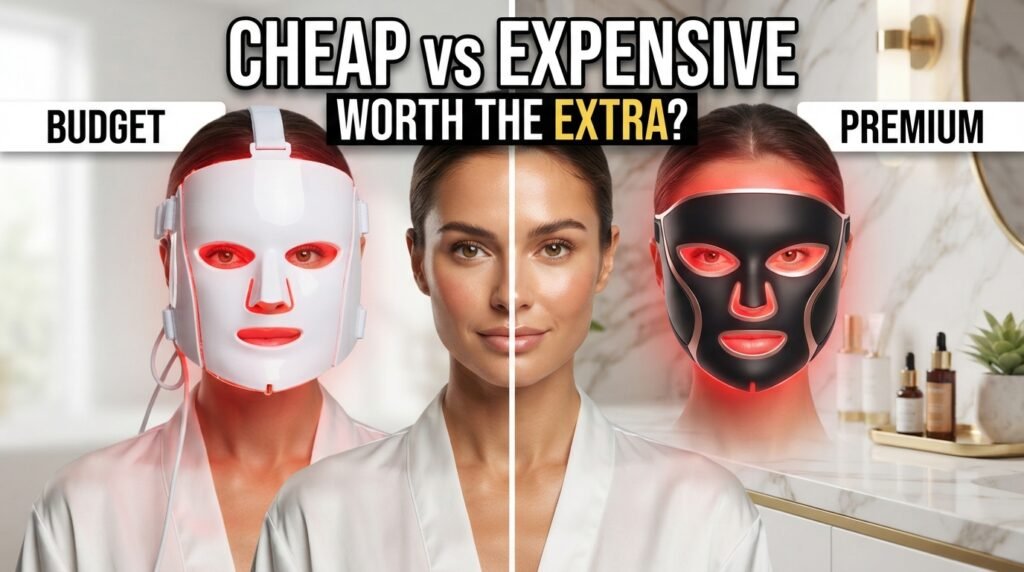
LED face masks now range from under $100 to well over $500, and the price gap can feel confusing. Two masks might claim similar red and near-infrared wavelengths, yet sit hundreds of dollars apart. So what’s actually different?
This guide breaks down the real factors behind LED face mask pricing — not marketing claims — so you can decide how much mask you actually need, and how much mask is worth paying for.
Quick Answer
Price alone does not determine how well an LED face mask performs. What matters more is wavelength accuracy, irradiance (light intensity), treatment dose, coverage, fit, build quality, and whether you’ll actually use the device consistently. Expensive masks often offer better documentation, construction, and coverage — but not always, and not automatically. Some mid-priced masks offer strong value, while some expensive masks include extras you may never use.
Cheap vs Expensive LED Face Masks at a Glance
| Factor | Budget Masks | Premium Masks |
|---|---|---|
| Wavelength transparency | Sometimes vague | Usually specified |
| Irradiance data | Rarely published | Often published |
| Coverage/fit | Variable | Often more consistent |
| Build quality | Mixed | Generally sturdier |
| Clinical testing | Uncommon | More common, not universal |
| Warranty | Shorter or limited | Often longer |
This is a general pattern, not a guarantee. Specifications vary by individual product, so it’s worth checking the details rather than assuming price equals quality. For a deeper breakdown of what specs actually matter, see this guide on what to look for in an LED face mask.
What Actually Makes One LED Mask More Expensive?
1. Wavelengths
LED masks typically use red light (around 630–660 nanometers) and near-infrared light (around 810–850 nanometers). Wavelength refers to the specific “color” of light being used, and it determines how deeply the light penetrates skin and what cellular processes it may influence.
Cheaper masks sometimes list wavelengths vaguely (“red light therapy”) without exact numbers. More transparent brands publish precise wavelength specs, which lets you compare devices against published research.
2. Irradiance and Dose
Irradiance is the amount of light energy delivered to a specific area of skin, usually measured in milliwatts per square centimeter. Dose is the total amount of light energy delivered over a session, which depends on irradiance multiplied by treatment time.
Higher irradiance is not automatically better. If irradiance is too high or too low relative to the intended protocol, results may not match what’s shown in research. What matters is a dose range that’s been reasonably studied, not simply “more power.”
3. LED Placement and Facial Coverage
Expensive masks often space LEDs more deliberately across curved areas like the cheeks, jawline, and forehead, rather than just packing in more bulbs. Good coverage means fewer gaps between LEDs and more even light distribution across the whole face.
4. Fit and Comfort
Rigid masks can leave gaps around the nose, cheeks, or chin, especially on smaller or larger faces. Flexible silicone designs tend to hug the face more evenly, which affects how consistently light reaches the skin. A mask that doesn’t fit well may deliver uneven treatment regardless of its technical specs.
5. Treatment Time
Some masks require 20-minute sessions; others claim effective treatment in around 10 minutes due to higher irradiance. Shorter sessions can be more convenient, but only if the total dose remains appropriate — faster isn’t automatically better.
6. Build Quality
Higher-priced masks often use more durable straps, connectors, and housings. Cheaper units can still function well, but may show wear sooner, particularly with frequent use over a year or more.
7. Testing and Quality Control
Reputable brands often conduct internal testing and batch quality checks on irradiance consistency. This is harder to verify from the outside, but consistent customer reviews and manufacturer transparency are reasonable signals.
8. FDA Clearance and Clinical Evidence
Some LED masks have obtained FDA clearance through the 510(k) pathway. It’s important to understand that FDA clearance is not the same as FDA approval, and it does not automatically mean a device is more effective than a non-cleared one — it means the manufacturer demonstrated the device is substantially equivalent to an existing cleared device for a specific indication.
For example, the CurrentBody Skin LED Multi Light Therapy Mask received a 510(k) clearance, which you can review directly through the FDA’s own clearance database listing.
Separately, independent research adds useful context. A randomized controlled trial on photobiomodulation and periocular wrinkles explored red and amber light effects on fine lines, while a more recent randomized sham-controlled study of a home-use LED/IRED mask for crow’s feet found improvement using 630 nm and 850 nm light over 16 weeks. These studies support the plausibility of LED therapy for certain concerns, but they don’t prove that every consumer mask on the market performs identically.
9. Warranty and Customer Support
Premium brands often provide longer warranties (one to two years) and more responsive customer service. Budget brands may offer shorter coverage or slower support, though this varies by seller.
10. Extra Features
Some masks add features like companion apps, multiple light modes, heating, or vibration. These can be genuinely useful — or unnecessary, depending on whether you’ll actually use them.
Cheap vs Expensive: What Changes at Each Price Level?
Pricing tiers are general patterns, not guarantees. Individual products within the same price range can vary significantly in quality.
| Price Tier | What You Usually Get | Potential Advantages | Potential Weaknesses | Who It Makes Sense For |
|---|---|---|---|---|
| Under $100 | Basic red/near-infrared LEDs, limited specs listed | Affordable entry point, low risk to try | Vague wavelength data, inconsistent fit, shorter lifespan | Curious first-time users wanting to test the category |
| $100–$200 | More defined wavelengths, moderate coverage | Reasonable balance of price and documentation | Irradiance data still sometimes missing | Budget-conscious buyers wanting better transparency |
| $200–$300 | Improved fit, published specs, brand reputation | Better coverage and comfort | Still a meaningful price jump for casual users | Users wanting a dependable mid-range option |
| $300–$400 | Flexible designs, clearer dosing protocols | Strong coverage, often better warranties | Diminishing returns if used infrequently | Users committed to a consistent routine |
| $400–$500+ | Established brands, FDA-cleared options, published specs | Strong documentation, refined fit, support | Premium pricing partly reflects brand and R&D costs | Users prioritizing documentation and long-term use |
Examples across these tiers include the CurrentBody Skin LED Mask Series 2 product details and the HigherDOSE Red Light Face Mask product page, both of which sit in the premium range with published specifications. Omnilux Contour and the Dr. Dennis Gross DRx SpectraLite FaceWare Pro are other well-known names in similar price territory, while Solawave’s Wrinkle Retreat Pro represents a more accessible mid-tier option. Always check current pricing directly from the brand, since promotions and costs change.
Are Expensive LED Masks Actually More Effective?
Not automatically. Effectiveness depends on wavelength accuracy, adequate irradiance, sufficient coverage, and consistent use — not price tag alone. A well-designed $150 mask with accurate specs can outperform a poorly fitted $400 mask with gaps in coverage.
That said, expensive masks more often (not always) publish verifiable specs, fit more consistently, and have more supporting documentation. This guide on whether LED face masks really work goes deeper into the evidence behind the category as a whole.
Why LED Count Can Be Misleading
Marketing often highlights total LED count — “200 LEDs” sounds impressive. But LED count alone doesn’t indicate irradiance, wavelength accuracy, or even coverage, since bulbs could be clustered unevenly. A mask with fewer, well-placed, accurately calibrated LEDs can deliver a more effective dose than one with more LEDs spaced inconsistently.
When a Cheap LED Mask Is a Smart Buy
A lower-priced mask may be reasonable if you:
- Are new to LED therapy and want to try it before investing more
- Have a flexible budget constraint
- Mainly want general skin maintenance rather than targeting specific concerns
- Are comfortable researching wavelength specs yourself
When Paying More Is Worth It
Spending more can be justified when it buys you:
- Clearly published wavelength and irradiance specifications
- Better facial coverage and fit
- Stronger build quality for long-term use
- A longer warranty and more reliable customer support
- Features you will genuinely use, such as shorter session times
If fine lines or firmness are your main concern, it may help to compare options built specifically for that goal, such as masks reviewed in this guide to LED face masks for wrinkles and firming skin or this roundup of red light therapy masks for anti-aging.
When Paying More Is Probably Not Worth It
Higher price doesn’t automatically mean better value when it mainly reflects:
- Brand name recognition without corresponding spec transparency
- Extra features you’re unlikely to use, like app connectivity or multiple unused light modes
- Marketing-driven LED counts without irradiance data
- Premium packaging or aesthetics rather than functional improvements
Cost Per Use: The Number Most Buyers Ignore
Purchase price only tells part of the story. Consider cost per session over time.
Example: A $100 mask used three times per week for two years totals roughly 312 sessions, or about $0.32 per session.
A $400 mask used the same frequency over the same period also totals about 312 sessions, working out to roughly $1.28 per session.
The price difference per use is real, but it’s modest when spread over consistent long-term use. The bigger issue is actual usage: a cheaper mask that sits in a drawer because it’s uncomfortable or ill-fitting delivers zero value, regardless of its low price. A pricier mask that you use consistently because it’s comfortable and easy may represent better value — not necessarily because it’s more effective, but because consistency matters for any skincare routine.
How to Choose an LED Mask Without Overpaying
- Check whether wavelengths are specified in nanometers, not just “red light”
- Look for irradiance information if available
- Confirm expected treatment time and how it compares to published research
- Try to assess fit — does it cover your whole face without gaps?
- Check warranty length and return policy before buying
- Consider your specific skin concern; browsing options built for sensitive skin and redness or mature skin and fine lines can help narrow choices
- Review broader at-home options in this guide to at-home red light therapy for face rejuvenation
Best Questions to Ask Before Buying
- What exact wavelengths does this mask use?
- Is irradiance or power density published anywhere?
- How long is a typical session, and how many sessions per week are recommended?
- Does the mask fit snugly across cheeks, forehead, and jawline?
- What is the warranty period and return policy?
- Is there any independent research behind this specific device, or only general LED therapy research?
FAQ
Are expensive LED face masks worth the money?
Sometimes. They often offer better documentation, fit, and build quality, but effectiveness depends on specifications and consistent use, not price alone.
Are cheap LED face masks effective?
They can be, provided wavelengths are accurate and the mask fits well enough to deliver consistent coverage. Quality varies widely at lower price points, so checking specs matters.
What makes an LED face mask expensive?
Published specifications, better coverage and fit, stronger build quality, warranty support, clinical documentation, and brand reputation all contribute to higher pricing.
How much should I spend on an LED face mask?
There’s no universal number. A reasonable approach is choosing the lowest price point that still offers transparent wavelength and irradiance information and a fit that works for your face.
Does a higher LED count mean a better mask?
No. LED count alone doesn’t indicate irradiance, wavelength accuracy, or coverage quality. Placement and calibration matter more than raw numbers.
What matters more: wavelength or LED count?
Wavelength accuracy matters more, since it determines what the light can potentially do. LED count without proper wavelength and irradiance data tells you very little.
Is a $100 LED mask worth buying?
It can be a reasonable starting point if the wavelengths are specified and the fit works for you, though options in this range may have less published testing than premium alternatives.
How long should an LED face mask last?
This varies by brand and build quality, but many well-maintained masks are designed to last several years of regular use. Check manufacturer warranty information for specifics.
Should I buy a premium LED mask or a budget one?
It depends on your budget, how much documentation matters to you, and whether you’ll realistically use the mask consistently. Neither choice is automatically correct for everyone.
Final Verdict
The smartest LED mask is not necessarily the cheapest or the most expensive. It’s the one that provides credible specifications, appropriate wavelengths, adequate coverage, transparent information from the manufacturer, and a treatment routine you’ll actually follow.
Price can reflect genuine improvements — better fit, stronger documentation, longer warranties — but it can also reflect branding and unused extras. The best approach is comparing actual specifications across price points rather than assuming a higher number on the price tag guarantees a better result.