
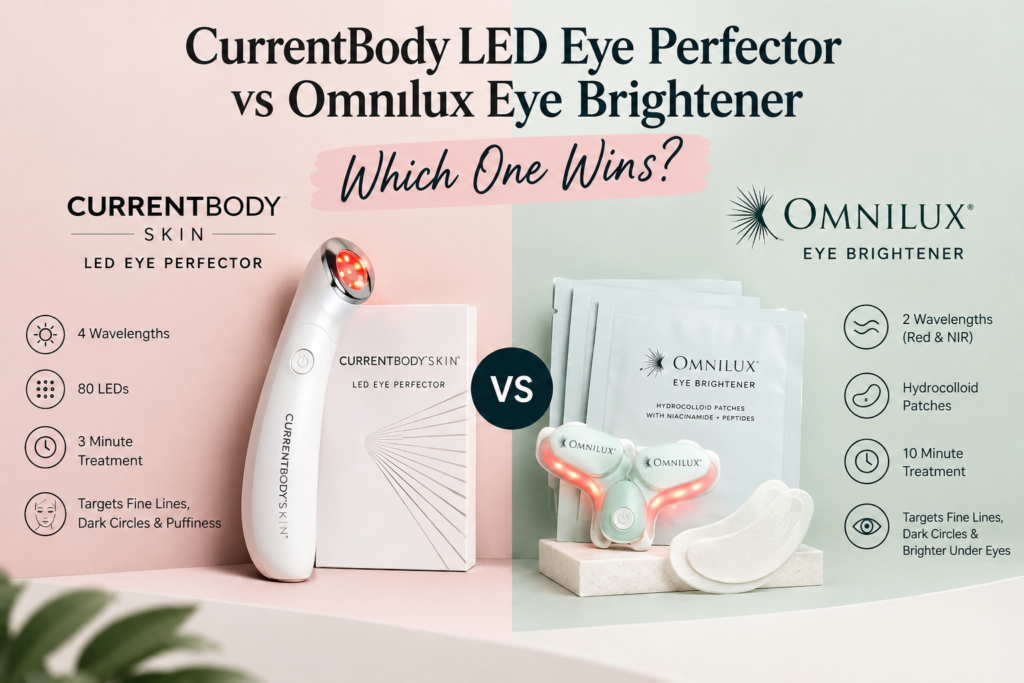
Choosing between the CurrentBody LED Eye Perfector and the Omnilux Eye Brightener comes down to three real differences: treatment speed, ongoing patch costs, and whether you want a standalone LED device or a combined light-and-skincare system. CurrentBody uses four wavelengths in roughly three-minute sessions with no consumables. Omnilux pairs two wavelengths with niacinamide-infused hydrocolloid patches that must be replaced. If fast, low-maintenance treatments matter most, CurrentBody has the edge. If you prefer an integrated patch-based approach and don’t mind recurring costs, Omnilux may suit your routine better.
Quick Verdict: Which Device Wins?
- Best for a short treatment routine: CurrentBody LED Eye Perfector (~3 minutes per session).
- Best for a patch-based skincare approach: Omnilux Eye Brightener (hydrocolloid patches with active ingredients).
- Best for fine lines and crow’s feet: No clear winner. Both deliver red and near-infrared light to the periocular area, and no direct comparative trial exists.
- Best for dark circles: Neither device can be recommended as a proven solution. Dark circles have multiple causes, many of which LED light does not address.
- Best overall value: CurrentBody, if you factor in the absence of ongoing replacement costs. Omnilux has a lower upfront price but requires recurring patch purchases.
CurrentBody vs Omnilux: Comparison Table
| Feature | CurrentBody LED Eye Perfector | Omnilux Eye Brightener |
|---|---|---|
| Device design | Goggle-style, wraps around both eyes | Compact device used with hydrocolloid patches |
| Wavelengths | 605 nm, 633 nm, 660 nm, 830 nm | 633 nm, 830 nm |
| Number of LEDs | 80 | Not confirmed |
| Treatment time | ~3 minutes | ~10 minutes |
| Recommended frequency | 3–5× per week | 3–5× per week |
| Treatment area | Periocular (crow’s feet, under-eye) | Under-eye area |
| Included accessories | USB-C cable, protective eyewear | Hydrocolloid patch starter set, charging cable |
| Skincare patches required | No | Yes |
| Charging | USB-C rechargeable | USB rechargeable |
| Warranty | 2 years (verify on official site) | 2 years (verify on official site) |
| Current US price | ~$249 | ~$199 |
| Ongoing ownership costs | None | Replacement patches (~$30–$40 per pack) |
| Main advantage | Fast sessions, no consumables | Combined LED + topical skincare delivery |
| Main limitation | Larger goggle design | Ongoing patch expense, longer sessions |
Prices and specifications reflect information available at the time of writing. Always verify current details on each manufacturer’s official product page before purchasing.
CurrentBody LED Eye Perfector: Detailed Review
The CurrentBody LED Eye Perfector uses a goggle-shaped design that positions 80 LEDs across the periocular area. Its four wavelengths—605 nm amber, 633 nm red, 660 nm deep red, and 830 nm near-infrared—cover a broader spectrum than most competing eye devices. The manufacturer states that sessions last approximately three minutes, making this one of the fastest targeted LED devices for under-eye wrinkles currently available.
The absence of replacement patches is a genuine practical advantage. Once purchased, the device has no recurring consumable costs. It is rechargeable via USB-C and portable enough for travel.
A few caveats are worth noting. Four wavelengths do not automatically produce better results than two. The additional amber and deep-red channels are theoretically interesting, but no published head-to-head trial has demonstrated that this specific four-wavelength configuration outperforms a two-wavelength approach for periocular concerns. The goggle design may also feel bulkier than a compact patch system, and fit can vary depending on face shape.
Omnilux Eye Brightener: Detailed Review
The Omnilux Eye Brightener takes a different approach. It combines a compact LED array emitting 633 nm red and 830 nm near-infrared light with single-use hydrocolloid patches infused with niacinamide and peptides. The idea is that light therapy and topical actives work together during each ~10-minute session.
The compact form factor is easy to store and travel with. The patches adhere to the under-eye area, which some users find more comfortable than a goggle-style device.
The trade-off is ongoing cost and time. Replacement patches must be purchased regularly, adding to the total cost of ownership over months and years. Sessions are roughly three times longer than CurrentBody’s. And while the skincare ingredients in the patches are well-studied topicals, their inclusion does not independently prove that the complete Omnilux system delivers better anti-aging results than a standalone LED device. For a broader look at how these two brands compare across their full product lines, this Omnilux vs CurrentBody LED mask comparison covers additional models.
Head-to-Head Performance Comparison
Fine Lines and Crow’s Feet
Both devices deliver red and near-infrared light to the periocular area, the wavelengths most consistently associated with collagen stimulation in published research. CurrentBody’s shorter treatment time may make daily adherence easier, which matters because consistency drives results with any LED device. Omnilux’s patches add topical hydration and active ingredients that may temporarily plump fine lines. Neither approach has been proven superior in a direct clinical trial.
Dark Circles and Uneven Under-Eye Tone
Dark circles can result from hyperpigmentation, visible blood vessels, thin skin, structural shadows, or puffiness. LED light therapy has limited evidence for addressing most of these causes. Neither manufacturer should be expected to eliminate dark circles, and buyers whose primary concern is significant under-eye discoloration should consult a dermatologist before investing in either device.
Puffiness and Tired-Looking Eyes
Near-infrared light has been studied for its anti-inflammatory properties, which may modestly help with fluid-related puffiness. Results are likely to be subtle and gradual. If puffiness is your main concern, exploring a broader range of LED eye masks for crow’s feet and puffiness may help you compare additional options.
Treatment Time and Daily Convenience
CurrentBody’s ~3-minute sessions are a clear advantage for busy schedules. Omnilux’s ~10-minute sessions are still manageable but require more daily commitment. Over weeks and months, shorter sessions tend to improve long-term adherence.
Comfort, Portability, and Fit
Omnilux’s compact patch-based design is lighter and more travel-friendly. CurrentBody’s goggle design covers a wider area but may feel less comfortable for some face shapes. Fit is personal, and return policies matter here.
Total Cost of Ownership
CurrentBody costs approximately $249 upfront with no ongoing expenses. Omnilux starts at roughly $199 but requires replacement patches at an estimated $30–$40 per pack. Over 12 months of regular use, Omnilux’s total cost may equal or exceed CurrentBody’s.
What Does the Scientific Evidence Actually Say?
Red and near-infrared photobiomodulation has been studied for skin rejuvenation, including periocular wrinkles. Research published in peer-reviewed journals has shown that wavelengths in the 630–850 nm range can stimulate fibroblast activity and collagen production in controlled settings (Lee et al., 2017; recent photobiomodulation review).
However, there are important distinctions to make. Most published studies use professional-grade equipment with higher irradiance than consumer devices. General evidence that red light can improve skin texture does not automatically transfer to any specific at-home product at its exact power output and treatment duration.
Critically, no direct head-to-head clinical trial comparing the CurrentBody LED Eye Perfector to the Omnilux Eye Brightener has been identified. Neither product has been proven superior to the other in a controlled comparative study. Visible cosmetic improvements, if they occur, are gradual and vary significantly between individuals.
Safety and Who Should Be Cautious
Both devices are intended for cosmetic use and should be used strictly according to manufacturer instructions. Protective eyewear should be worn as directed.
People who should exercise caution or consult a healthcare provider before use include those with photosensitivity disorders, individuals taking photosensitizing medications (certain antibiotics, retinoids, and acne treatments), anyone with active eye conditions or recent ocular surgery, and people with a history of skin cancer in the treatment area.
One of these devices has received FDA 510(k) clearance, which is documented in FDA record K221444. It is important to understand that FDA clearance indicates the device is substantially equivalent to an already-marketed predicate device for its intended use. It is not the same as FDA approval, and it does not establish that the cleared device produces superior results compared to other LED products on the market.
Which One Should You Buy?
Choose the CurrentBody LED Eye Perfector if:
- You want the shortest possible treatment sessions.
- You prefer a one-time purchase with no replacement costs.
- You want broader wavelength coverage and are comfortable with a goggle-style fit.
- Consistency is a challenge and a three-minute routine feels more sustainable.
Choose the Omnilux Eye Brightener if:
- You prefer a compact, lightweight device.
- You want the added step of hydrocolloid patches with niacinamide and peptides.
- You don’t mind longer sessions and ongoing patch purchases.
- You already use and enjoy patch-based under-eye treatments.
If you’re still unsure, consider whether you’re more likely to stick with a three-minute goggle routine or a ten-minute patch routine over several months. The best LED device is the one you’ll actually use consistently. For readers exploring full-face options alongside a targeted eye device, this roundup of the best LED face masks for crow’s feet and under-eye wrinkles covers complementary products. And if you’re considering other brands entirely, this guide to CurrentBody alternatives for wrinkles and firming offers additional comparisons.
Frequently Asked Questions
1. Is CurrentBody LED Eye Perfector better than Omnilux Eye Brightener?
Neither device has been proven superior in a direct clinical comparison. CurrentBody offers faster sessions and no ongoing costs. Omnilux provides a combined LED-and-skincare patch approach. The better choice depends on your priorities.
2. Which device is better for crow’s feet?
Both deliver red and near-infrared light to the periocular area, which is the wavelength range most associated with collagen support. No evidence establishes one as more effective than the other for crow’s feet specifically.
3. Can either device help with dark circles?
Dark circles have multiple causes, including pigmentation, thin skin, visible vasculature, and facial structure. LED light therapy has limited evidence for most of these causes. Neither device should be expected to eliminate dark circles.
4. How long does each treatment take?
CurrentBody sessions last approximately 3 minutes. Omnilux sessions last approximately 10 minutes. Verify current instructions on each manufacturer’s product page.
5. Do Omnilux Eye Brightener patches need replacing?
Yes. The hydrocolloid patches are single-use and must be replaced regularly, adding to the ongoing cost of ownership.
6. How soon might someone notice a difference?
Manufacturer timelines typically suggest 4–8 weeks of consistent use. Individual results vary, and some users may not notice significant changes. Gradual improvement is more realistic than dramatic transformation.
7. Are LED eye devices safe for everyone?
Not necessarily. People with photosensitivity, certain eye conditions, or those taking photosensitizing medications should consult a healthcare provider before use. Always follow the included safety instructions and wear any provided eye protection.
8. Is either device worth the price?
That depends on your budget, expectations, and likelihood of consistent use. CurrentBody offers lower long-term costs. Omnilux has a lower entry price but ongoing patch expenses. Neither device replaces professional treatments for significant concerns.
Conclusion
The CurrentBody LED Eye Perfector and Omnilux Eye Brightener are both legitimate at-home LED devices targeting the periocular area, but they serve slightly different preferences. CurrentBody wins on speed, simplicity, and long-term value. Omnilux appeals to buyers who want an integrated patch-and-light routine and don’t mind the extra time and recurring cost.
Neither device has been proven clinically superior to the other, and realistic expectations are essential. LED light therapy may support gradual improvements in skin texture and fine lines with consistent use, but it is not a substitute for professional dermatological care.
Before purchasing, verify current pricing, included accessories, warranty terms, and return policies directly on the CurrentBody product page and the Omnilux product page. A clear return window matters when you’re investing in a device that may or may not suit your face shape and routine.
Affiliate disclosure: Syloma Skincare may earn a commission on qualifying purchases made through links in this article, at no additional cost to you. We only link to products we have researched and believe may be useful to our readers. All opinions are our own.
SEO Title: CurrentBody vs Omnilux Eye LED: Which Device Wins?
Meta Description: Compare CurrentBody LED Eye Perfector vs Omnilux Eye Brightener on wavelengths, treatment time, cost, and results to find the right device for you.
Slug: currentbody-led-eye-perfector-vs-omnilux-eye-brightener
Primary Keyword: CurrentBody LED Eye Perfector vs Omnilux Eye Brightener
Secondary Keywords:
- CurrentBody vs Omnilux eye device
- Omnilux Eye Brightener review
- CurrentBody LED Eye Perfector review
- Best LED eye device for fine lines
- Red light therapy for under-eye wrinkles
- LED eye device for dark circles
- Omnilux Eye Brightener replacement patches https://sylomaskincare.com/