
Disclosure: SylomaSkincare.com may earn a commission if you buy through links on this page, at no extra cost to you. It doesn’t change our picks or how we describe drawbacks.
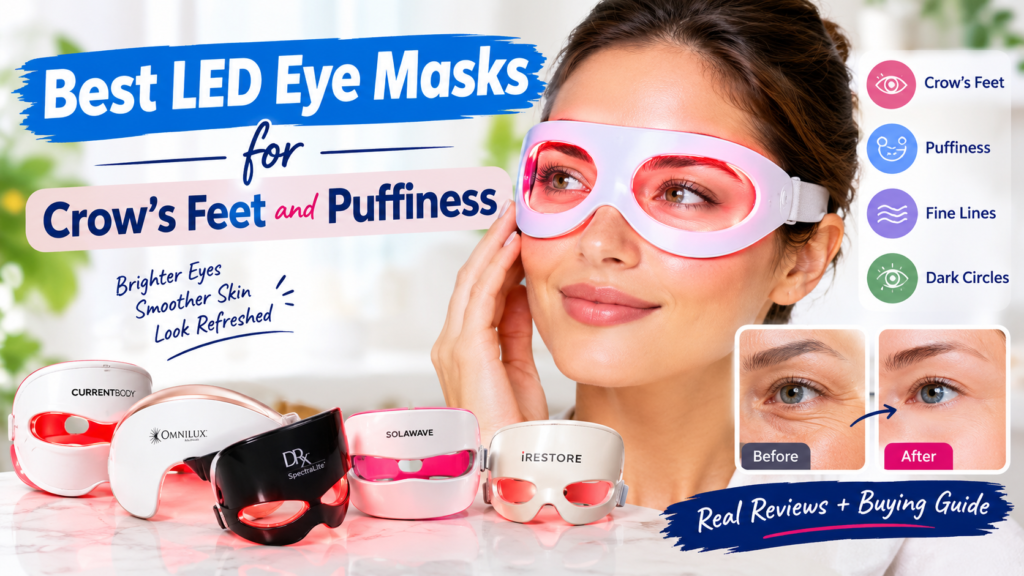
If crow’s feet, fine lines, puffiness or dark circles are making your eyes look tired, a red light eye mask is an easy device to be curious about. Here’s the honest short version: LED may help soften the look of fine lines over several weeks, but it isn’t a quick fix for puffiness, and no device removes wrinkles or bags. We compared five popular options using each manufacturer’s own pages plus published research. Specs are as of late September 2026, and performance claims are manufacturer claims unless we say otherwise.
Quick Answer: Best LED Eye Masks at a Glance
- Best for crow’s feet: Dr. Dennis Gross DRx SpectraLite EyeCare Max Pro (wraparound coverage, red plus infrared light)
- Best for puffiness and tired-looking eyes: Solawave Radiant Renewal Eye Recovery Pro (amber light included, though puffiness evidence is thin)
- Best for quick treatments: Dr. Dennis Gross (3 minutes, and the brand says no goggles are needed)
- Best for targeted eye treatment: iRESTORE Illumina Eye Mask (three zone modes)
- Best for fine lines plus dark circles: CurrentBody Skin LED Eye Mask (four wavelengths, published light output)
- Best lower-cost, portable option: Omnilux Eye Brightener (small coverage and patch costs are the trade-off)
- Best alternative if you prefer a full-face mask: see the full-face section below
Comparison Table
| Product | Best For | Light/Wavelengths | Treatment Time | Eye-Area Coverage | Key Feature | Main Drawback |
|---|---|---|---|---|---|---|
| Dr. Dennis Gross DRx SpectraLite EyeCare Max Pro | Crow’s feet, quick sessions | Amber, red, deep red, infrared (exact nm not listed on pages we checked) | 3 min | 96 LEDs, wraparound | FDA-cleared; 1-year warranty | No published irradiance; premium price |
| CurrentBody Skin LED Eye Mask | Fine lines + dark circles | 605, 633, 660, 830 nm | 3 min | 80 LEDs | Publishes 61.59 mW/cm² | Availability varies; 6x/week routine |
| Omnilux Eye Brightener | Lower-cost, portable | 633 nm red, 830 nm near-infrared | 10 min | 12 LEDs, crescent shape | FDA-cleared; 2-year warranty | Small area; battery and patch costs |
| Solawave Radiant Renewal Eye Recovery Pro | Puffy, tired-looking eyes | 605, 630, 660, 830 nm | 3 min | 80 LEDs | 60-day money-back guarantee | Goggles required |
| iRESTORE Illumina Eye Mask | Targeted zones | 633 nm red, 830 nm near-infrared | 5 min | 180 LEDs, 3 modes | 32 mW/cm²; 100-day guarantee | FDA status not confirmed on page |
Best LED Eye Masks for Crow’s Feet and Puffiness: Our Reviews
Prices, bundles and availability change often. Check the manufacturer’s current product page (and the seller’s return policy) before you buy.
Dr. Dennis Gross DRx SpectraLite EyeCare Max Pro: Best for Crow’s Feet and Quick Sessions
This silicone, hands-free mask has 96 LEDs in four wavelengths and runs one automatic 3-minute cycle. The brand says it covers the outer corners, brow bone, “elevens” and under-eye area, and that it was safety-tested to be worn without goggles. It is FDA-cleared, rechargeable by USB, and carries a 1-year warranty. The brand cites a 10-week study reporting visible improvement for 97% of subjects, but we couldn’t verify the design, so treat it as a manufacturer claim.
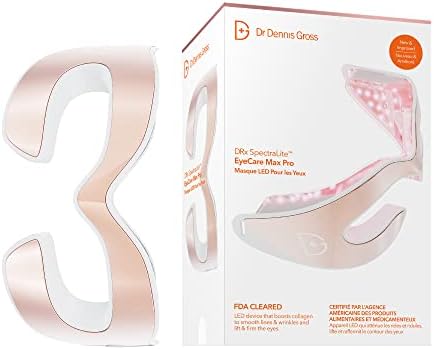
- WHAT IT IS: Dermatologist-developed and FDA-cleared, this LED eye device builds natural elasticity to firm skin, reduce …
- HOW IT WORKS: Four wavelengths of red light stimulate collagen production to treat wrinkles, firm skin & even tone aroun…
- HOW TO USE: On clean, dry skin, place device comfortably over eye area. (Strap included for comfort & hands-free use.) P…
- Pros: short session, wide coverage, adjustable strap.
- Cons: exact wavelengths and irradiance weren’t published on pages we checked; premium price; its puffiness claims are the brand’s own.
Suits: anyone who wants a short daily routine with wide coverage.
CurrentBody Skin LED Eye Mask: Best for Fine Lines and Dark Circles
This wearable mask uses amber (605 nm), red (633 nm), deep red (660 nm) and near-infrared (830 nm) light from 80 LEDs in 3-minute sessions. The brand lists 61.59 mW/cm² and recommends six sessions a week for eight weeks on clean, product-free skin, with a skin sensitivity test 24 hours before first use. See the CurrentBody official LED Eye Mask page for current details.

- Anti-aging LED eye treatment to treat fine lines and wrinkles
- 4 powerful LED wavelengths target collagen and elastin production. 80 LEDs deliver 61.59 mW/cm² for a powerful 3-minute …
- Use 6 times a week for 8 weeks to see a fresher, more youthful eye area
- Pros: publishes light output; four wavelengths; a charging stand is included.
- Cons: the storefront we checked showed it out of stock and not shipping to that location, so confirm US availability; we couldn’t confirm FDA clearance on that page; a full charge takes 6 to 8 hours, per the brand.
Suits: people with both fine lines and dark circles who will stick to a near-daily routine.
Omnilux Eye Brightener: Best Lower-Cost, Portable Option
This small crescent uses 12 LEDs (633 nm red, 830 nm near-infrared, about 30 mW/cm²) and sticks to your skin with single-use hydrocolloid patches. Omnilux recommends 10-minute sessions, three to five times a week for four to six weeks, then maintenance. It is FDA-cleared for facial wrinkles, per the brand, with a 2-year warranty and a 30-day money-back guarantee. Details are on the Omnilux official Eye Brightener page. For a head-to-head with a full-face option, see our Omnilux vs CurrentBody LED mask comparison.

- Omnilux Mini Eye Brightener
- Item form : Plastic
- Product benefit : De-puff, brighten, and firm the under eye area with Mini device.
- Pros: lower upfront cost than the others; portable and wireless.
- Cons: the brand says a full charge gives about three treatments, and some buyers report poor battery life or discomfort peeling off the patches; small treatment area; refill patches are an ongoing cost.
Suits: first-time buyers who want to test red light around the eyes without a big investment.
Solawave Radiant Renewal Eye Recovery Pro: Best for Puffy, Tired-Looking Eyes
Solawave’s mask has 80 LEDs in four wavelengths (605, 630, 660 and 830 nm), an adjustable strap, and a 3-minute cycle used three to five times a week. It is FDA-cleared and backed by a 60-day money-back guarantee. The brand cites an 8-week consumer study with 34 users, which is small and self-reported. Claims about puffiness and dark circles are the brand’s.
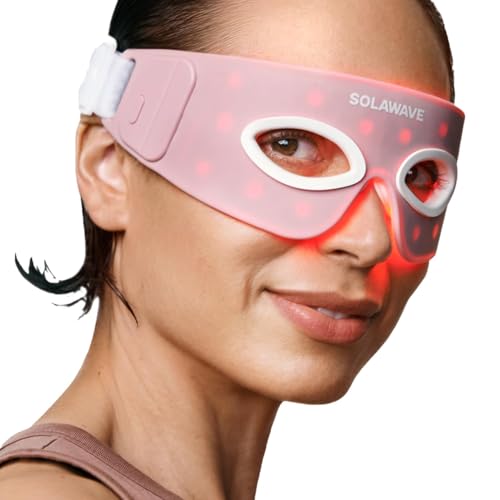
- FOUR LED WAVELENGTHS: Features Amber (605nm), Red (630nm), Deep Red (660nm), and Near-Infrared (880nm) light in a single…
- SHORT, CONVENIENT SESSIONS: Designed for quick, 3-minute use, making it easy to incorporate into daily beauty routines.
- FLEXIBLE SILICONE DESIGN: Made with soft, medical-grade silicone that contours comfortably around the eye area.
- Pros: short sessions; generous return window; amber light for those who want it.
- Cons: included goggles are required every session, per the brand; irradiance wasn’t listed; the brand says it may feel slightly warm.
Suits: shoppers focused on a tired, puffy look who like a strong return policy.
iRESTORE Illumina Eye Mask: Best for Targeted Treatment
With 180 LEDs (633 nm and 830 nm, 32 mW/cm² per the brand), this mask offers three modes: full eye area, side and under-eye only, or brow line and upper eye only. Sessions are 5 minutes daily. The brand advertises a 100-day money-back guarantee (conditions apply) and a 1-year warranty, and says results can start around six weeks. It lists IEC safety testing, but we found no FDA statement for the eye mask on its page, so verify before buying.

- 180 LEDs – Highest Density in an Eye Mask : Targeted red and infrared light surrounds your eyes with concentrated power—…
- Visibly Targets Key Aging Areas Around the Eyes : Engineered to support smoother-looking skin under the eyes, between th…
- Complements Eye Creams, Lash & Brow Serums : Designed to layer effortlessly into your existing beauty routine. Boosts th…
- Pros: zone control; strong return window; published light output.
- Cons: FDA status unclear; brand study claims aren’t independently verified; the brand suggests relaxing with eyes closed, so it’s less multitask-friendly.
Suits: readers who want to focus on the outer corners or the brow area.
Can LED Eye Masks Really Help Crow’s Feet and Puffiness?
These are two different problems. Crow’s feet are lines from repeated squinting and smiling, plus sun exposure and natural collagen loss. LED light aims at how skin looks and feels over weeks. Puffiness has many possible causes, such as fluid, sleep, salt, allergies or natural fat pads, and a light device isn’t built to address all of them. It shouldn’t be treated as an instant fix.
The American Academy of Dermatology’s red light therapy guide says some studies show subtle to noticeable improvements in fine lines, but that at-home devices are hard to compare and more research is needed. For the wider evidence, see our guide to whether LED face masks really work.
Can LED Eye Masks Help Crow’s Feet?
Possibly, modestly, and over time. The best evidence is a 2025 randomized, double-blind, sham-controlled trial, published in Medicine, of a home-use mask with 630 nm LED and 850 nm infrared light. You can read the abstract on PubMed. In plain language:
- Who: 60 adults aged 30 to 65, mostly women, of Asian descent, with mild-to-moderate crow’s feet.
- What: real device vs. a look-alike “sham” that emitted far less light, used for 9 minutes, five times a week, for 12 weeks.
- Result: blinded raters saw improvement of at least one step on a crow’s feet scale in 25 of 29 real-device users (86%) vs. 5 of 30 sham users (17%). The gap was significant at 8, 12 and 16 weeks.
Limits matter. The trial was small, short and funded by the device maker. Participants’ own ratings didn’t differ significantly between groups. It tested a full-face device, not any of the five masks above, and it described the improvement as temporary.
A 2023 split-face trial in PubMed tested red and amber light around the eyes in 137 women and reported reduced wrinkle volume. It compared two colors of light rather than using a sham, and a published response questioned some of its reported light-dose figures. Treat it as encouraging, not conclusive.
Can LED Eye Masks Reduce Puffiness?
We haven’t seen a well-controlled trial showing a home LED eye mask reduces under-eye puffiness. Brand claims, such as amber light “supporting circulation,” are unproven for these devices. If swelling is sudden, one-sided, painful or paired with vision changes, see a clinician rather than a device.
LED Eye Mask vs Full-Face LED Mask
A dedicated eye mask puts LEDs close to the orbital area, including the outer corners and under-eyes, which full-face masks often cover less well or shield with goggles. A full-face mask is more practical if you also want cheeks, forehead and jawline treated, or you’d rather buy one device. Our best LED face masks for crow’s feet and under-eye wrinkles covers that route, and Omnilux vs HigherDose for mature skin compares two popular options. Full-face masks vary in eye protection, so follow their manual.
Red Light vs Near-Infrared Light for the Eye Area
Red light (roughly 630 to 660 nm) works closer to the surface and is the wavelength most tied to skin tone and texture claims. Near-infrared (roughly 830 to 850 nm) is invisible and reaches deeper. Amber (about 605 nm) appears in some masks, but evidence for its extra benefit is mostly from brands. Most masks here combine red and near-infrared, similar to the 2025 trial.
On irradiance (how much light power reaches the skin), only some brands publish it. Higher isn’t automatically better: the 2025 trial used a maximum of about 10 mW/cm². Brands may measure differently, so treat numbers as context, not a scoreboard.
How Often Should You Use an LED Eye Mask?
Follow your device’s manual, because schedules differ. Dr. Dennis Gross specifies one 3-minute cycle daily, Solawave three to five times a week, Omnilux three to five times a week (it hasn’t studied daily use), CurrentBody six times a week, and iRESTORE daily. More isn’t necessarily better.
How Long Does It Take to See Results?
Expect weeks, not days. Brands cite roughly 4 to 12 weeks, and in the 2025 trial, differences from the sham appeared at 8 weeks. Take photos in the same light every couple of weeks. Puffiness has no reliable timeline, and results can be subtle.
What to Look For Before Buying
- Wavelengths: red plus near-infrared is the most studied combination.
- Published irradiance: useful transparency, not a guarantee.
- Coverage and fit: does it reach the outer corners and under-eyes without pressing on the eyes?
- Session time and hands-free use: you’ll use what fits your routine.
- Eye protection: know whether goggles are required.
- Battery and cord: check charging time and battery life reports.
- FDA clearance: clearance reflects safety review, not proof of better cosmetic results, as the AAD explains. Verify it on the product page.
- Warranty and returns: check the manufacturer’s terms, and whether they apply if you buy from a third-party seller.
- Cost per use: divide price by expected uses. A $300 device used five times a week for a year is roughly $1.15 per use, before any refills.
Safety and Eye-Area Precautions
Use the exact device as directed. Eye-area masks are designed and tested for that region, and other red light products (panels, or full-face masks) aren’t interchangeable with them. Some brands require goggles, others say they aren’t needed, and the manual decides.
Manufacturer safety pages, such as CurrentBody’s, list concerns including light-sensitizing medications, photosensitive conditions, light-induced headaches and eye conditions, and pregnancy or breastfeeding is a common caution. Omnilux advises checking with a dermatologist before combining light therapy with retinol. The AAD notes people with darker skin tones may be more prone to pigmentation from visible light and should talk with a dermatologist first. This is general information, not personal medical advice.
Who May Want to Skip an LED Eye Mask?
Consider skipping, or asking a healthcare professional first, if you have a light-sensitive condition, take light-sensitizing medications, have an eye condition, are pregnant or breastfeeding, or expect instant puffiness relief.
FAQ
What’s the best LED eye mask for crow’s feet?
It depends on coverage and comfort. Look for outer-corner coverage and red plus near-infrared light. Our pick for crow’s feet is the Dr. Dennis Gross, but no mask has been proven better in head-to-head research.
Is an LED eye mask for dark circles worth it?
Dark circles come from pigment, thin skin, visible vessels or shadows from puffiness. LED may help some, but brand claims about brightening are unproven, so expect mixed results.
Can I use a full-face LED mask around my eyes?
Only if the manual says so. Some full-face masks include eye shields, and some don’t treat the eye area the way a dedicated device does.
Is an LED eye mask good for mature skin?
It can be reasonable, since crow’s feet are most common with age. See our best LED face masks for mature skin and fine lines.
Final Buying Advice
The right red light eye mask depends on your priority. For crow’s feet, choose wraparound coverage with red plus near-infrared light. For puffiness or tired-looking eyes, keep expectations low and favor comfort and a good return policy. For dark circles plus fine lines, a four-wavelength option like CurrentBody makes sense. For speed, pick a 3-minute mask; for precision, iRESTORE’s zone modes; for a cheaper trial, Omnilux. Consistent use and realistic expectations matter most: expect subtle changes over weeks, not overnight results. Confirm current pricing, warranty, and availability on the manufacturer’s page before buying.