You are about to spend hundreds of dollars on an at-home beauty device. The product page says “FDA-cleared.” A competitor claims “FDA-approved.” Another brand casually mentions it is “FDA-registered.” These phrases sound interchangeable, but they describe fundamentally different levels of regulatory review — and confusing them could cost you money on a device that has not been evaluated the way you think it has.
The beauty device market is booming, and marketing teams know that FDA-related language builds instant credibility. Unfortunately, not every claim you encounter is used accurately. This guide breaks down exactly what each term means, how to verify regulatory status yourself, and what to look for before you buy.

- **THE WORLD'S FIRST COMPLETE CLINICAL-GRADE RED LIGHT KIT** RED LIGHT THERAPY MASK & POST-SESSION COLLAGEN Most red ligh…
- 8 TARGETED COLOR MODES — ONE RED LIGHT THERAPY FACE MASK: Red (630nm) for wrinkles. Blue light for acne breakouts. Plus …
- 432 HIGH-DENSITY LEDs — PROFESSIONAL LED FACE MASK — INFRARED FACE MASK LIGHT THERAPY FOR FACE: The irradiance level rec…
FDA-Cleared vs FDA-Approved: What Is the Difference?
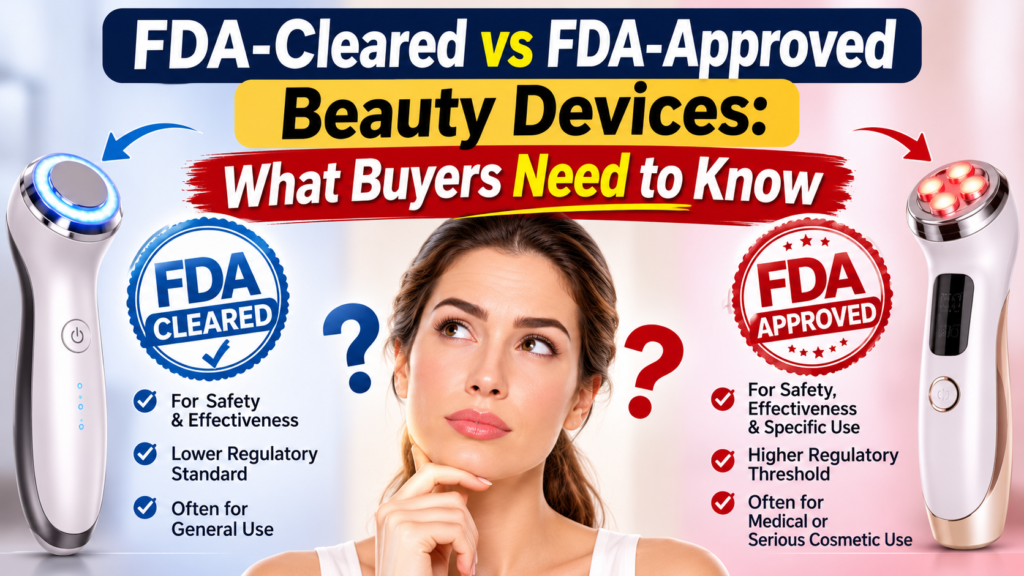
Most consumers use “FDA-cleared” and “FDA-approved” as synonyms. They are not. The distinction comes down to the regulatory pathway a device follows before it reaches the market.
| FDA-Cleared | FDA-Approved | |
|---|---|---|
| Meaning | The FDA has determined the device is substantially equivalent to an already-marketed predicate device. | The FDA has independently reviewed scientific evidence and determined the device is safe and effective for its intended use. |
| Regulatory Pathway | 510(k) premarket notification | Premarket Approval (PMA) |
| Typical Classification | Class I or Class II | Class III (highest risk) |
| Type of Review | Comparison to a predicate device | Rigorous clinical data evaluation |
| What Buyers Should Understand | Clearance confirms equivalence, not independent proof of dramatic results. | Approval reflects the most stringent level of FDA scrutiny. |
For at-home beauty devices, the vast majority follow the 510(k) clearance pathway. True FDA approval through PMA is reserved for high-risk implantable and life-sustaining devices and is extremely rare in the consumer beauty category.
What Does FDA-Cleared Actually Mean?
- **THE WORLD'S FIRST COMPLETE CLINICAL-GRADE RED LIGHT KIT** RED LIGHT THERAPY MASK & POST-SESSION COLLAGEN Most red ligh…
- 8 TARGETED COLOR MODES — ONE RED LIGHT THERAPY FACE MASK: Red (630nm) for wrinkles. Blue light for acne breakouts. Plus …
- 432 HIGH-DENSITY LEDs — PROFESSIONAL LED FACE MASK — INFRARED FACE MASK LIGHT THERAPY FOR FACE: The irradiance level rec…
When a beauty device is FDA-cleared, the manufacturer has submitted a 510(k) premarket notification to the FDA. In this submission, the company must demonstrate that its device is “substantially equivalent” to a predicate device — a similar product already legally sold in the United States.
The FDA reviews the comparison and, if satisfied, issues a clearance letter with a K-number. This process is outlined in detail on the 510(k) premarket notification process page.
What clearance does establish: the device is legally marketable and the FDA has accepted the substantial equivalence argument. What clearance does not establish: that the FDA independently tested the device, confirmed specific cosmetic outcomes, or guaranteed it will deliver the results shown in advertisements.
What Does FDA-Approved Mean?
FDA approval follows the Premarket Approval (PMA) pathway, which applies to Class III medical devices — the highest-risk category. PMA requires the manufacturer to submit extensive clinical trial data demonstrating that the device is both safe and effective for its intended use. The FDA conducts its own thorough scientific review before granting approval.
This pathway is fundamentally more rigorous than 510(k) clearance. However, it is also far more expensive and time-consuming. As a result, PMA approval is almost never the pathway for consumer beauty gadgets like LED masks, microcurrent tools, or at-home IPL devices. If a beauty brand claims its at-home device is “FDA-approved” in the PMA sense, that claim deserves close verification.
FDA-Registered vs FDA-Cleared vs FDA-Approved
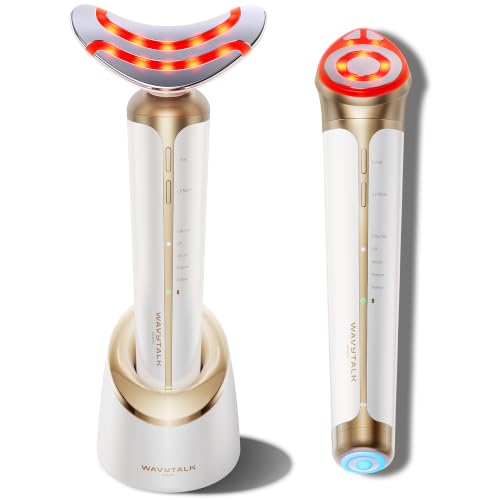
- 【Your 5-Minute Face Lift】High-tech, clinically tested skincare with zero guesswork. Sculpt Time preset 5-minute treatmen…
- 【3 Heads for Total Precision】Three precision heads target every area: the Y-Shaped Head covers cheeks, jawline, and perm…
- 【5 Modes, One Complete Routine】Replaces multiple devices, the Sculpt Time Microcurrent Facial Device delivers five targe…
This is where marketing language gets most misleading. The FDA itself warns consumers about the confusion, as explained in the FDA guidance on device registration and approval.
FDA-registered means the manufacturer has listed its facility and products with the FDA, which is a basic administrative requirement. Registration does not mean the FDA has reviewed, cleared, or approved the device. Any company that manufactures or distributes medical devices in the U.S. must register — it is a paperwork obligation, not a quality endorsement.
FDA-cleared means the device passed the 510(k) substantial equivalence review described above.
FDA-approved means the device passed the rigorous PMA process.
The FDA also explicitly states that there is no such thing as an “FDA-certified” medical device. If you see that phrase on a product page, treat it as a red flag.
What About Popular At-Home Beauty Devices?
Regulatory status varies by product, intended use, and specific claims. The FDA’s overview of aesthetic and cosmetic devices provides useful context on how the agency categorizes these products.
LED red light therapy masks. Many LED masks on the market have received 510(k) clearance for specific indications such as temporary improvement of facial wrinkles or mild acne. However, not every LED mask is cleared, and clearance for one indication does not extend to every benefit a brand might advertise. If you are researching options, our guide to red light therapy masks for anti-aging covers what to look for. The American Academy of Dermatology’s guidance on red light therapy also provides a helpful clinical perspective.
Microcurrent facial devices. Several popular microcurrent tools hold 510(k) clearance for facial muscle stimulation and temporary toning. Regulatory status is product-specific, so check the exact model you are considering.
At-home radiofrequency devices. RF skin-tightening devices are generally Class II and may require 510(k) clearance. The intended use stated in the clearance letter matters — a device cleared for temporary skin tightening is not necessarily cleared for fat reduction.
IPL hair removal devices. Many at-home IPL devices are 510(k)-cleared for hair reduction. Again, clearance is tied to the specific device model and its stated intended use.
Does FDA Clearance Guarantee Results?
No. Regulatory clearance and clinical effectiveness are related but distinct concepts. A 510(k) clearance confirms that a device is substantially equivalent to a predicate — it does not independently validate every marketing claim or guarantee visible cosmetic improvements for every user.
Product-specific clinical evidence matters. Some cleared devices are backed by published peer-reviewed studies; others rely primarily on the predicate comparison. If you want to dig deeper into the evidence behind LED technology specifically, our article exploring whether LED face masks really work examines the research in detail.
Realistic expectations are essential. Clearance means the device met a regulatory threshold to be legally sold — it is not a promise of dramatic transformation.
How to Check Whether a Beauty Device Is FDA-Cleared
You do not have to take a brand’s word for it. Follow these steps to verify clearance yourself:
- Find the exact device model and manufacturer name. Vague brand names are not enough — you need the specific product name as it would appear in FDA records.
- Search the FDA’s device approvals and clearances database. Use the 510(k) search tool and enter the manufacturer or device name.
- Check the K-number and clearance decision. A legitimate clearance will have a K-number (e.g., K123456) and a decision date.
- Compare the intended use and device description. Read the FDA summary to confirm the cleared indications match the claims the brand is making.
- Verify that marketing claims align with the FDA record. If the brand advertises benefits beyond the cleared intended use, that is a discrepancy worth noting.
- Check other applicable regulatory pathways such as De Novo classification if the device is novel and no predicate exists.
Red Flags to Watch for Before Buying
Protect yourself from misleading marketing by watching for these warning signs:
- “FDA-certified” language. This designation does not exist for medical devices.
- FDA registration presented as approval. Registration is an administrative step, not a safety or efficacy endorsement.
- Missing model numbers. If a brand will not tell you the exact device model, you cannot verify its regulatory status.
- No verifiable FDA records. If you search the 510(k) database and find nothing, the clearance claim may be false or misapplied.
- Unsupported medical claims. Phrases like “clinically proven to eliminate wrinkles” go well beyond what 510(k) clearance establishes.
- Blanket brand claims. A company may have clearance for one device but imply that its entire product line is cleared. Always verify the specific product you intend to buy.
What Should Buyers Look for Before Spending Money?
Use this practical checklist before purchasing any at-home beauty device:
- Regulatory verification. Confirm the exact device model in the FDA database.
- Device-specific clinical evidence. Look for published studies on the actual product, not just the technology category.
- Clear safety instructions. Reputable devices include detailed usage guidelines and contraindications.
- Defined intended treatment. Know exactly what the device is cleared to do.
- Warranty and customer support. Premium devices should come with responsive support and a meaningful warranty.
- Return policy. A fair return window lets you evaluate the device risk-free.
- Realistic expectations. No at-home device replicates in-office professional treatments overnight.
- Total purchase cost. Factor in replacement parts, gels, or subscription fees if applicable.
If you are specifically comparing LED options, our roundup of FDA-cleared LED face masks for at-home skincare can help you evaluate models that have gone through the clearance process.
Frequently Asked Questions
1. Is FDA-cleared the same as FDA-approved?
No. FDA-cleared means the device was found substantially equivalent to an existing product through the 510(k) process. FDA-approved means it passed the more rigorous Premarket Approval (PMA) pathway, which requires independent clinical evidence of safety and effectiveness.
2. Are at-home LED masks FDA-approved?
Most at-home LED masks are not FDA-approved in the PMA sense. Some models hold 510(k) clearance for specific indications like temporary wrinkle improvement or mild acne. Always check the specific device model in the FDA database.
3. Does FDA registration mean a beauty device is safe?
No. FDA registration is an administrative requirement for manufacturers. It does not mean the FDA has reviewed, tested, or endorsed the safety or effectiveness of the device.
4. How can I check if an LED mask is FDA-cleared?
Locate the exact device model and manufacturer, then search the FDA 510(k) database. Look for a K-number and review the clearance summary to confirm the intended use matches the brand’s claims.
5. Do microcurrent devices need FDA clearance?
Many microcurrent facial devices are Class II and require 510(k) clearance. However, regulatory requirements depend on the specific device and its intended use. Some low-risk devices may be exempt.
6. Are FDA-cleared beauty devices more effective?
Not necessarily. Clearance confirms substantial equivalence to a predicate device, which is a regulatory benchmark. Effectiveness depends on the device’s technology, treatment protocol, and individual skin response.
7. Can a beauty device be legally marketed without 510(k) clearance?
Yes, in certain cases. Some Class I and Class II devices are exempt from 510(k) requirements, and some products may not meet the definition of a medical device depending on their intended use. However, they must still comply with general FDA controls.
8. What does FDA 510(k) clearance mean?
It means the FDA has reviewed a premarket notification and determined the device is substantially equivalent to a legally marketed predicate device. It is a clearance to market the product, not an independent certification of clinical results.
Conclusion
The difference between FDA-cleared, FDA-approved, and FDA-registered is not just semantics — it directly affects how much scrutiny a beauty device has undergone before reaching your hands. Most at-home beauty devices you encounter will be 510(k)-cleared at best, and some may carry no premarket review at all.
Before investing in any device, take ten minutes to search the FDA database, read the clearance summary, and compare the brand’s marketing claims against the official record. Pair that regulatory due diligence with a look at product-specific clinical evidence, realistic expectations, and a solid return policy. Informed buyers make better purchases — and better purchases lead to better results.
If you are exploring LED technology specifically, our guide to the best LED face masks for wrinkles and firm skin and our recommendations for LED face masks for acne-prone skin can help you narrow down your options after you have verified regulatory status.
On-Page SEO
1. SEO Title
FDA-Cleared vs FDA-Approved Beauty Devices: The Buyer’s Guide
2. Meta Description
FDA-cleared vs FDA-approved beauty devices — learn the real difference, verify claims, avoid misleading marketing, and buy with confidence.
3. Recommended URL Slug
fda-cleared-vs-fda-approved-beauty-devices
4. Primary Focus Keyword
FDA-cleared vs FDA-approved beauty devices
5. Five Secondary Keywords
- FDA clearance meaning
- FDA 510(k) clearance
- FDA registered vs FDA approved
- How to check FDA clearance
- At-home beauty device safety
6. Suggested Image Alt Text
- “Comparison chart showing the difference between FDA-cleared and FDA-approved beauty devices”
- “Consumer searching the FDA 510(k) database to verify beauty device clearance”
- “At-home LED face mask with FDA clearance documentation”
7. FAQ Schema Questions and Answers
Q: Is FDA-cleared the same as FDA-approved?
A: No. FDA-cleared means a device was found substantially equivalent to an existing product through the 510(k) process. FDA-approved means it passed the more rigorous Premarket Approval pathway requiring independent clinical evidence.
Q: How can I check if a beauty device is FDA-cleared?
A: Find the exact device model and manufacturer, then search the FDA 510(k) premarket notification database. Look for a valid K-number and review the clearance summary to confirm the intended use matches the brand’s marketing claims.
Q: Does FDA registration mean a beauty device is safe?
A: No. FDA registration is an administrative requirement for manufacturers and does not mean the FDA has reviewed, tested, or endorsed the device’s safety or effectiveness.