
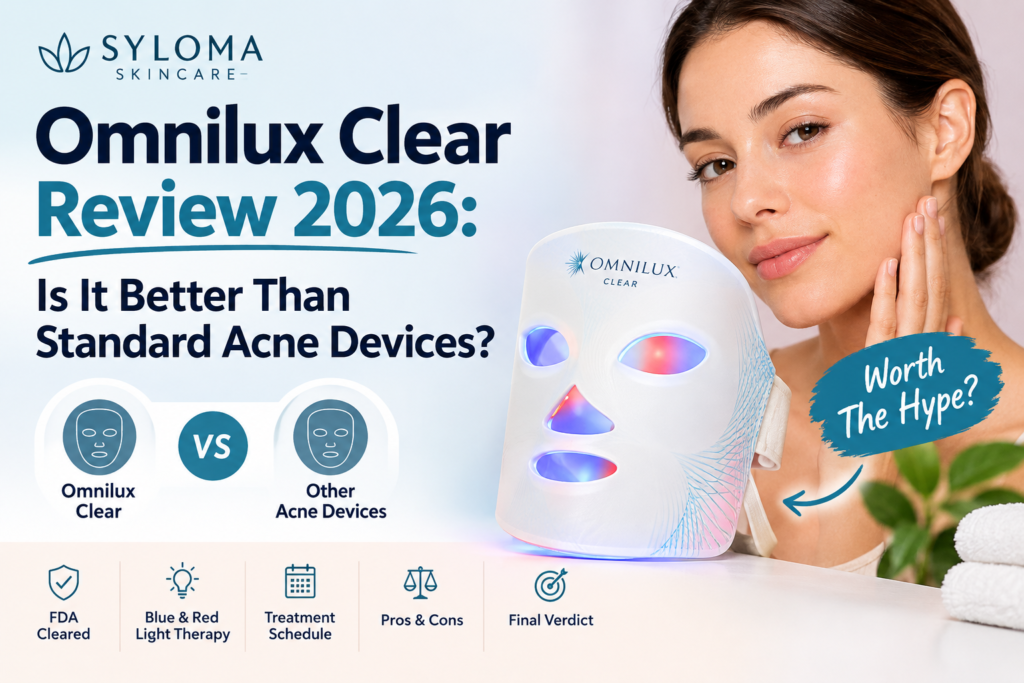
Affiliate disclosure: Syloma Skincare may earn a commission from qualifying purchases made through links on this page, at no additional cost to you. We do not accept payment from manufacturers in exchange for favorable reviews.
If you are dealing with recurring breakouts and wondering whether a premium LED mask can actually help, this Omnilux Clear review 2026 breaks down the technology, the evidence, the real-world trade-offs, and how it stacks up against cheaper and more expensive alternatives. The short answer: Omnilux Clear is a well-built, FDA-cleared device with a plausible mechanism for mild-to-moderate inflammatory acne, but it is not a miracle cure, and it is not the right choice for every type of breakout.
Quick Verdict
Buy it if you have mild-to-moderate inflammatory acne (red, tender pimples), you want a dedicated acne device from a brand with a clinical background, and you are willing to commit to a consistent multi-week routine.
Skip it if your primary concerns are blackheads, deep cystic nodules, or acne scarring, or if you are looking for a single device that also targets fine lines and hyperpigmentation. In those cases, a multifunction LED mask or a dermatologist-guided treatment plan may serve you better.
Is it worth the price? At roughly $395, Omnilux Clear sits in the mid-to-upper tier of at-home acne devices. You are paying for medical-grade LED specifications, a flexible silicone build, and FDA clearance for its stated indication. Whether that justifies the cost depends on how your skin responds—and on what you would otherwise spend on professional treatments.
Omnilux Clear Specifications
| Feature | Detail |
|---|---|
| Wavelengths | 415 nm (blue) and 633 nm (red) |
| LED count | 132 |
| Session length | 10 minutes |
| Initial protocol | 4 sessions per week for 6 weeks (per manufacturer) |
| Design | Flexible silicone full-face mask |
| Power | Rechargeable controller |
| FDA status | Cleared for mild-to-moderate acne vulgaris on the face |
| Warranty | 2 years (device and controller) |
| Listed price | ~$395 (verify current pricing on the official Omnilux Clear product page) |
Specifications reflect manufacturer-stated details at the time of research. Always confirm current pricing, warranty terms, and included accessories directly with Omnilux before purchasing.
What Is Omnilux Clear?
Omnilux Clear is a flexible, medical-grade LED face mask designed specifically for acne-prone skin. Unlike general-purpose LED masks that cycle through multiple colors for anti-aging and pigmentation, this device focuses on two wavelengths chosen for their role in targeting acne-causing bacteria and supporting skin recovery. Omnilux is a brand with roots in professional clinical phototherapy, which distinguishes it from many consumer-first LED startups.
How Its Blue and Red LED Technology Works
The mask combines two wavelengths, each with a distinct intended function:
- 415 nm blue light targets Cutibacterium acnes (formerly Propionibacterium acnes), the bacteria involved in inflammatory acne. Blue light at this wavelength is absorbed by porphyrins produced by the bacteria, generating reactive oxygen species that can reduce bacterial load on the skin’s surface and within pores.
- 633 nm red light is intended to support the skin’s healing response. Red light at this wavelength penetrates more deeply than blue and is associated with modulation of inflammatory pathways and support of cellular repair processes.
The combination is designed to address both the bacterial and inflammatory components of acne. For a deeper look at the science behind LED masks in general, our guide on whether LED face masks really work explains the evidence and its limitations in plain language.
What Does the Clinical Evidence Actually Show?
A 2025 peer-reviewed study on 415 nm and 633 nm phototherapy for mild-to-moderate acne found that combined blue and red light treatment was associated with reductions in inflammatory lesion counts over the study period. This is consistent with a broader body of dermatological research suggesting that visible-light phototherapy can be a useful adjunct for certain acne types.
However, important caveats apply:
- Many LED acne studies are small, short-duration, and sometimes funded by or affiliated with device manufacturers.
- Results in controlled clinical settings do not always translate directly to at-home use, where treatment consistency, device positioning, and individual skin biology vary widely.
- The American Academy of Dermatology notes that lasers and light-based therapies can play a role in acne management but are generally considered complementary to, not replacements for, established topical and oral treatments.
- Visible light therapy is most relevant for inflammatory lesions. It is not a primary treatment for comedonal acne (blackheads and whiteheads), deep cysts, or nodules.
The FDA 510(k) clearance record for Omnilux Clear confirms that the device met the agency’s requirements for substantial equivalence to a legally marketed predicate device for the treatment of mild-to-moderate acne vulgaris. Importantly, FDA clearance is not the same as FDA approval. Clearance indicates that the device is substantially equivalent to an existing product in safety and effectiveness for its stated use—it does not independently validate large-scale clinical outcomes.
Omnilux Clear Pros and Cons
Pros
- Dedicated acne wavelengths (415 nm + 633 nm) at clinically relevant specifications
- Flexible silicone design conforms to facial contours for more even light delivery
- FDA-cleared for its stated indication
- Simple 10-minute sessions with a straightforward controller
- Two-year warranty
Cons
- Premium price for a single-purpose device
- Not designed for anti-aging, pigmentation, or deep cystic acne
- Requires consistent, multi-week commitment before evaluating results
- Limited independent, long-term clinical data specific to this exact consumer device
What It Is Like to Use: Fit, Comfort, Eye Shields, Controller, and Routine
The flexible silicone construction is one of Omnilux Clear’s practical advantages over rigid hard-shell masks. The mask drapes over the face and is secured with adjustable straps, which generally allows for closer contact with the skin and more even light distribution across the forehead, cheeks, nose, and chin.
The mask includes integrated eye shields to reduce light exposure to the eyes during treatment. You should always follow the manufacturer’s eye-protection instructions and avoid looking directly at the LEDs during use.
The rechargeable controller is compact and attaches to the mask via a short cable. Sessions are a single 10-minute cycle, which is relatively easy to fit into a morning or evening routine. The mask should be used on clean, dry skin, which means your cleansing step matters. If you are unsure whether a water-based or oil-based cleanser is better for your acne-prone skin, that guide can help you build a compatible routine.
Cleaning the mask between uses is straightforward: a gentle wipe with a damp cloth or the manufacturer’s recommended cleaning method is typically sufficient. Avoid submerging the device or using harsh solvents.
How Often to Use Omnilux Clear and What Results to Expect
The manufacturer recommends an initial course of four 10-minute sessions per week for six weeks. After the initial phase, the guidance is to take a break and then use the device as needed based on your skin’s response, following the directions provided with the product.
Realistic expectations are important. If the device works for your skin type and acne profile, you may begin to notice a reduction in the frequency and severity of inflammatory breakouts after several weeks of consistent use. It is not an overnight fix, and individual results vary considerably. Light therapy is best understood as a complement to a well-formulated topical acne routine, not a standalone solution for moderate-to-severe cases.
Omnilux Clear vs. Standard Acne Devices: Comparison Table
| Feature | Omnilux Clear | CurrentBody Anti-Blemish | Dr. Dennis Gross FaceWare Pro | Therabody TheraFace Mask |
|---|---|---|---|---|
| Primary purpose | Acne | Acne | Acne + anti-aging | Multi-concern (acne, aging, tension) |
| Wavelengths | 415 nm + 633 nm | 415 nm + 633 nm | 415 nm + 633 nm | Red, near-infrared, blue |
| Treatment time | 10 min | ~10 min | 3 min | ~9 min |
| Fit/design | Flexible silicone | Flexible silicone | Rigid hard-shell | Rigid with vibration |
| Additional features | None (acne-dedicated) | None (acne-dedicated) | Multiple modes | Percussive vibration |
| Regulatory status | FDA-cleared (acne) | FDA-cleared (acne)* | FDA-cleared (acne) | FDA-cleared (multiple indications) |
| Approximate price | ~$395 | ~$300–$350* | ~$435 | ~$599 |
Prices and some specifications could not be independently verified at the time of writing. Confirm current details on each manufacturer’s website before purchasing. For a broader look at acne-focused LED options, see our roundup of the best LED face masks for acne breakouts in 2026.
Omnilux Clear vs. CurrentBody Anti-Blemish
The CurrentBody Skin Anti-Blemish LED Mask is the closest direct competitor. Both devices use 415 nm blue and 633 nm red light in a flexible silicone format, and both target mild-to-moderate inflammatory acne. The CurrentBody mask is generally priced somewhat lower, which may appeal to budget-conscious buyers. Omnilux Clear’s advantage lies in its brand heritage in clinical phototherapy and its specific FDA 510(k) clearance record. If both devices meet the same wavelength and irradiance benchmarks, the decision may come down to price, fit preference, and warranty terms. For more options in this category, browse our guide to the best blue light therapy masks for oily and acne-prone skin.
Omnilux Clear vs. Dr. Dennis Gross FaceWare Pro
The Dr. Dennis Gross DRx SpectraLite FaceWare Pro is a rigid hard-shell mask that offers both blue-light and red-light modes, including a combined setting. Its standout feature is a short three-minute treatment time, which is significantly faster than the Omnilux Clear’s 10-minute sessions. However, the rigid design may not conform as closely to all face shapes, potentially creating gaps that reduce light delivery to certain areas. The FaceWare Pro also costs slightly more. If speed and dual-purpose use (acne plus anti-aging) matter to you, the Dr. Dennis Gross mask is a strong alternative. If you want a dedicated acne device with a closer-fitting flexible build, Omnilux Clear has the edge.
Omnilux Clear vs. Therabody TheraFace Mask
The Therabody TheraFace Mask is a premium multi-function device that combines red, near-infrared, and blue LED light with percussive vibration therapy. It is designed to address a broader range of skin concerns, including fine lines, tension, and overall skin quality, in addition to acne. At approximately $599, it is significantly more expensive than the Omnilux Clear. If acne is your sole concern, the Therabody mask’s additional features may not justify the price premium. If you want a single device that covers multiple skin goals and you have the budget, it is a versatile option. See our full comparison of the best LED face masks for acne-prone skin in 2026 for additional context.
Potential Side Effects and Safety Precautions
At-home LED light therapy is generally considered low-risk when used as directed. Potential side effects are typically mild and may include temporary redness, dryness, or mild irritation, particularly in the first few sessions.
Important safety considerations:
- Eye protection: Always use the integrated eye shields and do not stare directly at the LEDs. The American Academy of Dermatology provides guidance on at-home red-light therapy safety that is worth reviewing before starting any LED device.
- Photosensitivity: If you take medications or use topical products that increase photosensitivity (such as certain retinoids, antibiotics like doxycycline, or isotretinoin), consult your dermatologist before using any light-based device.
- Skin conditions: People with lupus, porphyria, or other light-sensitive conditions should avoid LED therapy unless cleared by a medical professional.
- Pregnancy: The safety of LED light therapy during pregnancy has not been extensively studied. Consult your healthcare provider.
Who Should Buy It—and Who Should Skip It?
Consider Omnilux Clear if:
- You have mild-to-moderate inflammatory acne (red papules and pustules)
- You have tried conventional topicals and want an evidence-informed adjunct
- You prefer a dedicated acne device over a multi-function mask
- You are comfortable committing to a 6-week initial protocol
Skip it if:
- Your acne is primarily comedonal (blackheads and whiteheads) or deeply cystic
- You are currently on isotretinoin or other strongly photosensitizing medications without dermatologist approval
- You want a single device for anti-aging, pigmentation, and acne
- Your budget is limited and a lower-cost blue-light wand or conventional skincare routine has not yet been fully explored
Is Omnilux Clear Worth $395 in 2026?
Whether the Omnilux Clear is worth its price depends on your acne profile, your budget, and your willingness to maintain a consistent treatment schedule. For someone with persistent mild-to-moderate inflammatory acne who has already established a solid topical routine, the device represents a reasonable investment in an FDA-cleared adjunct therapy with a plausible mechanism of action. For someone with occasional breakouts or predominantly non-inflammatory acne, a less expensive device or a focus on proven topical ingredients (benzoyl peroxide, adapalene, salicylic acid) may deliver better value.
Frequently Asked Questions
Does Omnilux Clear cure acne?
No. Omnilux Clear is cleared to help treat mild-to-moderate acne vulgaris. It may reduce inflammatory lesion counts when used consistently, but it is not a cure and results vary. It works best as part of a broader acne management plan.
How long before I see results from Omnilux Clear?
The manufacturer recommends a six-week initial course. Some users report noticing changes within a few weeks, while others may need the full protocol—or longer—to evaluate whether the device is effective for their skin.
Can I use Omnilux Clear with retinol or benzoyl peroxide?
LED light therapy is generally compatible with many topical acne treatments, but some active ingredients can increase photosensitivity. Check with your dermatologist if you use prescription retinoids, oral antibiotics, or other sensitizing products.
Is Omnilux Clear FDA-approved?
Omnilux Clear is FDA-cleared, not FDA-approved. Clearance through the 510(k) pathway means the device was found substantially equivalent to an existing legally marketed device for its stated use. This is a meaningful regulatory benchmark but is distinct from the more rigorous premarket approval process.
Can I use Omnilux Clear on body acne?
The device is designed and cleared for facial use. Using it on other body areas is not https://sylomaskincare.com/