
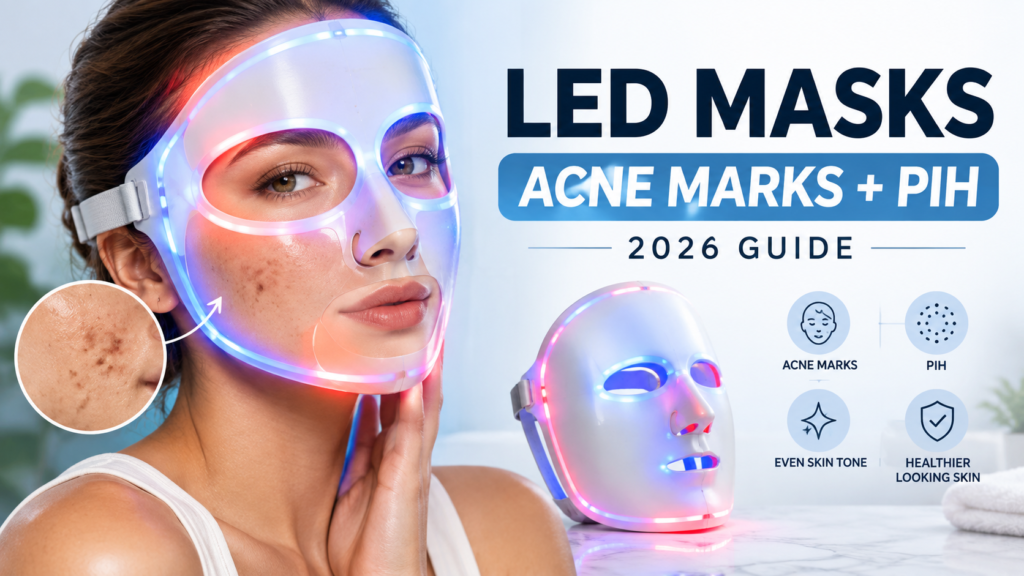
You cleared the acne. The marks stayed.
Maybe it’s a scatter of brown spots where old breakouts used to be. Maybe it’s redness that won’t fully fade. Maybe it’s a few small dips in your skin that show up under certain lighting. Whatever it is, you’ve probably typed some version of “best LED mask for acne scars” into Google, and you’ve probably noticed that most articles answer a slightly different question than the one you’re actually asking.
Affiliate disclosure: Syloma Skincare may earn a commission if you buy through links in this article. This doesn’t affect the price you pay, and we only recommend devices we believe are genuinely relevant to the concern you’re researching.
This article is about the specific, unglamorous, very common situation of dealing with skin after acne — not during it. We’ll walk through what an LED mask can realistically do for post-acne marks and dark spots, what it almost certainly can’t do, and which devices are worth considering depending on what you’re actually looking at in the mirror.
No miracle claims. Just a clear, honest breakdown.
Quick Answer: Can LED Masks Help Acne Scars and PIH?
Here’s the short version, before we get into the detail.
LED masks are, at best, a supportive tool. Red and blue light devices have reasonable evidence behind them for calming active acne and inflammation, and there’s early, more limited evidence that red light may help skin tone and texture appear more even over time. That can be genuinely useful for someone dealing with lingering redness, a dull or uneven complexion, or acne that keeps recurring and creating new marks.
What LED masks are not: a way to erase established dark spots quickly, and definitely not a way to fill in or smooth out indented (atrophic) scarring. Post-inflammatory hyperpigmentation (PIH) is a pigment problem, and true pitted or raised scars are a structural problem in the skin. LED light works on inflammation and cellular activity — it doesn’t rebuild collagen loss the way a professional resurfacing procedure can, and it doesn’t reliably break up melanin deposits the way targeted topicals, peels, or lasers can.
If you take one thing from this article, take this: identifying what you’re actually looking at matters more than which mask you buy.
First: Are Those Really Acne Scars?
This is the question almost nobody answers clearly, and it’s the one that determines everything else.
“Acne scars” gets used as a catch-all phrase for four fairly different things:
Post-acne redness (PIE – post-inflammatory erythema). Flat pink or red marks left where a pimple used to be. This is residual blood vessel dilation, not pigment or scarring. It usually fades on its own over weeks to months and tends to be more visible on lighter skin tones.
Post-inflammatory hyperpigmentation (PIH). Flat brown, tan, or grayish marks. This is a pigment change — inflammation triggers melanocytes (the cells that make pigment) to produce extra melanin. It’s flat, not indented, and it’s more common and often more stubborn in medium to deep skin tones.
Atrophic (pitted/indented) scars. Actual textural damage — ice pick, boxcar, or rolling scars where collagen was lost during the healing process. These have depth you can feel with a fingertip, and they don’t fade with time the way pigment does.
Hypertrophic or keloid scars. Raised, thickened scar tissue, less common with acne than the other three but seen occasionally, especially on the jawline, chest, and back.
Here’s why this distinction matters before you spend $300–$650 on a device: LED light has a plausible mechanism and some supportive evidence for calming inflammation and redness, and early evidence for helping tone and texture. It has essentially no ability to rebuild lost collagen structure in a pitted scar. If what you have is genuinely textured, indented scarring, an LED mask is not the tool that’s going to fix it — no matter how good the marketing copy sounds. If what you have is flat redness or early pigmentation, an LED mask may be a reasonable supporting piece of a broader routine.
The American Academy of Dermatology’s overview of acne scar treatment makes this same distinction — dermatologists treat depressed scars very differently from flat discoloration, and a consultation typically starts with figuring out exactly which type (or combination) you’re dealing with.
Acne Scars vs PIH: What’s the Difference?
| Concern | What It Looks Like | Is It a True Scar? | Can LED Help? |
|---|---|---|---|
| Post-acne redness (PIE) | Flat pink/red mark, no texture | No — vascular, not structural | Possibly, for calming appearance; evidence is limited |
| Post-inflammatory hyperpigmentation (PIH) | Flat brown/tan/gray mark | No — pigment change | May offer modest support alongside sunscreen and topicals; not a primary treatment |
| Atrophic (pitted) scar | Indented, has depth/texture | Yes | Unlikely to meaningfully improve; professional treatment usually needed |
| Hypertrophic/keloid scar | Raised, thickened tissue | Yes | Not a treatment for this; consult a dermatologist |
What Is Post-Inflammatory Hyperpigmentation?
PIH happens when inflammation — from a popped pimple, an aggressive cyst, or even just picking at a breakout — triggers melanocytes in the skin to overproduce melanin as part of the healing response. The result is a flat mark that’s darker than your surrounding skin tone. It’s not an infection, it’s not permanent scarring, and it’s not dangerous. It’s essentially your skin’s pigment-producing cells overreacting to injury.
A few things worth understanding:
It’s more noticeable, and often more stubborn, in darker skin tones. This isn’t because darker skin is somehow more “damaged” by acne — it’s because skin with more baseline melanin activity tends to respond to inflammation with more pronounced pigment production. The AAD’s guidance on fading dark spots in darker skin tones notes that PIH is one of the most common reasons people with skin of color see a dermatologist, and that new spots can keep appearing as older ones fade if the underlying acne isn’t controlled.
New breakouts create new marks. This is the part people often miss. If you’re still getting occasional breakouts while trying to fade old PIH, you’re essentially creating new marks faster than the old ones clear. Getting active acne under control is usually the actual first step — not the LED mask, not the brightening serum, but stopping the cycle of new inflammation.
Sunscreen matters more than almost anything else here. UV exposure darkens existing PIH and slows fading significantly. This is unglamorous advice, but it’s the single most evidence-backed thing you can do for post-acne dark spots, and no LED mask replaces it.
PIH usually fades on its own, slowly. Left alone, most PIH lightens over months, though deeper pigment can take longer. Treatments (topical retinoids, azelaic acid, vitamin C, chemical peels, and in more stubborn cases, prescription options) can speed this up, but the timeline is measured in months, not days.
Where does LED fit into this? Realistically, in a supporting role. There is some research suggesting light in the visible spectrum — including certain wavelengths used in professional and at-home devices — may have modest effects on skin tone evenness and pigmentation over time, but this evidence is much stronger for general “skin tone and texture” claims than for treating established PIH specifically. It should not be presented, and we won’t present it, as a proven PIH treatment. Think of it as a possible complement to sun protection and topical actives — not a replacement for either.
Can LED Masks Actually Fade Acne Marks?
Let’s separate this by category, because the honest answer is different for each.
Post-acne redness (PIE): This is where LED has its best plausible fit, since red light’s proposed mechanism involves reducing inflammation and supporting skin recovery. Reduced inflammation may help redness look calmer over time, though robust head-to-head trials specifically on post-acne redness (as opposed to general skin tone) are limited.
Brown PIH: LED is not a targeted depigmenting treatment. Ingredients like retinoids, azelaic acid, and vitamin C, along with consistent sunscreen, have far more direct evidence for fading pigment. LED may be a reasonable add-on within a broader routine, not the centerpiece of a PIH plan.
Pitted (atrophic) scars: This is the category where expectations need to be most realistic. Depressed scars involve a physical loss of collagen structure. Reputable treatments for this — microneedling, fractional lasers, subcision, chemical reconstruction of skin scars (CROSS technique), and dermal fillers — work by physically stimulating new collagen or altering the scar’s structure. LED light’s mechanism doesn’t do this in any way that’s been convincingly demonstrated. If your main concern is texture you can feel with a fingertip, an LED mask is not going to be the answer, and no honest source should tell you otherwise.
Raised (hypertrophic/keloid) scars: Similarly outside LED’s realistic scope. These need dermatologist-guided treatment (such as corticosteroid injections, laser, or silicone therapy).
Where LED masks earn their keep is upstream of all of this: helping manage active acne and inflammation so that fewer new marks form in the first place, and potentially supporting overall skin tone and texture as part of a consistent routine. A 2025 systematic review and meta-analysis published in JAMA Dermatology, led by researchers at Mass General Brigham, pooled data from six randomized trials and found that at-home red and/or blue LED devices produced significant reductions in both inflammatory and noninflammatory acne lesions compared with control groups, with a favorable safety profile. That’s solid evidence for acne itself — it doesn’t extend to scar remodeling or pigment removal, but it does support LED’s role in reducing the inflammation that creates new marks to begin with.
Consistency is the other unglamorous truth here. Every study on at-home LED devices involves weeks of regular use, not a few sessions. If you’re not going to use a mask several times a week for at least a month or two, the realistic benefit — whatever it is — probably won’t materialize.
Red Light vs Blue Light vs Near-Infrared for Post-Acne Skin
None of these wavelengths is universally “best” — they do different jobs, and the right choice depends on what you’re dealing with right now.
| Wavelength | Typical Range | Primary Association | Relevance to Post-Acne Skin |
|---|---|---|---|
| Blue light | ~405–415nm | Targeting acne-causing bacteria, calming active breakouts | Most useful if you still have active or recurring acne; not targeted at existing pigment or texture |
| Red light | ~630–660nm | Inflammation, skin recovery, general appearance of tone and texture | The most commonly cited wavelength for supporting redness and overall skin appearance after acne |
| Near-infrared (NIR) | ~800–850nm+ | Deeper tissue effects, often paired with red light in multi-wavelength masks | Marketed heavily for collagen support and firmness; evidence for pigment-specific benefit is limited, and penetration claims are often overstated by marketers |
Blue light is mainly an acne-fighting wavelength — its main studied mechanism involves acting on the bacteria and sebaceous gland activity associated with breakouts. If your primary concern is preventing new marks by getting active acne under control, blue light (or a red/blue combination) has the most direct evidence behind it. It’s not designed to fade existing dark spots.
Red light is the wavelength most often discussed in the context of “overall skin appearance,” including tone, redness, and texture. It’s the more relevant wavelength if your acne is mostly under control and you’re now focused on how your skin looks and feels afterward.
Near-infrared is frequently added to multi-wavelength masks under the banner of deeper penetration and collagen support. Be cautious of exaggerated claims here — “penetrates deeper” is true in a narrow physical sense, but that alone doesn’t prove a specific cosmetic outcome. NIR is best thought of as a complementary wavelength in a broader device, not a standalone pigment or scar treatment.
If a mask combines multiple wavelengths (commonly red + blue, or red + NIR, or all three), it can be more versatile across different phases of post-acne skin — useful if you’re managing occasional breakouts while also caring about overall tone and texture. That versatility is a legitimate reason to prefer a multi-wavelength device, separate from any specific pigment or scar claim.
If you want a deeper dive into how LED technology works in general and whether it lives up to the hype, see our guide on do LED face masks really work.
What to Look for in an LED Mask for Acne Scars and PIH
- Wavelength transparency. A manufacturer that clearly states its wavelengths (e.g., “633nm red, 415nm blue”) is giving you something you can actually cross-reference against research. Be wary of devices that only say “red and blue light” with no numbers.
- FDA clearance where applicable — and understand what it actually means (see the section below).
- Treatment time. Ranges from 3 minutes (Dr. Dennis Gross, Solawave) to 10 minutes (Omnilux, CurrentBody) per session. Shorter isn’t automatically worse; it depends on the device’s designed irradiance.
- Irradiance/dose information, when published. Few consumer brands disclose this fully, which limits how precisely you can compare devices.
- Full-face coverage, including jawline, chin, and around the mouth — areas prone to hormonal or jawline acne and its resulting marks.
- Eye protection or eye-safe design, since LED light near the eyes needs to be handled carefully.
- Comfort and fit, especially for daily or near-daily use — a rigid mask you dread wearing won’t get used consistently.
- Warranty, typically 1–2 years on these devices.
- Return policy — many brands don’t accept returns on opened masks for hygiene reasons, so check before buying.
- Manufacturer instructions on frequency and duration, and following them rather than improvising.
- Skin-tone considerations — see the dedicated section below.
- Evidence behind the specific device, not just the wavelength category in general. Some brands cite their own manufacturer-commissioned testing rather than independent, peer-reviewed studies; it’s worth knowing which kind of evidence you’re looking at.
If you’re weighing LED masks purely for active breakouts rather than post-acne marks, our roundup of best LED face masks for acne-prone skin covers that angle in more depth.
Understanding FDA Clearance (Read This Before You Buy)
This gets muddled constantly in marketing copy, so let’s be precise.
FDA clearance (510(k)) means a manufacturer demonstrated their device is “substantially equivalent” to an existing legally marketed device — it’s a paperwork and safety-equivalence process, not a clinical trial proving effectiveness for a specific claim. A device cleared for “mild to moderate acne” has clearance for that specific indication. It does not mean the FDA has separately verified that the same device fades PIH or improves pitted scars, even if the marketing page mentions those benefits in passing.
For example, the Omnilux CLEAR mask’s own FDA filing states its indication for use is specifically to treat mild to moderate acne vulgaris on the face — the clearance is about acne, not about scarring or pigmentation, even though the product’s marketing sometimes references reducing the appearance of scarring or redness. Similarly, some CurrentBody marketing materials describe additional wavelengths for tone and firmness, but a third-party review of the device’s FDA record notes that the published clearance documentation lists 633nm and 830nm as the subject device wavelengths, without a third wavelength appearing in that filing — a good reminder to check what’s actually in the FDA record versus what’s in the sales copy.
The practical takeaway: treat “FDA-cleared” as a safety and marketing-claim baseline, not proof that a device will fix your specific concern. Read the actual indication for use, not just the badge on the box.
Can LED Masks Help Dark Spots on Darker Skin Tones?
This deserves its own honest section, because it’s a genuine content gap and a genuine safety consideration.
PIH is, as covered above, particularly common and often more persistent in medium-to-deep skin tones. That’s a function of melanocyte biology, not a flaw in darker skin — but it does mean people with more melanin-rich skin are statistically more likely to be dealing with PIH specifically (rather than PIE or textured scarring) after acne clears.
A few points worth being direct about:
- Inflammation and skin irritation — including from a device used too aggressively, too often, or on already-irritated skin — can itself contribute to new pigmentation. This is true regardless of what caused the irritation, LED mask included.
- Some dermatology sources note that darker skin can be more reactive to visible light, including red light, in terms of pigment response, which is one reason to start conservatively (lower frequency, shorter sessions) rather than assuming “more is better.”
- This does not mean all LED devices are unsafe for darker skin tones. LED phototherapy is broadly considered a lower-risk category of device precisely because it doesn’t use UV light. The caution is about following manufacturer instructions carefully, not skipping devices altogether based on skin tone.
- If you have persistent, widespread, or worsening pigmentation, that’s a reasonable point to bring in a dermatologist, ideally one experienced with skin of color, rather than continuing to self-treat indefinitely.
The AAD’s guidance on red light therapy safety is a useful general reference here, alongside a dermatologist consultation if your pigmentation concerns are significant or long-standing.
How Long Does an LED Mask Take to Work?
Results vary by person, by device, and by what you’re actually trying to change. Here’s a realistic, non-hyped timeline based on how these devices are typically studied.
First few sessions (week 1–2): Most people notice little to nothing dramatic. Some people report skin feeling calmer or looking slightly less red after a session, but this is often temporary and related to warmth and blood flow rather than a lasting change.
Several weeks (4–8 weeks of consistent use): This is the window where most clinical research on LED and acne shows measurable change — the JAMA Dermatology review found benefit typically emerging over four to twelve weeks of regular use for acne lesions specifically. If you’re using LED to support calmer, less inflamed skin (and by extension, fewer new marks), this is roughly when you’d expect to notice something.
Longer-term consistent use (3+ months): Any modest improvements in overall tone or texture that LED may contribute tend to show up gradually here, layered on top of whatever your topical routine and sun protection are doing. This is also the point where, if pigmentation or texture concerns haven’t budged, it’s worth reassessing whether LED alone is the right tool — or whether it’s time to add a professional treatment.
There is no version of this where a handful of sessions “erases” marks. If a product page implies otherwise, that’s marketing outpacing evidence.
How to Use an LED Mask for Post-Acne Skin
- Cleanse your skin thoroughly — no makeup, sunscreen, or heavy product residue.
- Dry your skin before use; most manufacturers specify a clean, dry surface for even light contact.
- Follow the manufacturer’s specific instructions for your device rather than assuming all masks work the same way.
- Use the correct treatment duration — don’t extend sessions assuming more time equals better results; irradiance and duration are calibrated together by the manufacturer.
- Protect your eyes if the device requires it, or keep eyes closed throughout the session.
- Don’t exceed the recommended frequency. Most devices suggest 3–5 sessions per week; daily use isn’t necessarily better and some devices caution against it.
- Continue wearing sunscreen every day, regardless of your LED routine — this remains one of the most important things you can do for PIH.
- Continue any appropriate acne or PIH skincare your dermatologist or routine already includes; LED is additive, not a replacement.
- Stop use if you notice significant irritation, unusual redness, or discomfort beyond mild warmth.
- Seek professional advice if you’re on photosensitizing medication, have a light-sensitive condition, or aren’t seeing any change after a reasonable trial period.
Where an LED Mask Fits Into a Skincare Routine
A simple way to think about sequencing:
- Cleanser — start with clean, dry skin.
- LED treatment — use the mask per manufacturer instructions.
- Moisturizer — apply afterward to support the skin barrier.
- Sunscreen — non-negotiable every morning, especially if PIH is a concern.
- Acne or PIH-targeted ingredients (like a retinoid, azelaic acid, or vitamin C) — used as your dermatologist or routine directs, at the times of day recommended for those specific ingredients.
We’re not going to tell you exactly which actives to use or at what strength — that’s a personalized skincare decision, ideally made with a dermatologist if you’re using prescription-strength products. And to be clear: an LED mask is not a reason to stop any prescribed acne medication. If you’re on a retinoid, an antibiotic, isotretinoin, or anything else prescribed for acne, keep following your dermatologist’s plan alongside (not instead of) any device.
LED Masks vs Other Acne Scar Treatments
| Treatment | Best For | At Home? | Main Limitation |
|---|---|---|---|
| LED light therapy | Active acne, inflammation, general tone/texture support | Yes | Not effective for structural (pitted) scarring; modest, gradual effects |
| Topical skincare (retinoids, azelaic acid, vitamin C) | PIH, mild texture, prevention | Yes | Slow (months); some options need a prescription |
| Chemical peels | PIH, surface texture, some mild scarring | Some OTC options; stronger peels are professional | Downtime with stronger peels; not for deep atrophic scars |
| Microneedling | Mild-to-moderate atrophic scarring | At-home rollers exist but are far less effective than professional devices | Professional-grade needling needed for real structural change |
| Laser treatments (fractional, ablative) | Atrophic and some hypertrophic scarring | No | Cost, downtime, requires a qualified provider |
| Dermatologist-guided treatment (subcision, fillers, steroid injections, combination plans) | Established or severe scarring | No | Cost and access; but the most effective option for true structural scars |
The pattern here is consistent: the more established and textured the scar, the more likely it is that a professional, in-office approach is what actually moves the needle. LED sits comfortably in the “at-home, supportive, low-risk” tier — genuinely useful for some things, not a substitute for the tools further down this list when the concern is structural.
Are LED Masks Safe?
Generally, yes, for most people, when used as directed. A few things worth knowing:
- Mild redness or temporary irritation is the most commonly reported side effect and typically resolves quickly.
- Eye safety matters — direct light exposure to the eyes should be avoided; use eye protection if your device includes or recommends it.
- Photosensitivity is a real consideration. Certain medications (some antibiotics, isotretinoin, certain acne treatments) and conditions (like lupus) increase sensitivity to light, including visible light from LED devices. Check with a doctor or pharmacist if you’re on any medication known to cause light sensitivity.
- Seizure disorders — while LED masks are steady light rather than a strobe, anyone with a seizure disorder triggered by bright or flashing light should check with their doctor before using any light-based device, and avoid devices with strobing or flashing modes.
- Skin conditions like active eczema, rosacea flares, or open wounds in the treatment area may need a professional assessment before starting LED use.
- Darker skin and pigmentation — covered in detail above; the short version is caution and following instructions, not avoidance.
- Always follow the manufacturer’s specific instructions for your device, including maximum frequency and session length.
The FDA’s product code for many of these devices (such as OHS, used for at-home light-therapy devices cleared for wrinkles) reflects a device category considered over-the-counter and lower-risk — but “lower-risk” isn’t the same as “risk-free for everyone,” which is why the precautions above matter.
If you have any active skin condition, are pregnant, or are managing a chronic illness, a quick conversation with a dermatologist before starting a new device is a reasonable, low-effort step.
7 Mistakes People Make When Using LED Masks for Acne Marks
- Expecting overnight results. These devices work on a timeline of weeks to months, not days.
- Confusing PIH with true scarring. This leads to buying the wrong tool for the actual problem — or expecting an LED mask to do something it was never going to do.
- Buying without checking wavelengths. “Red and blue light” without numbers tells you very little about what the device is actually designed to do.
- Ignoring sunscreen. No LED routine outperforms sun protection for preventing PIH from getting worse or lasting longer.
- Using the device too often, assuming more sessions equal faster results. Follow the manufacturer’s frequency guidance.
- Assuming expensive automatically means better. Price often reflects LED count, design, and brand — not necessarily a proportionally better outcome for your specific concern.
- Replacing proven acne treatment with LED alone. If you have moderate-to-severe acne, LED is a complement to (not a substitute for) dermatologist-directed treatment.
Product Reviews: LED Masks Worth Considering for Post-Acne Skin
A note before this section: every device below has a genuine reason to be included — either strong acne-specific evidence, a widely used multi-wavelength design, or a clearly documented FDA clearance relevant to this topic. Prices and promotions change frequently, so check the manufacturer’s current price before buying.
Omnilux CLEAR
Best for: Active mild-to-moderate acne, with secondary support for redness
Wavelengths: Blue 412.5nm (±7.5nm) and Red 630nm (±5nm), per its FDA filing
Treatment time: 10 minutes, four sessions per week for six weeks as the recommended starting protocol
FDA status: FDA-cleared (K210948) with an indication specifically for treating mild to moderate acne vulgaris on the face

- Omnilux Tech with Dual Chip LEDs
- Suitable for All Skin Types
- FDA-Approved Home Use
Why it stands out Omnilux is one of the more established names in LED phototherapy, with technology also used in professional clinic settings. The CLEAR mask’s blue/red combination is well-aligned with the acne-focused evidence base, and its FDA clearance is specifically and narrowly for acne — which is refreshingly precise compared to some competitors.
Pros
- Clear, specific FDA indication for acne
- Flexible silicone design for comfort
- Backed by a long-standing brand with in-clinic heritage
- Two-year device warranty
Cons
- Marketing occasionally references “softening the appearance of scarring,” which goes beyond the device’s specific FDA acne indication — treat this as a marketing claim, not a verified scar treatment
- No published irradiance data on the retail product page
- Premium price point (check the manufacturer’s current price before buying)
Best for acne or PIH? Primarily active acne and the redness/inflammation that comes with it. Not a targeted PIH or scar solution — think of any tone-related benefit as a possible secondary effect of calmer, less inflamed skin, not a primary indication.
Who should consider it: Someone with ongoing mild-to-moderate breakouts who wants an acne-focused device with strong brand credibility and a narrow, honest FDA claim.
Who may want another option: Someone whose acne is already fully resolved and whose main concern is now purely flat pigmentation or textured scarring — for pigmentation, a targeted topical routine will likely do more; for texture, a professional treatment is the more direct route.
Omnilux Contour Face
Best for: General skin tone, texture, and mild signs of aging after acne has cleared
Wavelengths: Red 633nm and near-infrared 830nm, 132 LEDs
Treatment time: 10 minutes, three to five times weekly for four to six weeks, then maintenance
FDA status: FDA-cleared, with certifications including CE and TGA
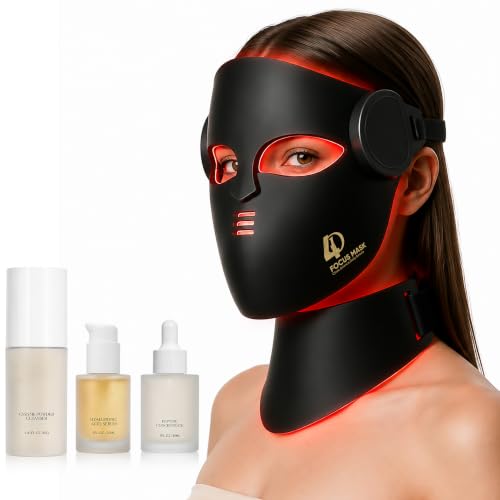
- 8-in-1 LED Light Therapy for Face & Neck: Featuring 272 face LEDs and 128 neck LEDs, this LED light therapy mask combine…
- 4D Curved Design for Full-Face Comfort: The ergonomic 4D curved design follows facial contours for comfortable, even lig…
- Cordless Controller for Hands-Free Skincare: The wireless controller lets you easily adjust light modes, intensity level…
Why it stands out This is Omnilux’s red/NIR device, distinct from the acne-specific CLEAR mask. It’s positioned for tone, firmness, and the general appearance of skin after active acne is under control — a reasonable fit for someone past the breakout stage and now focused on overall skin quality.
Pros
- Published irradiance figure (35 mW/cm²) — more transparency than many competitors offer
- Comfortable, flexible silicone design
- Backed by the same Omnilux medical-device manufacturing as the acne-specific CLEAR mask
Cons
- Not indicated for acne — this is a tone/anti-aging device, not an acne treatment
- No blue light, so it won’t address active breakouts
- Premium price similar to CLEAR (check the manufacturer’s current price before buying)
Best for acne or PIH? More relevant to overall skin tone support once acne itself is controlled, rather than to acne or PIH specifically. Reasonable as a general “skin recovery” tool, not a scar or pigment treatment.
Who should consider it: Someone whose acne is resolved and who wants a red/NIR device focused on overall complexion, alongside anti-aging benefits, our guide to best red light therapy masks for anti-aging covers this angle in more depth.
Who may want another option: Anyone still dealing with active breakouts — this device has no blue light component.
CurrentBody Skin LED Anti-Blemish Mask (Red & Blue)
Best for: Active acne management with a home-friendly design
Wavelengths: Blue 415nm and red light (per manufacturer’s product page), 220 LEDs
Treatment time: 10 minutes per session
FDA status: FDA-cleared for acne

- Enhanced collagen production capability significantly reduces fine lines, wrinkles and redness, for younger-looking skin…
- Upgraded light coverage provides our famous instant glow, for a healthier, brighter and smoother complexion.
- An all-new, exclusive layout of 236 LED bulbs emits three clinically recognised wavelengths: red (633nm), near-infrared …
Why it stands out This is CurrentBody’s dedicated acne mask (distinct from their Series 2 anti-aging mask below), combining blue light for bacteria and red light in a single 10-minute session. It’s a widely available, well-reviewed option in the blue/red acne category.
Pros
- Combination blue/red design targets both active blemishes and calming redness
- Widely stocked with accessible customer support and return policies through major retailers
- Straightforward, single sensitivity-test-then-use protocol
Cons
- Marketing claims (such as “clear skin by 90% in 2 weeks”) should be read as brand-reported figures rather than independently verified clinical results — check the manufacturer’s current claims and study details before relying on a specific number
- Not designed or indicated for PIH or textured scarring
Best for acne or PIH? Active acne, primarily. Any secondary benefit to marks would come from reduced ongoing inflammation, not a targeted pigment or scar mechanism.
Who should consider it: Someone actively managing whiteheads, small cysts, or nodules who wants a straightforward blue/red combination device.
Who may want another option: Someone with no active acne left, whose only concern is old, flat dark marks — a targeted topical routine or the tone-focused Series 2 (below) may be more relevant.
CurrentBody Skin LED Light Therapy Mask Series 2
Best for: General skin tone, firmness, and texture after acne — not active breakouts
Wavelengths: Per the FDA 510(k) filing, 633nm (red) and 830nm (near-infrared); the manufacturer’s marketing also references an additional 1072nm deep near-infrared array, which independent reviewers have noted is not listed in the published FDA clearance documentation as of mid-2026
Treatment time: 10 minutes
FDA status: FDA 510(k)-cleared (K250966, granted June 2025)

- Targeted full face, neck and chest anti-ageing treatment
- Reduces wrinkles by 30% after 8 weeks
- Upgraded best-fit coverage for optimal results
Why it stands out This is CurrentBody’s more premium, anti-aging-focused mask, with 236 LEDs and full jawline/chin coverage. It’s a popular multi-wavelength option, though — importantly — it is not an acne-specific or PIH-specific device.
Pros
- Wide coverage area, including chin and jawline
- Wireless, rechargeable design
- Manufacturer cites commissioned SGS/Eurofins testing over an eight-week period (manufacturer-commissioned, not independent peer-reviewed research)
Cons
- The extra 1072nm wavelength promoted in marketing isn’t confirmed within the FDA clearance record for the wavelengths used in that filing — worth knowing if the “third wavelength” is a deciding factor for you
- No blue light, so not built for active acne
- One of the pricier masks in this category (check the manufacturer’s current price before buying)
Best for acne or PIH? Neither is the device’s primary indication. It’s positioned for general anti-aging and skin-tone benefits, which may indirectly support the appearance of skin after acne has cleared, but it is not a targeted acne or pigment treatment.
Who should consider it: Someone past the active-acne stage who wants a broad, multi-wavelength device for overall skin quality, and who has confirmed current specifications directly with the manufacturer.
Who may want another option: Anyone whose priority is acne control (no blue light here) or who wants certainty about every advertised wavelength matching the FDA filing exactly.
Dr. Dennis Gross DRx SpectraLite FaceWare Pro
Best for: People who want both an acne mode and an anti-aging mode in one device
Wavelengths: Red and blue, with the device offering separate red, blue, and combined red+blue treatment modes; published figures include roughly 100 red and 60+ blue LEDs depending on version
Treatment time: 3 minutes per session
FDA status: FDA-cleared
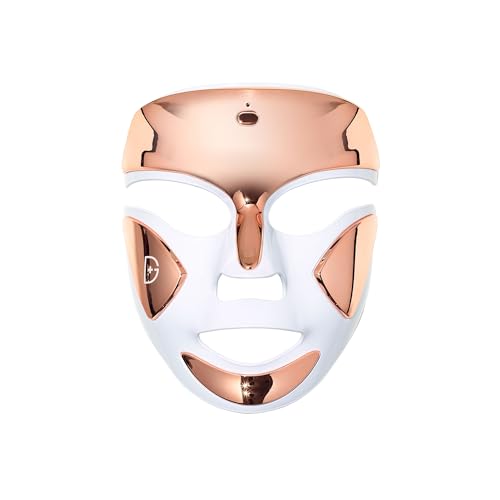
- WHAT IT IS: This LED device for the face targets wrinkles and acne for visibly smoother, clearer skin in just 3 minutes….
- HOW IT WORKS: Treat acne and breakouts with blue light, smooth wrinkles and build collagen with red light, or address bo…
- HOW TO USE: After cleansing, place the mask over your face, securing the strap around your head. Press & hold the power …
Why it stands out The three-minute treatment time is the standout practical feature — for people who won’t commit to a 10-minute daily ritual, a much shorter session may mean better real-world consistency, which matters more than any single wavelength choice. The switchable red/blue/combined modes also let you shift focus depending on whether you’re dealing with active breakouts or general tone that week.
Pros
- Very short treatment time supports consistency
- Switchable modes for acne vs. tone-focused sessions
- Created by a dermatologist-founded brand
- No cord needed during treatment (hands-free, battery-powered)
Cons
- Marketing references “diminishing discoloration,” which should be understood as a general tone claim rather than a specific, verified PIH treatment claim
- Shorter session time means less light exposure per use than 10-minute masks — whether this matters in practice isn’t independently settled
Best for acne or PIH? Reasonable as a dual-purpose device for people managing both occasional breakouts and general tone concerns, but not a dedicated or proven PIH treatment.
Who should consider it: Someone who wants one device that flexes between acne-mode and tone-mode sessions, and who values a fast routine.
Who may want another option: Someone who wants the longest possible per-session light exposure or the widest LED coverage area.
Therabody TheraFace Mask
Best for: People who want LED plus a facial-tension/vibration feature in one device
Wavelengths: Red, Red+Infrared, and Blue (three selectable modes), 648 LEDs
Treatment time: 9-minute preset, or 3-minute targeted sessions
FDA status: FDA-cleared, Class II medical device
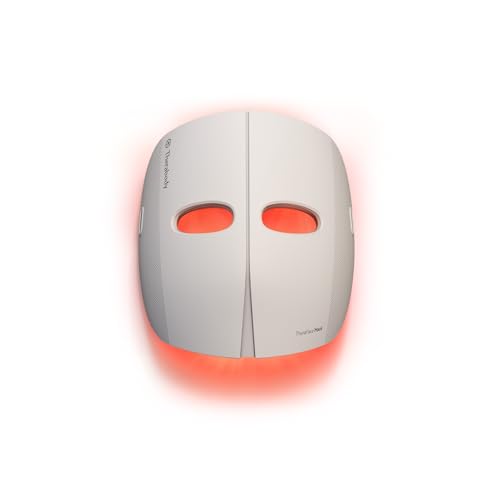
- Supercharged Face Care in 9 Minutes: A facial mask routine with 3 impressive LED light therapy technologies. Red light t…
- Vibrating Facial Massager, Too: TheraFace LED mask delivers a 15-minute vibration therapy treatment to key pressure poin…
- Powerful, Medical-Grade Lights: With 3x more LEDs than leading mask competitors for maximum efficacy and mask skincare r…
Why it stands out TheraFace is one of the higher-LED-count masks on the market and adds a vibration/massage element aimed at facial tension, which is a genuinely different feature set from the purely optical devices above. Its three wavelength modes give some flexibility between acne-focused and tone-focused sessions.
Pros
- Highest LED count among the masks covered here (648)
- Three selectable wavelength modes in one device
- Added vibration therapy is a genuine point of differentiation, not just marketing
- Covers lips and nose area, often missed by rigid mask designs
Cons
- One of the most expensive options in this category (check the manufacturer’s current price before buying)
- Some users report mild redness around the eye area from the eyeshields, per the manufacturer’s own product notes
- Vibration feature adds complexity and cost that isn’t relevant if you only want light therapy
Best for acne or PIH? The blue mode addresses active acne; the red and red+infrared modes are positioned for tone, discoloration, and firmness in general marketing language. As with other devices here, “dark spot” and “discoloration” claims should be read as general tone claims rather than a specific, clinically verified PIH treatment.
Who should consider it: Someone who wants an all-in-one device combining light therapy with facial massage/tension relief and doesn’t mind the higher price.
Who may want another option: Anyone who specifically wants a simpler, lighter, or lower-cost device and has no interest in the vibration feature.
Final Buying Guide: Matched to Your Actual Concern
Rather than naming one universal “best,” here’s how to match a device to what you’re actually dealing with:
Best for active acne: Omnilux CLEAR or CurrentBody’s Red & Blue Anti-Blemish Mask — both have blue light and a clear, narrow acne-focused positioning.
Best for acne plus a desire for anti-aging benefits in one device: Dr. Dennis Gross DRx SpectraLite FaceWare Pro, thanks to its switchable red/blue/combined modes and short treatment time.
Best for post-acne tone and general skin recovery (acne already controlled): Omnilux Contour Face, given its published irradiance and dedicated red/NIR focus.
Best for a simple red/NIR routine with broad coverage: CurrentBody Skin LED Light Therapy Mask Series 2, keeping in mind the note above about verifying its exact wavelength specifications with the manufacturer.
Best for people who want multiple wavelengths plus an added wellness feature: Therabody TheraFace Mask, for its three light modes and vibration therapy.
If your primary concern is actually anti-aging and firmness rather than post-acne marks, you may find more direct value in our dedicated guides on LED face masks for mature skin and fine lines, best LED face masks for wrinkles and firm skin, or red light therapy devices for sagging skin and firmness.
Frequently Asked Questions
1. Can LED masks remove acne scars? No, not in the sense of erasing established, textured scarring. LED may support calmer, less inflamed skin and help manage acne, which can reduce the formation of new marks, but it doesn’t rebuild lost collagen structure the way professional treatments can.
2. Can red light fade post-inflammatory hyperpigmentation? It may offer modest support as part of a broader routine, but it’s not a primary or proven PIH treatment. Sunscreen and targeted topicals (retinoids, azelaic acid, vitamin C) have stronger evidence for fading PIH specifically.
3. Is blue light good for acne scars? Blue light is mainly studied for active acne and bacteria, not for existing scars or pigmentation. It’s more relevant if you still have breakouts than if your main concern is old marks.
4. Is red or blue light better after acne? It depends on your current concern. Blue light is more relevant if you have ongoing active breakouts. Red light is more commonly associated with general tone, redness, and recovery once acne is under control. Many people benefit from a device offering both.
5. Can LED masks help brown spots left by acne? Possibly as a minor supporting factor, but they shouldn’t be relied on as the primary treatment. Sun protection and topical actives remain the more evidence-backed approach for PIH specifically.
6. How often should I use an LED mask? Follow the specific manufacturer’s guidance — typically 3 to 5 sessions per week, though some devices are designed for daily short sessions. More frequent use isn’t automatically better.
7. How long before I see results? Most research on LED and acne shows measurable change over 4 to 12 weeks of consistent use. There’s no basis for expecting visible change in just a few sessions.
8. Are LED masks safe for dark skin? Generally yes, when manufacturer instructions are followed. LED devices don’t use UV light, which is the main skin-cancer-associated risk factor. That said, darker skin tones may be more reactive to light-induced pigmentation, so starting conservatively and consulting a dermatologist for persistent PIH is reasonable.
9. Can LED masks treat pitted acne scars? Not effectively. Pitted (atrophic) scars are a structural collagen issue that typically requires professional treatments such as microneedling, fractional lasers, or subcision. LED is not a substitute for these.
10. Should I use skincare before or after an LED mask? Cleanse and dry your skin before use, following your specific device’s instructions. Apply moisturizer and other skincare afterward, per the manufacturer’s guidance and your existing routine.
11. Can I use an LED mask every day? Some devices are designed for daily short sessions; others recommend 3–5 times weekly. Check your specific device’s instructions rather than assuming daily use is always fine or always necessary.
12. Do I still need sunscreen? Yes, absolutely — every day, regardless of your LED routine. This remains one of the most important steps for preventing PIH from worsening or lasting longer.
If you’re still building out the rest of your post-acne routine, our guide on best LED face masks for acne-prone skin is a useful next stop, especially if you’re still dealing with occasional breakouts alongside old marks.
Sources referenced in this article: American Academy of Dermatology (acne scar treatment, fading dark spots in darker skin tones, red light therapy safety); a 2025 systematic review and meta-analysis published in JAMA Dermatology on at-home LED devices for acne; FDA 510(k) clearance records for Omnilux CLEAR and CurrentBody Skin LED Light Therapy Mask Series 2; and manufacturer product specifications, cross-checked across multiple retailer and brand sources as of 2026. Prices, promotions, and product specifications change — always check the manufacturer’s current listing before purchasing.