

If you have mature skin, you’re not shopping for “red light” in the abstract. You’re trying to figure out which mask is more likely to help with fine lines around the eyes and mouth, loss of firmness along the jaw, uneven tone, and that general dullness that comes with age — and which one you’ll actually keep using six months from now. Omnilux vs HigherDOSE is one of the most common questions in this category, because both are well-known, both are backed by FDA clearance, and both cost several hundred dollars, which makes the decision feel higher-stakes than picking a serum.
This guide compares the Omnilux Contour Face and the HigherDOSE Red Light Face Mask specifically through the lens of mature skin: wrinkles, firmness, comfort, and whether you’ll realistically stick with the routine. It also separates manufacturer marketing from independent evidence, because that distinction matters more than most comparison articles let on.

- Red Light Therapy for Face & Skin Rejuvenation – This FDA cleared, FSA eligible red light therapy mask uses red (630nm) …
- Facial Light Therapy, Anywhere – Lightweight and wireless, this LED face mask with red light therapy delivers targeted w…
- Red Light Mask That Works Deep – Red and near-infrared light reach deep layers to improve tone, reduce puffiness, and vi…
Quick Answer: Omnilux vs HigherDOSE for Mature Skin
Both masks use a nearly identical combination of red (630–633nm) and near-infrared (830nm) light, both use 132 LEDs in a flexible silicone mask, and both are FDA-cleared, over-the-counter devices in the same regulatory category as dozens of other wrinkle-reduction masks. There is no published head-to-head clinical trial showing that either one outperforms the other on mature skin.
The practical differences come down to: Omnilux has a higher (manufacturer-reported) irradiance figure and a longer device warranty, while HigherDOSE offers a wireless, goggle-free design with a 20-minute session option and a lower price. Neither difference is large enough to call one an outright “winner” for wrinkles or firmness — the more useful question is which design you’ll actually use consistently.
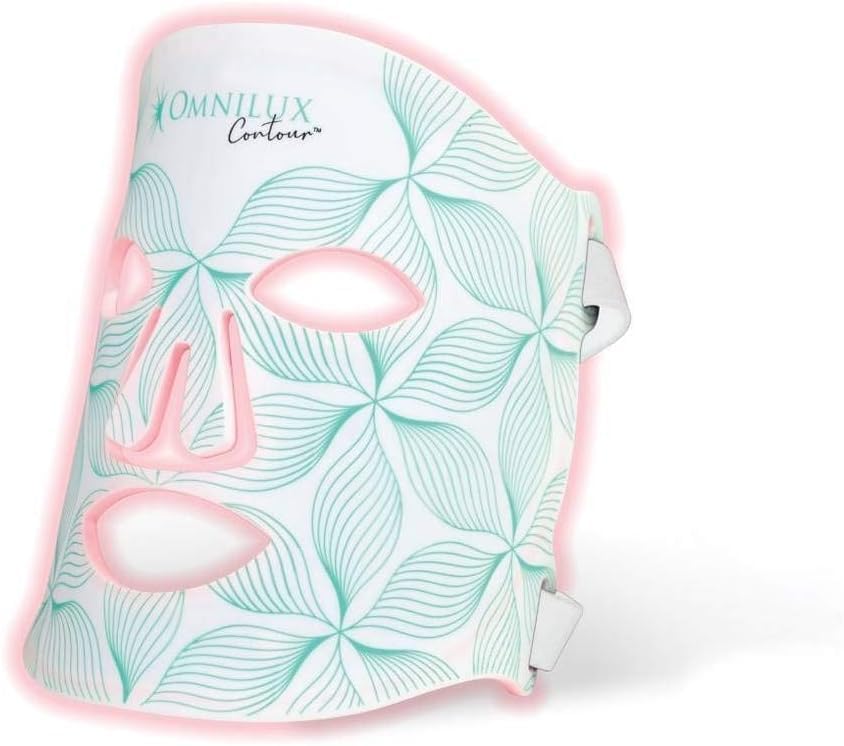
Omnilux Contour Face Overview
The Omnilux Contour Face is built around Omnilux’s clinical-technology background — the company’s LED platforms originated in dermatology and aesthetic clinics before the brand released a home version. The Contour Face uses 633nm red light and 830nm near-infrared light delivered through 132 medical-grade LEDs (66 dual-chip bulbs) set into a flexible silicone mask.
Sessions run 10 minutes, with Omnilux recommending three to five treatments per week for four to six weeks, then ongoing maintenance use. The mask connects to a rechargeable battery controller, and the whole kit — mask, controller, straps, carry bag, and plug adapters — currently retails at $395 in the US. (Current pricing as of publication; check the retailer for the latest price before buying.)
Why mature-skin users consider it: Omnilux markets the Contour Face specifically for full-face wrinkles, firmness, and pigmentation, and it’s the mask more frequently recommended by dermatologists in press coverage. Its irradiance is not published on Omnilux’s own spec sheet, but independent reviewers and third-party retailers commonly report figures in the 30–35 mW/cm² range.
Limitations: The controller is tethered to the mask by a short cable during use, so it’s less suited to walking around the house than HigherDOSE’s design. The higher price and shorter 10-minute-only session format are also worth weighing.
HigherDOSE Red Light Face Mask Overview
The HigherDOSE Red Light Face Mask uses 630nm red light and 830nm near-infrared light through 132 diodes arranged as 66 dual-core LEDs, in a similar flexible silicone shell. HigherDOSE publishes a manufacturer-reported total irradiance of 50 mW/cm², and the mask offers a choice of 10- or 20-minute preset sessions, with a recommended frequency of three to five times per week (HigherDOSE suggests easing in with two to three sessions weekly before building up).
The controller is a small, separate wireless unit rather than a cabled attachment, and the mask includes built-in eye openings plus a pair of goggles, an extra head strap, and a carry bag. It currently retails at $349 in the US. (Current pricing as of publication; verify before purchase, as HigherDOSE runs frequent promotions.)
Why mature-skin users consider it: The cordless design and longer 20-minute option appeal to people who want to fold a session into another activity — reading, a workout, or PEMF/sauna use, according to HigherDOSE. The lower price point and 30-day money-back return window also lower the risk of trying it.
Limitations: The battery runs roughly 80–100 minutes per charge, its 50 mW/cm² irradiance is still lower than dedicated LED panels (which commonly run 70–150 mW/cm²), and the warranty is one year — shorter than Omnilux’s two-year device warranty.
- Red Light Therapy for Face & Skin Rejuvenation – This FDA cleared, FSA eligible red light therapy mask uses red (630nm) …
- Facial Light Therapy, Anywhere – Lightweight and wireless, this LED face mask with red light therapy delivers targeted w…
- Red Light Mask That Works Deep – Red and near-infrared light reach deep layers to improve tone, reduce puffiness, and vi…
Omnilux vs HigherDOSE: Key Differences
| Feature | Omnilux Contour Face | HigherDOSE Red Light Face Mask |
|---|---|---|
| Price (US, current) | $395 | $349 |
| Wavelengths | 633nm red + 830nm NIR | 630nm red + 830nm NIR |
| LED / diode count | 132 LEDs (66 dual-chip bulbs) | 132 diodes (66 dual-core LEDs) |
| Irradiance | ~30–35 mW/cm² (third-party estimate; not published by Omnilux) | 50 mW/cm² (manufacturer-reported) |
| Treatment time | 10 minutes (fixed) | 10 or 20 minutes (selectable) |
| Recommended frequency | 3–5x/week for 4–6 weeks, then maintenance | 3–5x/week (ease in from 2–3x) |
| Design | Flexible silicone mask, cabled to controller | Flexible silicone mask, wireless controller |
| Wireless use | Battery-powered controller, short connecting cable | Fully cordless mask; separate wireless controller |
| FDA status | FDA-cleared (OTC wrinkle-reduction category) | FDA-cleared (OTC wrinkle-reduction category) |
| Main mature-skin focus | Full-face wrinkles, firmness, pigmentation | Fine lines, elasticity, skin barrier and glow |
| Warranty / returns | 2 years (device), 1 year (controller) | 1-year limited warranty; 30-day return window |
Which Is Better for Fine Lines and Wrinkles?
Both masks use essentially the same wavelength pairing that photobiomodulation research has focused on for wrinkle reduction: red light in the low 600s to mid-600s nanometer range, paired with 830nm near-infrared. The 3nm difference between Omnilux’s 633nm and HigherDOSE’s 630nm is not something skin can meaningfully distinguish — both fall inside the red-light band that the published research covers, so this is not a real differentiator.
Where the two masks diverge is dose: irradiance (light intensity) multiplied by time gives the total “dose” delivered per session. HigherDOSE’s higher manufacturer-reported irradiance (50 mW/cm²) combined with its optional 20-minute setting could mean a higher total dose per session than Omnilux’s fixed 10 minutes at a lower reported irradiance — but Omnilux doesn’t publish its own irradiance figure, so this comparison rests on third-party measurements rather than confirmed manufacturer data on both sides. Neither company has published a study comparing their device directly against the other’s, so any claim that one produces better wrinkle results than the other is not something either brand — or this article — can back up.
Which Is Better for Firmness and Loss of Elasticity?
Firmness and elasticity are tied to collagen and elastin in the dermis, which is where near-infrared light (both masks use 830nm) is thought to have its main effect, penetrating deeper than red light alone. The general photobiomodulation literature — reviewed in a 2024 clinical review in the Journal of the American Academy of Dermatology — supports red and near-infrared light as a noninvasive option with a favorable safety profile for skin rejuvenation, though it stresses that wavelength, dose, and schedule all affect results, and that more standardized research is still needed.
What this means practically: it’s reasonable to expect gradual improvements in skin firmness with either mask, used consistently over several weeks, but neither device is likely to produce the kind of lift you’d get from an in-office procedure, and results vary by individual. Be skeptical of any claim that either mask “restores” firmness lost to natural aging — that’s not something at-home LED therapy has been shown to reverse.
Which Is Better for Mature, Dry, or Thinner-Looking Skin?
Mature skin is often more prone to dryness and sensitivity, and irritation shows up faster on thinner skin. Both masks are made from medical-grade silicone that sits directly against the face, and neither applies heat intentionally, though red and near-infrared light does produce a mild warming sensation during use. Comfort reports for both devices are generally similar — a snug, warm mask experience rather than anything abrasive.
If your skin is very dry, dermatologists commonly suggest applying a plain moisturizer after (not before) an LED session, and skipping active ingredients like retinoids or exfoliating acids immediately before treatment to reduce the chance of irritation. If you have a diagnosed skin condition, are on photosensitizing medication, or have very sensitive or reactive skin, check with a dermatologist before adding either device to your routine.
Which Mask Is More Comfortable?
Both masks use flexible silicone designed to contour to the face rather than a rigid shell, and both include adjustable straps. The meaningful difference is the controller: Omnilux’s controller connects to the mask by a short cable, which some users find slightly restrictive during a session, while HigherDOSE’s mask is fully cordless with a separate handheld or clipped controller, making it easier to move around, do light stretching, or read while treating your skin.
HigherDOSE also includes protective goggles in the box and built-in eye openings in the mask itself, while Omnilux’s mask is designed to be used with eyes closed and does not include separate goggles in most retail listings. If you’re someone who wants to read, scroll, or watch something during your session, that’s worth factoring in.
Which Is Easier to Use Consistently?
With any LED mask, results depend on adherence — showing up for sessions three to five times a week for at least a month, not the specific brand. On that front, HigherDOSE’s cordless design and flexible 10-or-20-minute options may make it easier to fit into a varied routine (during a workout, at a desk, while cooking), while Omnilux’s simpler “put it on, wait 10 minutes” format has less to think about and a shorter, more predictable time commitment.
Neither is objectively easier — it depends on whether you prefer a short, fixed routine or a flexible one you can multitask through. The mask you’re more likely to actually use is the one that fits your daily rhythm, not the one with the higher spec sheet number.
Omnilux vs HigherDOSE for Sensitive Skin
Neither device is marketed specifically for sensitive skin, and individual sensitivity to light-based treatments varies widely — what feels fine for one person’s skin can cause redness or irritation in another. The American Academy of Dermatology notes that people with darker skin tones may be more sensitive to visible light, including red light, and may want to start with shorter or less frequent sessions. Anyone with a photosensitive condition (such as lupus), anyone taking photosensitizing medications, and anyone who is pregnant or breastfeeding should talk to a healthcare provider before using either mask, since neither manufacturer has tested their device in those populations.
- Red Light Therapy for Face & Skin Rejuvenation – This FDA cleared, FSA eligible red light therapy mask uses red (630nm) …
- Facial Light Therapy, Anywhere – Lightweight and wireless, this LED face mask with red light therapy delivers targeted w…
- Red Light Mask That Works Deep – Red and near-infrared light reach deep layers to improve tone, reduce puffiness, and vi…
Omnilux vs HigherDOSE: Price and Value
At current US pricing, Omnilux Contour Face is about $46 more than the HigherDOSE Red Light Face Mask ($395 vs. $349). For that difference, Omnilux offers a two-year device warranty against HigherDOSE’s one year, and a reputation built more heavily on in-clinic dermatology use. HigherDOSE offers a lower up-front cost, a 30-day return window, and a cordless design that some buyers value enough to offset the shorter warranty.
Neither price buys you a guarantee of results — you’re paying for the hardware, the wavelength combination (which is genuinely similar between the two), and the design choices around comfort and portability. If budget is your main constraint, HigherDOSE is the less expensive option; if a longer warranty and dermatologist-oriented brand history matter more to you, Omnilux’s price difference may be worth it.
What the Evidence Actually Tells Us
1. Evidence for red/NIR light therapy generally
Photobiomodulation (the umbrella term for red and near-infrared light therapy) has a real, published evidence base. A comprehensive review in the International Journal of Molecular Sciences summarizes research on red (620–700nm) and near-infrared (700–1440nm) light and its documented effects on skin, including stimulation of cellular energy production. A separate 2024 clinical review in the Journal of the American Academy of Dermatology concludes that photobiomodulation offers a noninvasive option with a favorable safety profile for skin rejuvenation, while stressing that treatment protocols still need standardization.
2. Manufacturer claims
Both Omnilux and HigherDOSE cite in-house or company-referenced statistics (for example, high percentages of test participants reporting firmer or brighter skin after several weeks). These come from company-run or company-sponsored testing rather than independent, peer-reviewed, randomized controlled trials comparing the device to a placebo mask, and should be read as marketing data rather than independent clinical proof.
3. Evidence directly related to each device
Neither the Omnilux Contour Face nor the HigherDOSE Red Light Face Mask, specifically, has a publicly available independent clinical trial isolating that exact product’s results on mature skin. Their FDA clearances are based on substantial equivalence to earlier cleared devices in the same regulatory category, not on new company-specific efficacy trials submitted for that purpose.
4. What has NOT been proven in direct head-to-head testing
There is no published study comparing the Omnilux Contour Face against the HigherDOSE Red Light Face Mask on the same participants. Any claim that one produces measurably better mature-skin results than the other is an assumption, not a documented finding — this article intentionally avoids making that claim.
Pros and Cons of Omnilux Contour
Pros:
- Longer warranty (2 years on the device)
- Widely recommended by dermatologists in press coverage
- Simple, fixed 10-minute routine
- FDA-cleared for full-face wrinkles
Cons:
- Higher price than HigherDOSE
- Controller is cabled to the mask during use
- No independently published irradiance figure
- No 20-minute option
Pros and Cons of HigherDOSE
Pros:
- Lower price
- Fully cordless, hands-free design with built-in eye openings and goggles
- Choice of 10- or 20-minute sessions
- Higher manufacturer-reported irradiance
Cons:
- Shorter, 1-year warranty
- Battery life limited to roughly 80–100 minutes per charge
- Irradiance still lower than dedicated LED panels
- Less dermatology-specific brand history than Omnilux
- Red Light Therapy for Face & Skin Rejuvenation – This FDA cleared, FSA eligible red light therapy mask uses red (630nm) …
- Facial Light Therapy, Anywhere – Lightweight and wireless, this LED face mask with red light therapy delivers targeted w…
- Red Light Mask That Works Deep – Red and near-infrared light reach deep layers to improve tone, reduce puffiness, and vi…
Who Should Choose Omnilux?
- You want the mask more frequently recommended by dermatologists in independent press coverage
- A longer device warranty matters to you given the price
- You prefer a short, fixed 10-minute routine with less decision-making
- You’re comparing masks used for post-procedure or clinic-adjacent skincare, where Omnilux’s clinical heritage is more established
Who Should Choose HigherDOSE?
- You want to spend less up front and still get a similar wavelength combination
- You want a cordless mask you can wear while doing something else
- You like having a 20-minute option for longer sessions
- You want a shorter return window with less financial risk if it’s not for you
Can You Use an LED Mask With Other Anti-Aging Skincare?
Most people use LED therapy alongside a normal skincare routine rather than instead of one. A common approach is to cleanse before a session, use the mask on bare skin, and apply moisturizer (and sunscreen, if it’s daytime) afterward. If you use prescription retinoids or other actives that can increase light sensitivity, it’s worth asking your dermatologist or prescribing provider how to sequence those products around LED sessions, since this article can’t make that call for your specific skin or medication.
How Often Should You Use an LED Mask for Mature Skin?
Both manufacturers recommend three to five 10-minute (or, for HigherDOSE, up to 20-minute) sessions per week, generally for four to six weeks before expecting to notice a difference, followed by ongoing maintenance use. These are manufacturer recommendations rather than independently established optimal protocols, but they’re broadly consistent with the treatment frequencies used in published photobiomodulation research. Skipping sessions or using the mask sporadically is unlikely to produce noticeable results with either device.
Frequently Asked Questions
Is Omnilux better than HigherDOSE for mature skin?
Neither has been shown in independent, head-to-head research to outperform the other on mature skin. Omnilux has a longer warranty and heavier dermatologist-facing marketing; HigherDOSE has a lower price and a cordless design. The “better” choice depends on your budget and how you’ll use it, not a documented performance gap.
Is HigherDOSE good for wrinkles?
It uses a wavelength combination (630nm red, 830nm near-infrared) that overlaps with the wavelengths studied in photobiomodulation research on wrinkles and skin texture, and it’s FDA-cleared in the same over-the-counter wrinkle-reduction category as Omnilux. It has not been shown in an independent trial to outperform other masks in that category.
Does Omnilux help with sagging skin?
Omnilux markets the Contour Face for firmness alongside wrinkles and pigmentation, and near-infrared light is thought to support collagen production, which relates to firmness. It is not shown to reverse significant sagging, and no LED mask is a substitute for procedures that address structural skin laxity.
How long does it take to see LED mask results?
Both brands suggest four to six weeks of consistent 3–5x weekly use before noticing a difference, which lines up with the timelines used in most published red-light skin studies. Results are typically gradual and subtle rather than dramatic.
Can mature skin use red light therapy?
Yes — mature skin is actually the primary audience these masks are marketed toward, since wrinkles, firmness, and tone are the concerns most associated with photobiomodulation skin research. As with any skin treatment, check with a dermatologist if you have an underlying skin condition or take photosensitizing medication.
Is HigherDOSE worth the price?
That depends on whether the cordless design and lower price outweigh the shorter warranty for you. It’s a legitimate FDA-cleared device using an evidence-supported wavelength range, not a novelty product, but “worth it” is a personal value judgment this article can’t make for you.
Is Omnilux worth the price?
Similarly, it depends on your priorities. The longer warranty and dermatologist-facing reputation are real advantages; whether they justify roughly $46 more than HigherDOSE is a personal budget decision.
Can you use an LED mask every day?
Both manufacturers recommend three to five sessions per week rather than daily use. Follow the specific device’s instructions rather than assuming more frequent use produces faster or better results.
Which is easier to use: Omnilux or HigherDOSE?
Omnilux has a simpler, fixed 10-minute format with fewer choices to make. HigherDOSE’s cordless design and adjustable session length make it easier to multitask during treatment. Which is “easier” depends on whether you prefer simplicity or flexibility.
What should you put on your skin before an LED mask?
Both manufacturers recommend cleansed, dry, product-free skin before a session (no sunscreen or heavy actives), with moisturizer applied afterward. If you use prescription actives, ask your dermatologist how to time them around LED sessions.
Final Buying Guide
Choose Omnilux if your priorities are a longer warranty, a simpler fixed-length routine, and a brand with deeper roots in clinical dermatology settings — and the extra cost doesn’t concern you.
Choose HigherDOSE if your priorities are a lower price, a fully cordless mask you can wear while multitasking, and the flexibility of a longer 20-minute session option.
Whichever you choose, the deciding factor in real-world results is likely to be consistency — three to five sessions a week for at least a month — more than any single spec on the comparison table above. For more mature-skin-specific buying guidance, see our related roundups on the best LED face masks for mature skin and fine lines, the best LED face masks for wrinkles and firmer skin, and the best red light therapy masks for anti-aging. If firmness and sagging are your main concern, our guide to the best red light therapy devices for sagging skin and firmness goes deeper on that specific issue, and if under-eye lines and crow’s feet are the priority, see the best LED face masks for crow’s feet and under-eye wrinkles. Curious whether this category of device works at all? We break that down in do LED face masks really work? And if you’re weighing a third option, see how Omnilux stacks up in Omnilux vs CurrentBody LED mask for wrinkles.
Sources: American Academy of Dermatology, “Is red light therapy right for your skin?”; Harvard Health Publishing, “Red light therapy for skin care”; U.S. FDA, device classification for light-based OTC wrinkle reduction (product code OHS, 21 CFR 878.4810); Mineroff et al., “Unlocking the Power of Light on the Skin: A Comprehensive Review on Photobiomodulation,” International Journal of Molecular Sciences; Maghfour et al., “Evidence-based consensus on the clinical application of photobiomodulation,” Journal of the American Academy of Dermatology. Product specifications and pricing verified against current manufacturer and retailer listings as of publication and are subject to change — confirm current price and availability before purchasing.
Affiliate disclosure: SylomaSkincare.com is a participant in the Amazon Associates Program and may earn a commission from qualifying purchases made through links on this page, at no additional cost to you. This does not affect our editorial evaluation of any product.