
The short answer: some at-home red light therapy devices are designed for daily use, while others recommend three to five sessions per week. The correct schedule depends on your specific device’s power output, wavelength configuration, and the manufacturer’s tested protocol. Always follow the instructions included with your device before increasing session frequency or duration.
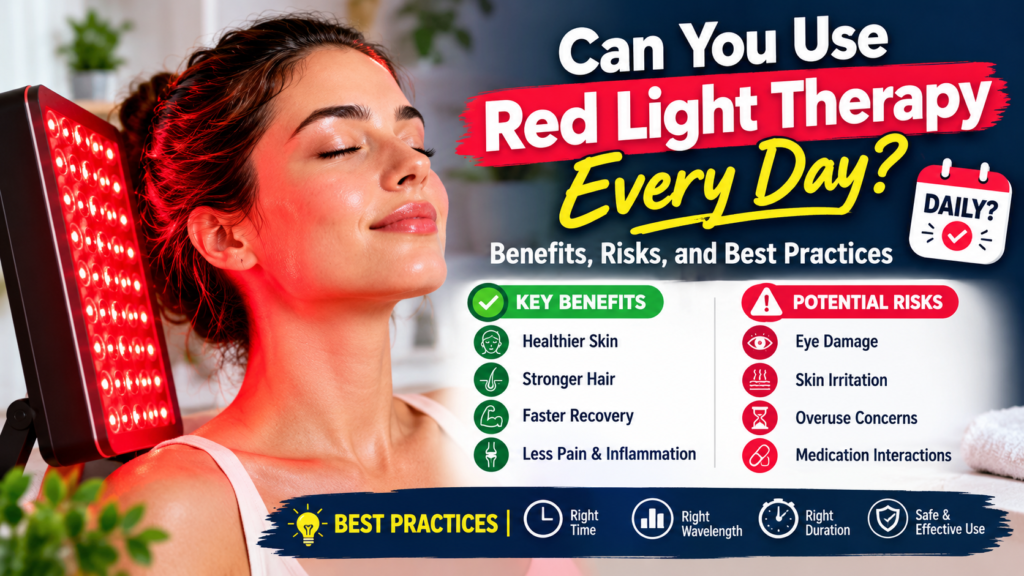
Can You Use Red Light Therapy Every Day?
Whether daily red light therapy is appropriate depends on several variables that differ from one device to the next. A low-power LED face mask delivering gentle irradiance over a 10-minute session may be cleared for daily use, while a higher-output panel designed for deeper tissue penetration may require rest days between treatments.
Key factors that influence the recommended schedule include:
- Power output (irradiance): Higher-intensity devices deliver more energy per minute, which may mean fewer sessions are needed.
- Wavelength combination: Devices that combine red (630–700 nm) and near-infrared (700–1100 nm) light may have different protocols than single-wavelength tools.
- Treatment area and goal: A targeted acne protocol may differ from a full-face anti-aging routine.
- Session duration: A three-minute treatment and a 20-minute treatment are not interchangeable, even on the same device.
Red light therapy is also a subset of the broader category of LED light therapy, which can include blue, amber, and green wavelengths. Each wavelength interacts with skin differently, so a multi-color LED mask may carry different frequency guidance than a dedicated red-light device. If you are exploring how often to use an LED face mask safely, the same principle applies: your device’s manual is the most reliable starting point.
What Happens If You Use Red Light Therapy Every Day?
When used according to a device’s tested protocol, daily red light therapy may support consistent stimulation of cellular energy production. Red and near-infrared wavelengths are absorbed by mitochondria, which can increase adenosine triphosphate (ATP) output and promote processes associated with skin repair and collagen synthesis.
However, photobiomodulation research describes a biphasic dose response: a beneficial range of light exposure exists, but exceeding that range does not produce proportionally greater results and may reduce effectiveness or cause irritation. In practical terms, doubling your session time or adding extra daily sessions is unlikely to accelerate your progress and could increase the risk of side effects.
The long-term effects of daily at-home use over months or years remain insufficiently studied. Most published clinical trials evaluate treatment courses of four to twelve weeks, and clinical research on the safety of red LED light emphasizes that appropriate dosing is critical to avoiding adverse outcomes.
Daily Use vs. Three to Five Sessions Per Week
There is no single schedule that applies to every red light therapy device. The table below outlines general scenarios — not medical prescriptions.
| Factor | Daily Use May Be Appropriate When | 3–5 Sessions/Week May Be Appropriate When |
|---|---|---|
| Device power | Lower irradiance, gentle LED masks | Higher-output panels or clinical-grade devices |
| Session length | Short sessions (3–10 minutes) | Longer sessions (10–20+ minutes) |
| Manufacturer guidance | Label explicitly permits daily use | Label recommends rest days between sessions |
| User experience | Established tolerance with no irritation | Beginner users building up gradually |
| Treatment goal | Maintenance or mild concerns | Targeted concerns requiring higher cumulative doses |
The most important takeaway is that neither schedule is universally superior. A device engineered for daily 10-minute sessions and a device engineered for 20-minute sessions three times a week may deliver comparable total weekly energy. If you are looking for red light therapy devices for a short skincare routine, check each product’s recommended frequency before assuming daily use is ideal.
Potential Benefits of Regular Red Light Therapy
Consistent use of red light therapy within the recommended dose range has been associated with several skin improvements in clinical settings. According to the Cleveland Clinic’s overview of red light therapy benefits and risks, studied applications include:
- Fine lines and wrinkles: Some trials report modest improvements in skin smoothness and collagen density after several weeks of regular treatment.
- Skin texture and tone: Users may notice a more even complexion and reduced roughness over time.
- Acne management: Red light’s anti-inflammatory properties may complement blue-light treatments for mild to moderate breakouts.
- Wound healing and recovery: Red and near-infrared wavelengths have shown promise in supporting tissue repair, though most evidence comes from clinical rather than at-home settings.
It is important to distinguish promising early findings from definitive proof. Many at-home studies are small, short-term, or funded by device manufacturers. If you are curious about whether LED face masks really work, a realistic expectation is gradual, subtle improvement rather than dramatic transformation.
Risks and Side Effects of Using Red Light Therapy Too Often
Red light therapy is generally well tolerated, but overuse or incorrect application can lead to unwanted effects. The American Academy of Dermatology’s red light therapy guidance notes that potential concerns include:
- Skin irritation and redness: Excessive exposure may cause temporary warmth, flushing, or dryness, particularly on sensitive areas.
- Pigmentation changes: Individuals with darker skin tones or a history of melasma may experience uneven pigmentation if sessions are too frequent or too intense.
- Eye strain or damage: Direct exposure to bright LEDs without appropriate eye protection can pose a risk to the eyes over time. Healthline’s review of red light therapy safety highlights the importance of shielding the eyes during treatment.
- Diminished returns: As noted above, exceeding the optimal dose range may actually reduce the therapy’s effectiveness rather than enhance it.
If you notice persistent redness, increased breakouts, darkening of pigmented areas, or eye discomfort, discontinue use and consult a dermatologist.
How to Use Red Light Therapy Safely at Home
Follow this checklist every time you use an at-home device:
- Read the exact device manual. Protocols vary significantly between brands and models. Do not assume one device’s schedule applies to another.
- Follow the prescribed session length and frequency. Set a timer if your device does not auto-shutoff.
- Cleanse your skin before treatment. Remove makeup, sunscreen, and heavy serums that could block light absorption, unless your device instructions state otherwise.
- Use recommended eye protection. Many devices include goggles or built-in eye shields. Use them consistently.
- Do not add extra sessions to compensate for missed treatments. Skipping a day is fine; doubling up is not recommended.
- Monitor your skin’s response. Keep a simple log of any redness, dryness, or irritation after each session.
- Check medication and medical-condition precautions with a qualified clinician. Some prescription drugs and supplements increase photosensitivity.
For a reliable starting point, consider exploring portable red light therapy devices for home use that come with clear, tested usage guidelines. Harvard Health Publishing’s advice on red light therapy for skincare also recommends starting conservatively and consulting a professional if you have underlying skin conditions.
Who Should Be Extra Careful?
Certain individuals should seek professional guidance before starting any light-based treatment:
- Photosensitivity disorders: Conditions such as lupus or porphyria can make the skin unusually reactive to light exposure.
- Photosensitizing medications: Common drugs including some antibiotics, retinoids, and diuretics may increase light sensitivity.
- Eye conditions: Pre-existing retinal or corneal issues may warrant additional precautions beyond standard eye protection.
- Darker skin tones with pigmentation concerns: While red light therapy is generally considered safe across skin types, individuals prone to post-inflammatory hyperpigmentation should start with shorter, less frequent sessions and monitor for changes.
- Active skin infections or open wounds: Consult a clinician before applying light therapy to compromised skin.
These considerations do not mean that everyone in these groups must avoid red light therapy entirely. They do mean that personalized medical advice is the safest path forward.
How Long Does It Take to See Results?
Timelines vary widely depending on the device, the skin concern being addressed, and individual biology. Some users report subtle improvements in skin texture and radiance within two to four weeks of consistent use. More significant changes in fine lines or acne may take eight to twelve weeks or longer.
There is no guaranteed timeline, and results are not universal. Consistency within the recommended protocol matters more than aggressive frequency. If you see no change after the duration suggested by your device manufacturer, it may be worth evaluating whether the device, wavelength, or treatment goal needs adjustment — not simply adding more sessions.
Should You Take Breaks Between Red Light Therapy Sessions?
There is no universal rest-day rule that applies to every device. Some manufacturers design their protocols around daily use with no scheduled breaks, while others build in recovery days. Follow the guidance specific to your device.
If you experience any adverse skin reactions — persistent redness, increased sensitivity, or unexpected pigmentation — reduce frequency or pause treatment entirely until your skin recovers. A short break of several days is unlikely to erase weeks of progress and gives your skin time to respond to the cumulative light exposure it has already received.
Best Practices for Different Skin Goals
- Anti-aging and fine lines: Consistency over several weeks is key. Look for LED face masks for wrinkles and firmer-looking skin that specify red and near-infrared wavelengths and follow the manufacturer’s anti-aging protocol closely.
- Acne-prone skin: Red light may help reduce inflammation, but many acne-focused devices combine red and blue wavelengths. Check out LED face masks for acne-prone skin and follow the device’s acne-specific schedule, which may differ from its anti-aging mode.
- Sensitive skin and redness: Start with the shortest recommended session at the lowest frequency. LED face masks for sensitive skin and redness often feature gentler irradiance levels and shorter default timers. Increase exposure only if your skin tolerates the initial sessions well.
- General maintenance: Once you have achieved your initial goals, some users transition to a reduced maintenance schedule. Your device manual may include guidance for long-term upkeep.
Frequently Asked Questions
1. Is it safe to use red light therapy every day?
It can be safe if your specific device is designed and tested for daily use. Always follow the manufacturer’s instructions rather than assuming daily use is appropriate for every product.
2. Can I use a red light therapy mask twice a day?
Most at-home devices are not designed for twice-daily use. Doubling your sessions increases total light exposure beyond the tested protocol and may cause irritation without improving results.
3. Is 10 minutes of red light therapy every day too much?
Not necessarily. Many LED face masks are designed for 10-minute daily sessions. Whether this is appropriate for you depends on your device’s power output and the manufacturer’s tested guidelines.
4. Is red light therapy better every day or every other day?
Neither schedule is universally better. The optimal frequency depends on your device’s irradiance, session duration, and the treatment protocol validated by the manufacturer.
5. Can daily red light therapy damage your skin?
Excessive or incorrectly administered exposure can cause irritation, redness, and pigmentation changes. Following the recommended dose minimizes this risk.
6. Should I take breaks from red light therapy?
Follow your device’s protocol. If the manufacturer recommends rest days, take them. If you experience adverse reactions, pause use until your skin recovers.
7. Can I use red light therapy if I have sensitive skin?
Many people with sensitive skin tolerate red light therapy well, but it is wise to start with shorter, less frequent sessions and monitor your skin’s response carefully.
8. How long does it take for red light therapy to work?
Most users need four to twelve weeks of consistent use to notice visible changes. Results vary by device, skin concern, and individual factors.
9. Do I need eye protection when using red light therapy?
Yes. Bright LED light can strain or damage the eyes over time. Use the goggles or eye shields provided with your device during every session.
10. Is FDA clearance a guarantee that a red light device works?
No. FDA clearance indicates that a device is substantially equivalent to an already-marketed device and meets safety standards. It does not independently verify every efficacy claim made by the manufacturer. If you want to learn more, explore FDA-cleared LED face masks for home skincare and review the specific clearances each product holds.
Conclusion
Consistency is the foundation of effective red light therapy, but more exposure is not automatically better. The safest and most productive approach is to follow your device’s specific instructions, start conservatively if you are a beginner, and resist the urge to add extra sessions in pursuit of faster results. Pay attention to how your skin responds, protect your eyes during every treatment, and consult a dermatologist or qualified clinician if you have medical conditions, take photosensitizing medications, or experience persistent side effects. Red light therapy can be a valuable addition to a thoughtful skincare routine when used responsibly and with realistic expectations.
Disclaimer: This article is for informational purposes only and does not constitute medical advice. Individual results vary. Consult a qualified healthcare professional before beginning any new treatment, especially if you have a medical condition, take prescription medications, or have concerns about skin or eye health.
SEO Deliverables
1. Primary Focus Keyword
Can you use red light therapy every day
2. Secondary Keywords
- Is red light therapy safe to use daily
- Red light therapy side effects
- How often should you use red light therapy
- Can you overuse red light therapy
- Daily LED face mask use
- Red light therapy for wrinkles
- Red light therapy at home
- Red light therapy best practices
3. SEO Title
Can You Use Red Light Therapy Every Day? Benefits, Risks & Best Practices
4. Meta Description
Is daily red light therapy safe? Learn how device type, session length, and skin goals affect frequency, plus expert-backed tips for safe at-home use.
5. URL Slug
can-you-use-red-light-therapy-every-day
6. Featured Image Alt Text
Woman using a red LED light therapy face mask at home with eyes protected
7. Five FAQs for Structured Data
- Is it safe to use red light therapy every day? It can be safe if your device is designed for daily use. Always follow the manufacturer’s tested protocol.
- Can you overuse red light therapy? Yes. Exceeding the recommended dose can cause irritation and may reduce effectiveness due to the biphasic dose response.
- How often should you use red light therapy? Frequency depends on your device’s power output, session length, and the manufacturer’s instructions. Common schedules range from daily to three times per week.
- How long does it take for red light therapy to work? Most users need four to twelve weeks of consistent use to notice visible improvements in skin texture, fine lines, or acne.
- Do I need eye protection for red light therapy? Yes. Use the goggles or shields provided with your device to protect your eyes from bright LED exposure during every session.
8. Link Audit
Internal Links Used:
| # | URL | Anchor Text | Verified |
|---|---|---|---|
| 1 | https://sylomaskincare.com/how-often-use-led-face-mask/ | how often to use an LED face mask safely | Not live-verified; URL matches supplied slug |
| 2 | https://sylomaskincare.com/best-red-light-therapy-devices-10-minute-routine/ | red light therapy devices for a short skincare routine | Not live-verified; URL matches supplied slug |
| 3 | https://sylomaskincare.com/best-portable-red-light-therapy-devices-face/ | portable red light therapy devices for home use | Not live-verified; URL matches supplied slug |
| 4 | https://sylomaskincare.com/do-led-face-masks-really-work/ | whether LED face masks really work | Not live-verified; URL matches supplied slug |
| 5 | https://sylomaskincare.com/best-led-face-masks-wrinkles-firm-skin-2026/ | LED face masks for wrinkles and firmer-looking skin | Not live-verified; URL matches supplied slug |
| 6 | https://sylomaskincare.com/best-led-face-masks-acne-prone-skin-2026/ | LED face masks for acne-prone skin | Not live-verified; URL matches supplied slug |
| 7 | https://sylomaskincare.com/best-led-face-masks-sensitive-skin-redness/ | LED face masks for sensitive skin and redness | Not live-verified; URL matches supplied slug |
| 8 | https://sylomaskincare.com/best-fda-cleared-led-face-masks-at-home-skincare/ | FDA-cleared LED face masks for home skincare | Not live-verified; URL matches supplied slug |
Note: All eight internal links use the exact URLs supplied in the brief. Live page verification was not possible in this environment. Please confirm each destination loads correctly and that the surrounding anchor text matches the page content before publishing.
External Links Used:
| # | URL | Anchor Text | Verified |
|---|---|---|---|
| 1 | https://pmc.ncbi.nlm.nih.gov/articles/PMC8887049/ | clinical research on the safety of red LED light | Known PMC article; supports safety and dosing claims |
| 2 | https://my.clevelandclinic.org/health/articles/22114-red-light-therapy | Cleveland Clinic’s overview of red light therapy benefits and risks | Known Cleveland Clinic article; supports benefits discussion |
| 3 | https://www.aad.org/public/cosmetic/safety/red-light-therapy | American Academy of Dermatology’s red light therapy guidance | Known AAD page; supports safety and side-effect claims |
| 4 | https://www.healthline.com/health/red-light-therapy | Healthline’s review of red light therapy safety | Known Healthline article; supports eye-safety discussion |
| 5 | https://www.health.harvard.edu/skin-and-hair-health/red-light-therapy-for-skin-care | Harvard Health Publishing’s advice on red light therapy for skincare | Known Harvard Health article; supports conservative-use guidance |
9. Originality and Content-Gap Checklist
- Direct answer upfront: The article opens with a clear, device-dependent answer rather than a vague “it depends” or a one-size-fits-all recommendation.
- Red light vs. LED distinction: Explicitly clarifies that red light therapy is a subset of broader LED light therapy, a nuance most competitor articles gloss over.
- Biphasic dose response explained: Introduces the concept that more light ≠ better results, grounded in photobiomodulation research — a gap in most consumer-facing guides.
- Session duration vs. frequency vs. total exposure: Separates these three variables clearly, helping readers understand why a 10-minute daily session and a 20-minute thrice-weekly session may deliver comparable weekly doses.
- No universal schedule prescribed: The comparison table presents scenarios rather than medical directives, avoiding the common competitor error of declaring one frequency “best.”
- FDA clearance vs. effectiveness: Directly addresses the misconception that FDA clearance guarantees a device delivers on every marketing claim.
- Skin-type-specific guidance: Provides tailored starting points for sensitive, acne-prone, mature, and pigmentation-prone skin rather than generic advice.
- Evidence limitations acknowledged: Clearly states that long-term home-use data is limited and that many studies are small or manufacturer-funded.
- Broader scope than the existing Syloma LED mask frequency article: This piece covers panels, wands, and clinical context alongside masks, addresses medical precautions in depth, and includes a comprehensive FAQ section — making it a standalone pillar page rather than a duplicate of the mask-specific guide.