
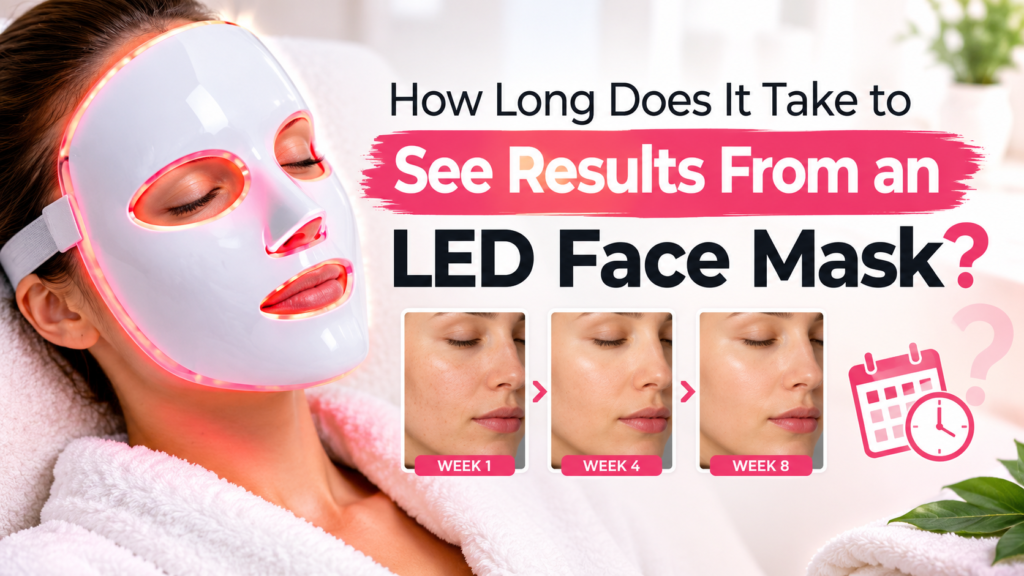
Most people need at least 8 to 12 weeks of consistent use before they can fairly judge whether an LED face mask is working for them. Some users notice subtle changes in skin radiance or acne within the first few weeks, but meaningful improvements in fine lines, texture, and tone generally require sustained treatment. Results depend heavily on the device, the skin concern being addressed, and individual biology — so treat any single timeline as a rough guide, not a guarantee. For a broader look at the evidence, it helps to understand whether LED face masks really work before setting expectations.
How Long Does It Take to See LED Face Mask Results?
The table below outlines a general LED face mask results timeline based on commonly reported patterns in clinical research and manufacturer guidance. Individual experiences will vary.
| Time Using the Mask | What You Might Notice | What to Realistically Expect |
|---|---|---|
| First few sessions | Slight warmth, temporary glow immediately after use | No structural skin changes; any radiance is likely from short-term increases in circulation |
| Weeks 2–3 | Fewer active breakouts for some acne-prone users | Anti-aging benefits are not yet visible; early acne response is possible but not universal |
| Around week 4 | Subtle improvements in skin smoothness or clarity for some users | Still too early for a fair evaluation; LED face mask results after 4 weeks are often modest |
| Weeks 6–8 | More noticeable shifts in texture, tone, or breakout frequency | Consistent users may begin to see real changes; LED face mask results after 8 weeks offer a more reliable snapshot |
| Weeks 8–12 and beyond | Softening of fine lines, more even tone, calmer skin for some | This is the window where a fair assessment is possible; improvements tend to be gradual and subtle |
An important distinction: the temporary “glow” many people see right after a session is not the same as longer-term collagen remodeling or pigment correction. That post-treatment radiance usually fades within hours. Lasting changes in skin structure take repeated exposure over weeks.
What Results Can You Expect for Different Skin Concerns?
Fine Lines and Wrinkles
Red and near-infrared wavelengths are the most studied for anti-aging, and clinical research suggests they may support collagen production over time. However, visible softening of fine lines typically takes at least 8–12 weeks of regular use, and the changes are often subtle compared to in-office procedures. If reducing wrinkles is your primary goal, exploring LED face masks for wrinkles and firm skin can help you find a device designed for that purpose. A 2026 systematic review of LED light therapy concluded that while the evidence is promising, study quality varies and results are not uniform across devices.
Acne and Breakouts
Blue light targets Cutibacterium acnes, the bacteria involved in inflammatory breakouts, and some users report fewer active blemishes within two to four weeks. Red light may also help calm post-breakout redness. That said, LED therapy is generally considered a complementary approach for mild to moderate acne, not a standalone treatment for severe cases. A peer-reviewed clinical study on LED phototherapy found improvements in acne severity with consistent use, though individual responses varied. For targeted options, see our guide to LED face masks for acne-prone skin.
Skin Texture and Radiance
Improved smoothness and a more reflective skin surface are among the earliest changes some users report, often around weeks 4–6. These improvements may relate to enhanced cellular turnover and circulation. However, texture changes driven by deep scarring or significant sun damage are unlikely to respond meaningfully to at-home LED alone.
Redness and Uneven Skin Tone
Red and amber wavelengths may help reduce visible redness and support a more even complexion over time. Users with rosacea-related flushing or post-inflammatory hyperpigmentation sometimes notice gradual improvement after 6–8 weeks. For pigment-specific concerns, LED masks for dark spots and uneven skin tone can provide more targeted guidance. Results for hyperpigmentation tend to be slower and less predictable than for acne.
Firmness and Skin Elasticity
Claims about firmer, more elastic skin are common in LED marketing, but structural changes in the dermis take time and are difficult to confirm by appearance alone. Any perceived improvement in firmness within the first few weeks is more likely related to hydration and temporary plumping than to new collagen formation. A fair evaluation of firmness benefits requires at least 12 weeks.
Why Do LED Face Mask Results Take Time?
LED light therapy works by delivering specific wavelengths of light energy to skin cells, which may stimulate mitochondrial activity and support processes like collagen synthesis and inflammation reduction. These biological changes happen incrementally. Collagen remodeling, for example, is a slow process that unfolds over weeks and months — not days.
At-home devices also deliver lower energy doses than professional in-office treatments, which means each session produces a smaller effect. The Cleveland Clinic notes that LED light therapy is generally safe and non-invasive but emphasizes that multiple sessions are needed and that results are not guaranteed. Device quality, wavelength accuracy, and treatment dose all influence how quickly — or whether — you see changes.
What Factors Affect How Quickly You See Results?
Several variables influence your personal LED face mask results timeline:
- Device specifications and fit. Wavelength accuracy, irradiance (power output), and how closely the mask sits against your skin all affect the dose your skin receives. Not all LED masks are built to the same standard. If you are still shopping, choosing the right LED face mask matters more than brand name alone.
- Consistency. Skipping sessions or using the mask irregularly slows progress. Most protocols require multiple sessions per week over several weeks.
- Starting skin condition. Someone with mild texture concerns may notice changes sooner than someone addressing deeper wrinkles or longstanding hyperpigmentation.
- Skincare routine and sun protection. LED therapy works best as part of a sensible routine that includes daily sunscreen. UV damage can counteract the benefits you are trying to build.
- Individual biology. Age, skin type, genetics, and overall health all play a role in how your skin responds.
How Often Should You Use an LED Face Mask for Best Results?
There is no universal schedule. Some manufacturers recommend three to five sessions per week, while others suggest daily use for an initial period followed by a maintenance phase. For example, Omnilux recommends specific treatment protocols that vary depending on the device model and the concern being treated.
The most important rule is to follow the instructions that came with your specific mask. More frequent or longer sessions do not necessarily accelerate results and may increase the risk of irritation. For a deeper dive into scheduling, read our guide on how often to use an LED face mask.
How to Track Your LED Face Mask Results
Because changes are gradual, relying on memory alone makes it easy to miss subtle improvements — or to overestimate them. Try these steps:
- Take baseline photos before your first session. Use natural, indirect light and the same angle each time. Avoid filters or editing.
- Photograph at consistent intervals — every two to four weeks is reasonable. Weekly photos often look too similar to be useful.
- Keep a simple treatment log noting the date, duration, and any skin observations after each session.
- Compare photos side by side at the 8-week and 12-week marks rather than day to day.
- Evaluate one concern at a time. Trying to assess acne, wrinkles, and pigmentation simultaneously can make progress harder to judge.
What If Your LED Face Mask Is Not Working?
If you have reached the 8–12 week mark with no noticeable change, consider the following before giving up:
- Have you been consistent? Gaps in treatment are the most common reason for disappointing results.
- Are your expectations realistic? At-home LED devices produce subtle changes, not dramatic transformations.
- Is the device appropriate for your concern? A mask that emits only red light will not address acne the way a blue-light device might.
- Are you using the mask correctly? Distance from the skin, session duration, and clean skin all matter.
- Could another factor be interfering? New skincare products, hormonal changes, or sun exposure can mask improvements.
If you have addressed all of the above and still see no benefit, it may be worth consulting a board-certified dermatologist. The American Academy of Dermatology notes that the evidence for at-home LED devices is more limited than for professional treatments, and a dermatologist can help you determine whether a different approach would be more effective for your skin.
Do LED Face Mask Results Last After You Stop Using It?
The durability of LED face mask results is not well established in long-term studies. Most manufacturers recommend ongoing maintenance sessions — often one to three times per week — after an initial treatment period. It is reasonable to expect that some benefits, particularly those related to active acne management, may diminish if treatment stops entirely. Structural improvements like modest collagen support may persist longer but are unlikely to be permanent given the natural aging process.
LED Face Mask Safety: What to Know
LED light therapy is considered low-risk for most people when used as directed. Key safety points include:
- Follow the manufacturer’s eye-safety instructions. Some masks include built-in eye protection; others require separate goggles.
- Be cautious if you take photosensitizing medications or have a condition that increases light sensitivity. Check with your healthcare provider if you are unsure.
- Stop use and seek advice if you experience persistent redness, irritation, or unexpected pigmentation changes.
- Do not use LED therapy as a substitute for professional dermatological care for serious skin conditions, suspicious lesions, or severe acne.
Frequently Asked Questions
Can you see LED face mask results in 2 weeks?
Some users with acne-prone skin may notice fewer active breakouts within two weeks, but anti-aging and pigmentation improvements are unlikely this early. Two weeks is generally too soon for a fair assessment of most concerns.
Is 4 weeks enough to see LED mask results?
LED face mask results after 4 weeks may include subtle improvements in skin smoothness or clarity for some users, but this is still early in the treatment process. Most experts suggest waiting at least 8 weeks before drawing conclusions.
How long does red light therapy take to improve wrinkles?
Red light therapy results for wrinkles typically require a minimum of 8–12 weeks of consistent use, and changes tend to be modest with at-home devices. Deeper wrinkles may not respond significantly without professional treatment.
How long does an LED mask take to help acne?
Acne-related improvements are among the fastest to appear, with some users reporting fewer breakouts within 2–4 weeks. Consistency is critical, and results vary depending on acne severity and the wavelengths used.
Should I use my LED face mask every day?
Not necessarily. Follow your specific device’s instructions. Some masks are designed for daily use, while others recommend three to five sessions per week. More frequent use does not automatically mean faster results.
What if I see no results after 8 weeks?
Review your consistency, device suitability, and treatment technique. Ensure you are using the mask on clean skin at the recommended distance. If everything checks out and you still see no change after 12 weeks, consult a dermatologist for personalized guidance.
Do LED face mask results last permanently?
No. LED therapy results are not permanent. Maintenance sessions are generally recommended to sustain benefits, and natural aging and environmental factors will continue to affect your skin over time.
Can using an LED mask for longer produce faster results?
Increasing session duration or frequency beyond the manufacturer’s recommendations has not been shown to reliably speed up results and may increase the risk of skin irritation. Stick to the prescribed protocol.
Conclusion
How long does it take to see results from an LED face mask? For most people, a fair evaluation requires 8 to 12 weeks of consistent, correctly performed sessions. Early changes may be subtle and limited to temporary radiance or minor acne improvement, while longer-term shifts in texture, tone, and fine lines develop gradually. Results are not guaranteed, and at-home devices have real limitations compared to professional treatments. Follow your device’s instructions, track your progress with photos, and keep expectations grounded. If LED therapy does not deliver the results you hoped for, a dermatologist can help you explore other evidence-based options.
SEO Metadata
SEO Title: How Long Does It Take to See Results From an LED Face Mask?
Meta Description: LED face mask results typically take 8–12 weeks of consistent use. Learn what to expect at each stage, why timelines vary, and how to track progress.
URL Slug: led-face-mask-results-timeline
Focus Keyword: how long does it take to see results from an LED face mask
Secondary Keywords: LED face mask results timeline, how long does red light therapy take to work, LED mask before and after, red light therapy results for wrinkles, LED face mask results after 4 weeks, LED face mask results after 8 weeks, how often to use an LED face mask, when to expect LED mask results
WordPress Excerpt: Most LED face mask users need 8–12 weeks of consistent treatment to fairly assess results. This guide breaks down what to expect at each stage, how timelines differ by skin concern, and what to do if you are not seeing improvement.
Featured Image Concept: A split-frame photograph showing a woman holding an LED face mask on one side and a close-up of healthy, natural skin on the other, with soft warm lighting. The image should feel editorial and realistic, not overly retouched.
Alt Text: Woman holding a red LED face mask next to her face with natural skin visible, illustrating the LED face mask results timeline
Link Audit
Internal Links
| Anchor Text | Destination URL |
|---|---|
| whether LED face masks really work | https://sylomaskincare.com/do-led-face-masks-really-work/ |
| LED face masks for wrinkles and firm skin | https://sylomaskincare.com/best-led-face-masks-wrinkles-firm-skin-2026/ |
| LED face masks for acne-prone skin | https://sylomaskincare.com/best-led-face-masks-acne-breakouts-2026/ |
| LED masks for dark spots and uneven skin tone | https://sylomaskincare.com/led-face-masks-hyperpigmentation-dark-spots/ |
| choosing the right LED face mask | https://sylomaskincare.com/ultimate-led-face-mask-buying-guide/ |
| how often to use an LED face mask | https://sylomaskincare.com/how-often-use-led-face-mask/ |
External Links
| Anchor Text | Destination URL |
|---|---|
| 2026 systematic review of LED light therapy | https://link.springer.com/article/10.1007/s00266-026-06333-w |
| peer-reviewed clinical study on LED phototherapy | https://pmc.ncbi.nlm.nih.gov/articles/PMC11835066/ |
| Cleveland Clinic notes that LED light therapy | https://my.clevelandclinic.org/health/treatments/22146-led-light-therapy |
| Omnilux recommends specific treatment protocols | https://omniluxled.com/pages/led-light-therapy-how-it-works-omnilux |
| American Academy of Dermatology notes | https://www.aad.org/public/cosmetic/safety/red-light-therapy |