
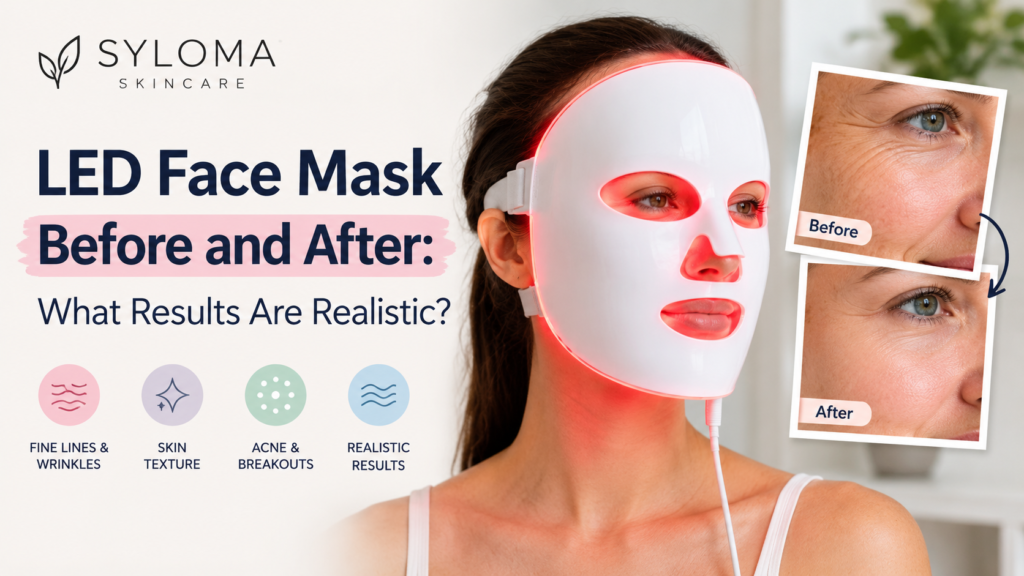
If you’ve been scrolling through LED face mask before and after photos online, you’ve probably seen some dramatic transformations — and some that look suspiciously similar to a good filter. Before you invest in an at-home light therapy device, it’s worth understanding what changes are genuinely supported by research, what timelines are realistic, and why some results look more impressive in photographs than they do in the mirror.
The short answer: LED face masks can produce modest, gradual improvements in skin texture, fine lines, and acne for many users. They are not a substitute for professional procedures, and the most dramatic before-and-after images you see online often involve factors beyond the mask itself. Here’s what the evidence actually shows.
What Can an LED Face Mask Realistically Improve?
Fine lines and wrinkles
Red and near-infrared light therapy has the strongest evidence base for addressing early signs of aging. The wavelengths most commonly used in at-home masks — typically red light around 630–660 nm and near-infrared around 810–850 nm — are thought to stimulate cellular energy production in the skin, which may support collagen synthesis over time. For fine lines around the eyes and forehead, consistent use over several weeks may produce subtle softening. If you’re specifically targeting signs of aging, exploring the best LED face masks for mature skin and fine lines can help you compare devices designed for this purpose.
Skin texture and overall appearance
Many users report that their skin looks smoother and more even-toned after a few weeks of regular LED use. This is one of the more commonly noted LED face mask results, and it aligns with the general understanding that photobiomodulation may improve cellular turnover and reduce low-grade inflammation in the skin.
Redness and uneven-looking tone
Red light therapy has shown some promise for calming visible redness, particularly in people with mild rosacea or post-inflammatory erythema. However, the evidence is less robust than for fine lines, and results tend to be subtle. Anyone with persistent or severe redness should consult a dermatologist before relying on an at-home device.
Acne and breakouts
Blue light LED therapy targets Cutibacterium acnes, the bacteria involved in inflammatory breakouts. A comprehensive evidence review of home-based dermatologic devices for acne and facial rejuvenation found that at-home LED devices can be a useful adjunct for mild to moderate acne, though results vary depending on the device and the individual. If breakouts are your primary concern, our guide to the best LED face masks for acne and breakouts in 2026 breaks down which features matter most.
Sagging skin, deep wrinkles, and claims that need caution
This is where expectations need the most adjustment. At-home LED masks deliver significantly less energy than in-office treatments, and there is limited evidence that they can meaningfully tighten sagging skin or erase deep folds. Claims of facelift-like results from a consumer LED mask are not well supported by independent research.
LED Face Mask Before and After: What the Research Shows
A systematic review of at-home LED photobiomodulation for facial rejuvenation examined multiple studies on consumer-grade light therapy devices and found that consistent use was associated with measurable improvements in skin elasticity, wrinkle depth, and overall texture. However, the review also noted significant variation in study quality, device specifications, and treatment protocols, making it difficult to generalize results across all products on the market.
In a more rigorous randomized, double-blind, sham-controlled clinical study of an at-home LED and infrared mask for crow’s feet, researchers compared a real LED and infrared mask against a sham device. The study found statistically significant improvements in the appearance of crow’s feet wrinkles in the active treatment group compared to the sham group — a meaningful finding because sham-controlled designs help rule out the placebo effect. That said, the improvements were modest, not the kind of dramatic transformation you might see in a marketing photo.
It is important to distinguish between independently published research like these studies and manufacturer-sponsored trials or marketing materials. Harvard Health Publishing’s overview of red light therapy for skin care offers a balanced perspective, noting that while the science behind photobiomodulation is promising, consumers should temper their expectations and recognize that at-home devices are less powerful than clinical-grade equipment. For a deeper dive into the overall evidence, our article on whether LED face masks really work covers the topic in detail.
How Long Does It Take to See LED Mask Results?
One of the most common questions is how long an LED face mask takes to work. The answer depends on your skin concerns, the device you’re using, and how consistently you follow the treatment protocol. Here’s a realistic LED light therapy results timeline based on the available research and typical user experiences:
| Timeframe | What You Might Notice | What Likely Hasn’t Changed | Evidence Confidence |
|---|---|---|---|
| First few sessions | A temporary healthy glow, possibly reduced puffiness. Skin may feel calm. | Fine lines, wrinkles, acne, and texture remain essentially unchanged. | Low — immediate effects are likely related to increased circulation and hydration, not structural skin changes. |
| Around 4 weeks | Skin may look slightly smoother and more even. Some users notice fewer active breakouts with blue light. | Deep wrinkles and sagging are unlikely to show visible improvement. | Moderate — early changes are subtle and may be difficult to distinguish from normal skin fluctuation. |
| Around 8 weeks | Fine lines may appear slightly softened. Skin texture and tone may look more uniform. Acne may be calmer. | Significant wrinkle reduction or skin tightening is still unlikely. | Moderate to high — this is the timeframe where several clinical studies begin to report measurable differences. |
| Around 12–16 weeks | Cumulative improvements in fine lines, elasticity, and overall skin quality may become more apparent. | Deep folds and significant volume loss will not be reversed. | Moderate — longer studies show continued gradual improvement, but individual results vary widely. |
| Longer-term maintenance | Continued use helps maintain results. Stopping treatment may lead to gradual fading over weeks to months. | LED therapy does not stop the natural aging process. | Moderate — maintenance protocols are recommended by most researchers, but long-term at-home data is still limited. |
For guidance on how frequently to use your device, our article on how often you should use an LED face mask explains typical treatment schedules.
Why Some Before-and-After Photos Look Dramatic
If the research shows modest improvements, why do some red light therapy mask before and after photos look so striking? Several factors can create the illusion of dramatic change:
- Lighting differences: Warm, diffused lighting in the “after” photo smooths skin texture and minimizes shadows that highlight wrinkles, while harsh overhead lighting in the “before” photo does the opposite.
- Camera angles and distance: Even a slight change in angle can alter the appearance of jawline definition, under-eye hollows, and nasolabial folds.
- Makeup and skincare: The “after” photo may feature concealer, primer, or a fresh layer of moisturizer that temporarily plumps the skin.
- Facial expressions: A relaxed smile versus a tense, neutral expression can dramatically change how wrinkles appear.
- Filters and retouching: Many social media images use beauty filters or editing apps, sometimes without disclosure.
- Hydration and time of day: Skin looks different in the morning versus the evening and after a glass of water versus a salty meal.
None of this means LED masks don’t work. It means that photographs alone — especially those provided by manufacturers — are not reliable evidence of effectiveness.
How to Take Honest LED Face Mask Before-and-After Photos
If you want to track your own LED face mask results fairly, follow these guidelines to make your progress photos as consistent as possible:
- Use the same room and the same light source every time. Natural daylight from a window is ideal.
- Photograph at approximately the same time of day to minimize natural skin fluctuation.
- Keep the camera at the same distance and angle. A phone propped on a shelf works better than a handheld selfie.
- Use the same camera and settings. Avoid switching between front and rear cameras.
- Photograph clean, bare skin without makeup, sunscreen, or freshly applied serums.
- Keep your facial expression neutral and consistent across all photos.
- Turn off all beauty filters, portrait modes, and automatic retouching.
- Record the device model, treatment dates, session duration, and frequency alongside your photos.
- Try to keep your other skincare products and habits as consistent as practical during the tracking period.
- Compare photos at planned intervals — such as 4, 8, and 12 weeks — rather than scrutinizing daily changes.
These steps won’t turn your bathroom into a clinical research lab, but they will give you a much more honest picture of your progress than a casual selfie comparison.
Why Results Vary Between People and Devices
Not all LED face masks are created equal, and not all skin responds the same way. Key variables include:
- Wavelength and irradiance: The specific wavelengths and the power output of the LEDs determine how much energy actually reaches your skin. A device with weak output may not deliver a therapeutic dose regardless of how long you wear it.
- Treatment consistency: Skipping sessions or using the mask irregularly will slow or prevent results.
- Skin type and concern: A 30-year-old with mild acne will see a different trajectory than a 55-year-old targeting deep wrinkles.
- Overall skincare routine: LED therapy works best as part of a consistent routine that includes sunscreen, gentle cleansing, and appropriate moisturization.
- Device quality and FDA clearance: When shopping, look for devices that have been cleared by the FDA. Our roundup of the best FDA-cleared LED face masks for at-home skincare explains what clearance actually means — and what it doesn’t guarantee.
Are LED Face Mask Results Permanent?
No. LED light therapy does not permanently alter your skin’s aging trajectory. The improvements you see are the result of ongoing cellular stimulation, and most evidence suggests that benefits gradually diminish if you stop treatment entirely. Many dermatologists and researchers recommend a maintenance schedule — such as a few sessions per week — after the initial treatment period to sustain results.
LED Face Mask Side Effects and Safety Precautions
LED light therapy is generally considered low-risk for most skin types. The American Academy of Dermatology notes that red light therapy is safe for most people when used as directed, with minimal reported side effects. However, a few precautions are worth keeping in mind:
- Wear the eye protection provided with your device, especially if it includes near-infrared or blue light wavelengths.
- Avoid using the mask over active skin infections, open wounds, or areas where you’ve recently applied photosensitizing medications or topical retinoids without consulting your dermatologist.
- If you have a history of melasma or hyperpigmentation, proceed cautiously, as some wavelengths may worsen pigmentation in susceptible individuals.
- People with photosensitivity disorders or those taking photosensitizing medications should consult a healthcare provider before starting LED therapy.
How to Decide Whether an LED Mask Is Worth Buying
An LED face mask is most likely to be a worthwhile investment if you have realistic expectations, are willing to use it consistently for at least 8–12 weeks, and view it as a complement to — not a replacement for — a solid skincare routine and sun protection. If you’re looking for dramatic wrinkle erasure or skin tightening comparable to professional laser treatments, you’ll likely be disappointed.
If you’re ready to compare options, our guide to the best red light therapy masks for anti-aging at home in 2026 covers top-rated devices across different budgets.
Frequently Asked Questions
Can you see LED face mask results after one use?
You may notice a temporary glow or calmer-looking skin immediately after a session, but this is typically related to increased blood flow and hydration, not lasting structural changes. Real LED face mask results require consistent use over weeks.
How long before LED face masks show results?
Most clinical studies report measurable improvements beginning around 4–8 weeks of regular use, with more noticeable changes by 12 weeks. Individual timelines vary based on skin concern, device quality, and treatment frequency.
Do LED face masks really reduce wrinkles?
Research suggests that red and near-infrared LED therapy can modestly reduce the appearance of fine lines, particularly around the eyes. However, the improvements are gradual and subtle, not comparable to injectable treatments or surgical procedures.
Can LED masks improve acne?
Blue light LED therapy has demonstrated effectiveness against acne-causing bacteria in clinical studies. Results are most consistent for mild to moderate inflammatory acne when used alongside a regular skincare routine.
Why do some before-and-after photos look better than others?
Differences in lighting, camera angle, makeup, facial expression, filters, and hydration can all create the appearance of dramatic improvement that may not reflect actual skin changes. Manufacturer-provided photos should be viewed with particular skepticism.
Do LED face mask results last after stopping treatment?
Benefits tend to fade gradually once you stop using the device. Most experts recommend ongoing maintenance sessions to sustain improvements.
Are expensive LED masks more effective?
Not necessarily. While very cheap devices may lack adequate power output, a higher price tag doesn’t automatically mean better results. Look for verified wavelength specifications, adequate irradiance, and FDA clearance rather than relying on price alone.
How can I track my LED mask results accurately?
Take consistent, well-lit photos of bare skin at planned intervals (4, 8, and 12 weeks), using the same camera, angle, and lighting each time. Keep a log of your treatment schedule and any changes to your skincare routine.
Are LED face masks safe for every skin type?
LED therapy is generally safe for all Fitzpatrick skin types, but individuals with photosensitivity conditions, active skin infections, or those taking photosensitizing medications should consult a dermatologist first.
Conclusion
LED face masks can be a useful addition to your at-home skincare routine, but the realistic LED face mask results you should expect are gradual and modest — not the overnight transformations that social media sometimes suggests. By understanding the evidence, setting appropriate timelines, and tracking your progress honestly, you can make an informed decision about whether light therapy is the right investment for your skin.
Disclaimer: This article is for informational purposes only and does not constitute medical advice. Consult a board-certified dermatologist before starting any new skincare treatment, especially if you have a skin condition or are taking medications that affect light sensitivity.
SEO Metadata
SEO Title: LED Face Mask Before and After: Realistic Results
Meta Description: Wondering if LED face mask before and after photos are real? Learn what results to expect, how long they take, and how to track your progress honestly.
URL Slug: led-face-mask-before-and-after
Primary Keyword: LED face mask before and after
Secondary Keywords: LED face mask results, red light therapy mask before and after, realistic LED face mask results, LED mask results after 4 weeks, LED mask results after 8 weeks, LED face mask wrinkles before and after, red light therapy skin results, LED face mask for fine lines, LED light therapy results timeline, how to track LED face mask results
Final Link Audit
Internal Links (6 used)
| # | Anchor Text | Destination URL | Placement |
|---|---|---|---|
| 1 | best LED face masks for mature skin and fine lines | https://sylomaskincare.com/best-led-face-masks-mature-skin-fine-lines/ | H3: Fine lines and wrinkles |
| 2 | evidence review of home-based dermatologic devices for acne and facial rejuvenation | (external — see below) | H3: Acne and breakouts |
| 3 | best LED face masks for acne and breakouts in 2026 | https://sylomaskincare.com/best-led-face-masks-acne-breakouts-2026/ | H3: Acne and breakouts |
| 4 | whether LED face masks really work | https://sylomaskincare.com/do-led-face-masks-really-work/ | H2: What the Research Shows |
| 5 | how often you should use an LED face mask | https://sylomaskincare.com/how-often-use-led-face-mask/ | After timeline table |
| 6 | best FDA-cleared LED face masks for at-home skincare | https://sylomaskincare.com/best-fda-cleared-led-face-masks-at-home-skincare/ | H2: Why Results Vary |
| 7 | best red light therapy masks for anti-aging at home in 2026 | https://sylomaskincare.com/best-red-light-therapy-masks-anti-aging-2026/ | H2: How to Decide |
External Links (5 used)
| # | Anchor Text | Destination URL | Placement | Claim Supported |
|---|---|---|---|---|
| 1 | evidence review of home-based dermatologic devices for acne and facial rejuvenation | https://pubmed.ncbi.nlm.nih.gov/42545315/ | H3: Acne and breakouts | At-home LED devices as adjunct for mild to moderate acne |
| 2 | systematic review of at-home LED photobiomodulation for facial rejuvenation | https://pubmed.ncbi.nlm.nih.gov/42875609/ | H2: What the Research Shows | Measurable improvements in elasticity, wrinkle depth, texture with at-home LED |
| 3 | randomized, double-blind, sham-controlled clinical study of an at-home LED and infrared mask for crow’s feet | https://pubmed.ncbi.nlm.nih.gov/39960921/ | H2: What the Research Shows | Sham-controlled evidence of modest crow’s feet improvement |
| 4 | Harvard Health Publishing’s overview of red light therapy for skin care | https://www.health.harvard.edu/skin-and-hair-health/red-light-therapy-for-skin-care | H2: What the Research Shows | Balanced perspective on photobiomodulation promise and limitations |
| 5 | American Academy of Dermatology notes that red light therapy is safe for most people | https://www.aad.org/public/cosmetic/safety/red-light-therapy | H2: Side Effects and Safety | General safety of red light therapy when used as directed |
Verification Notes: All internal URLs match the supplied list exactly. All five external URLs match the sources provided in the brief. No URLs were fabricated or substituted. Study descriptions are based on the information available in the article titles and abstracts as provided; specific sample sizes, percentages, and author names were not invented.